Moving block method applied between trains in new line railway engineering

A technology of mobile blocking and railway engineering, applied in railway signaling and safety, etc., can solve the problems of reduced engineering transportation efficiency, low traffic density of new railway lines, inability to meet the needs of high-density urban rail transit systems, etc., and achieve increased traffic density. , shorten the interval, improve the effect of transportation efficiency

CN112849224APending Publication Date: 2021-05-283TH ENG CO LTD OF CHINA RAILWAY CONSTR 11TH BUREAU GRP +1
7 Cites 0 Cited by

Patent Information

Authority / Receiving Office
CN · China
Current Assignee / Owner
Publication Date
2021-05-28

Smart Images

  • Figure 1
    Figure 1
  • Figure 2
    Figure 2
  • Figure 3
    Figure 3
Patent Text Reader

Abstract

The invention provides a moving block method applied between trains in new line railway engineering. The moving block method comprises the steps: obtaining the real-time positions of a first train and a second train; determining a relative distance between the first train and the second train; comparing the relative distance with a preset operation spacing distance; if the relative distance is smaller than the preset operation spacing distance, calculating the actual speed of the first train according to the relative distance, and obtaining an actual speed curve of the first train; acquiring a speed limit curve of a second train; comparing the actual speed curve with the speed limit curve; and if the actual speed curve is larger than the speed limit curve, adjusting the running speed of the first train according to the relative distance and the speed limit curve. According to the moving block method, unfixed intervals can be generated between the trains, as long as the braking distance of the follow-up trains and the proper protection distance are guaranteed, the rate of traffic flow is greatly improved, and the moving block method is particularly suitable for a high-density urban rail transit system.
Need to check novelty before this filing date? Find Prior Art

Description

technical field

[0001] The present application relates to the technical field of railway construction, and in particular to a moving block method applied between trains on a new line railway project. Background technique

[0002] During the transportation process of the new line railway construction project, the traffic organization is more difficult, and there are many construction operations, there are risks of vehicle-person collision and vehicle-vehicle collision.

[0003] However, there is no special railway signal system established in the new line railway, so in the existing new line railway construction, only the method of blocking the train in a fixed section can be used to organize the construction and transportation of trains. However, the use of the fixed interval blocking method will lead to a reduction in engineering transportation efficiency, and because this blocking system will lead to fixed intervals between trains, the overall traffic density of the new li...

Examples

Embodiment

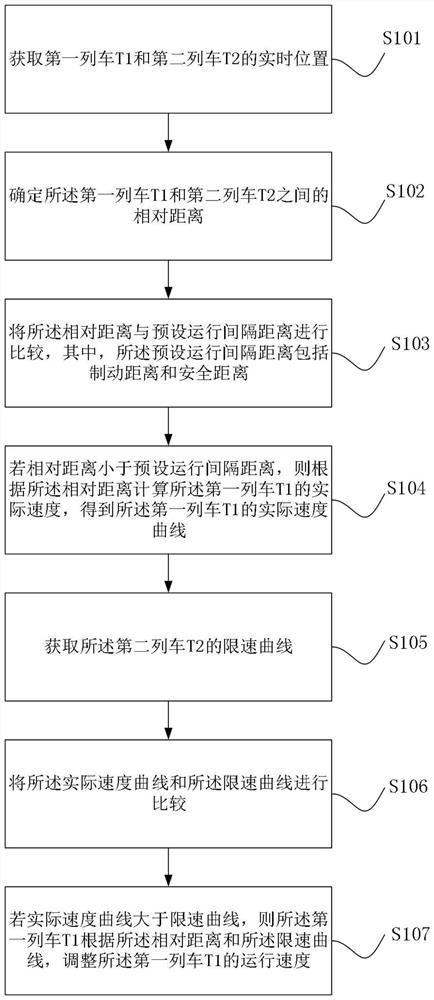
[0036] see figure 1 , is a flow chart of the moving block method in the embodiment of the present application.

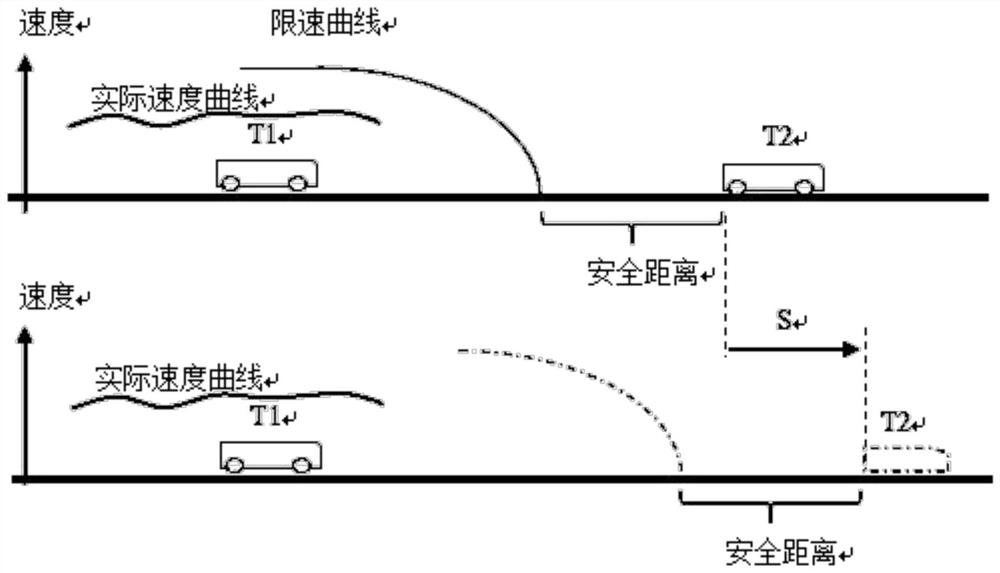
[0037] It should be noted, image 3 T1 shown in corresponds to the first train, and T2 corresponds to the second train.

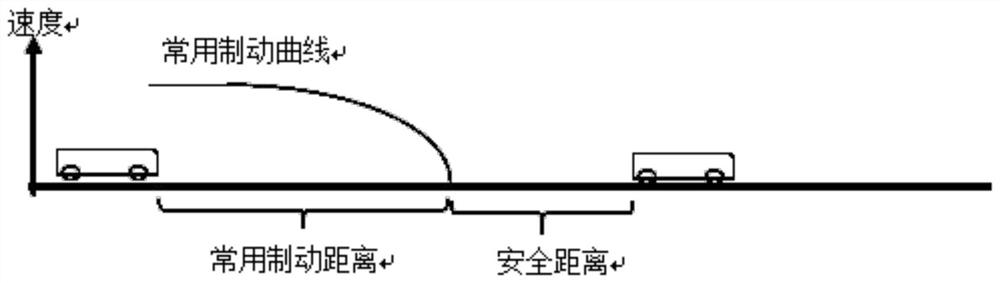
[0038] see Figure 1 to Figure 3 , a kind of mobile blocking method applied between trains on the new line railway project provided by the application, the mobile blocking method specifically includes the following steps:

[0039] S101, acquiring the real-time positions of the first train T1 and the second train T2;

[0040] S102. Determine the relative distance between the first train T1 and the second train T2;

[0041] S103, comparing the relative distance with a preset running distance, wherein the preset running distance includes a braking distance and a safety distance;

[0042] S104. If the relative distance is less than the preset running distance, calculate the actual speed of the first train T1 according to the relative distance to...