Botanical mollusk attractant and lure and preparation method thereof
What is AI technical title?
AI technical title is built by Patsnap AI team. It summarizes the technical point description of the patent document.
A mollusc and plant-derived technology, applied in the fields of botanical equipment and methods, attracting pests, animal repellents, etc.
Pending Publication Date: 2022-05-13
HENAN AGRICULTURAL UNIVERSITY
View PDF6 Cites 0 Cited by
Summary
Abstract
Description
Claims
Application Information
AI Technical Summary
This helps you quickly interpret patents by identifying the three key elements:
Problems solved by technology
Method used
Benefits of technology
Problems solved by technology
Attractants have been widely used in the control of agricultural pests. They are a new type of green and efficient control method. At present, there are no attractant products for molluscs in the market. The present invention can provide a new control method for slug control
Method used
the structure of the environmentally friendly knitted fabric provided by the present invention; figure 2 Flow chart of the yarn wrapping machine for environmentally friendly knitted fabrics and storage devices; image 3 Is the parameter map of the yarn covering machine
View more
Image
Smart Image Click on the blue labels to locate them in the text.
Viewing Examples
Smart Image
Click on the blue label to locate the original text in one second.
Reading with bidirectional positioning of images and text.
Smart Image
Examples
Experimental program
Comparison scheme
Effect test
preparation example Construction
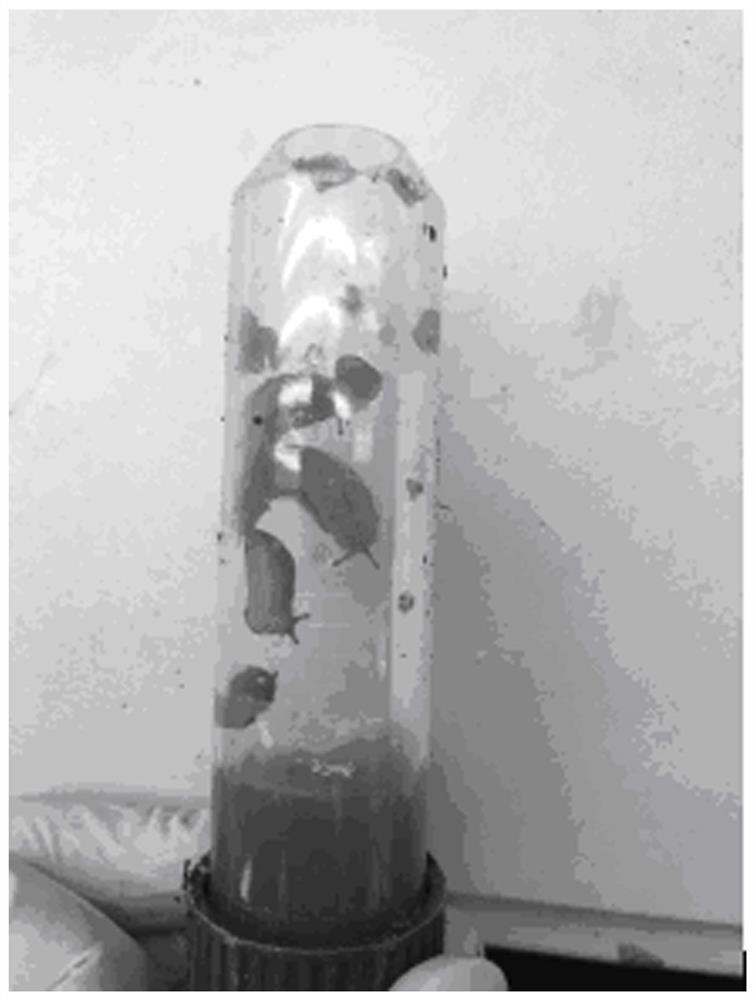
[0023] Adopt above-mentioned raw material that provides, carry out the preparation of the plant source lure core of mollusk, its preparation method comprises the following steps:
[0024] ① Prepare 10ml of 1%-1.5% agarose gel: weigh 0.1-0.5g of agarpowder and pour it into 10-50ml of pure water, boil the mixture until it is colorless and transparent;
[0025] ② Add 1.5-2ml of attractant to the hot solution prepared in ①, shake for 10-30 seconds, pour the solution into a 50ml centrifuge tube, and get the lure after cooling.
[0028] Prepare lures according to the following steps:
[0029] ① First prepare the attractant, fully grind 1 part of tobacco leaf tissue, add 6 parts of pure water, centrifuge at 3000-4000r / min for 1-2min, and take the supernatant to obtain the attractant;
[0030] ② Prepare 10ml of 1%-1.5% agarose gel: Weigh 0.5g of agarpowder and pour it into 20ml of pure water, boil the mixture until it is colorless and transparent;
[0031] ③ Add 2 ml of attractant mixture to the hot solution prepared in ②, shake for 30 seconds, pour the solution into a 50 ml centrifuge tube, and get the lure after cooling.
[0034] Prepare lures according to the following steps:
[0035] ① First prepare the attractant, fully grind 2 parts of tobacco leaf tissue, add 5 parts of pure water, centrifuge at 3000-4000r / min for 1-2min, and take the supernatant to obtain the attractant;
[0036] ② Prepare 10ml of 1%-1.5% agarose gel: Weigh 0.5g of agarpowder and pour it into 20ml of pure water, boil the mixture until it is colorless and transparent;
[0037] ③ Add 2 ml of attractant mixture to the hot solution prepared in ②, shake for 30 seconds, pour the solution into a 50 ml centrifuge tube, and get the lure after cooling.
the structure of the environmentally friendly knitted fabric provided by the present invention; figure 2 Flow chart of the yarn wrapping machine for environmentally friendly knitted fabrics and storage devices; image 3 Is the parameter map of the yarn covering machine
Login to View More
PUM
Login to View More
Abstract
The invention discloses a botanical mollusk attractant and a lure and a preparation method thereof, and belongs to the technical field of attractants, the botanical mollusk attractant comprises a plant extract and an auxiliary component, and the lure is prepared from the attractant and agarose gel. Wherein the plant extract is an extract of tobacco seedling leaf tissues, cabbages or lettuces. The mollusks such as slugs and snails which are harmful to the field can be effectively trapped in combination with a trap, and a new method is provided for mollusk prevention and control.
Description
technical field [0001] The invention belongs to the technical field of attractants, and in particular relates to a plant-derived mollusk attractant, a lure core and a preparation method thereof. Background technique [0002] Molluscs such as slugs and snails have caused great harm to cabbage, lettuce and other vegetables and tobacco cultivation in many countries and regions in the Americas and Asia. In addition, molluscs such as slugs and snails are intermediate hosts of some parasites, threatening social health and safety. The chemical pesticides used to control molluscs such as slugs and snails are mainly metaldehyde, carbaryl or the combination of the two, but these pesticides cause great environmental hazards. Therefore, there is an urgent need for a green and safe control method to prevent and control molluscs such as field slugs and snails. Attractants have been widely used in the control of agricultural pests. They are a new type of green and efficient control metho...
Claims
the structure of the environmentally friendly knitted fabric provided by the present invention; figure 2 Flow chart of the yarn wrapping machine for environmentally friendly knitted fabrics and storage devices; image 3 Is the parameter map of the yarn covering machine
Login to View More
Application Information
Patent Timeline
Application Date:The date an application was filed.
Publication Date:The date a patent or application was officially published.
First Publication Date:The earliest publication date of a patent with the same application number.
Issue Date:Publication date of the patent grant document.
PCT Entry Date:The Entry date of PCT National Phase.
Estimated Expiry Date:The statutory expiry date of a patent right according to the Patent Law, and it is the longest term of protection that the patent right can achieve without the termination of the patent right due to other reasons(Term extension factor has been taken into account ).
Invalid Date:Actual expiry date is based on effective date or publication date of legal transaction data of invalid patent.


 Login to View More
  Login to View More