Digital video broadcast-terrestrial (DVB-T) receiver interoperable with a gsm transmitter in a non-interfering manner

A technology for receivers and transmitters, applied in broadcast receiving circuits, broadcast broadcasting, broadcasting devices, etc.

CN1985445AInactive Publication Date: 2007-06-20NOKIA CORP
1 Cites 0 Cited by

Patent Information

Authority / Receiving Office
CN · China
Current Assignee / Owner
Publication Date
2007-06-20
Estimated Expiration
Not applicable · inactive patent

Smart Images

  • Figure 1
    Figure 1
  • Figure 2
    Figure 2
  • Figure 3
    Figure 3
Patent Text Reader

Abstract

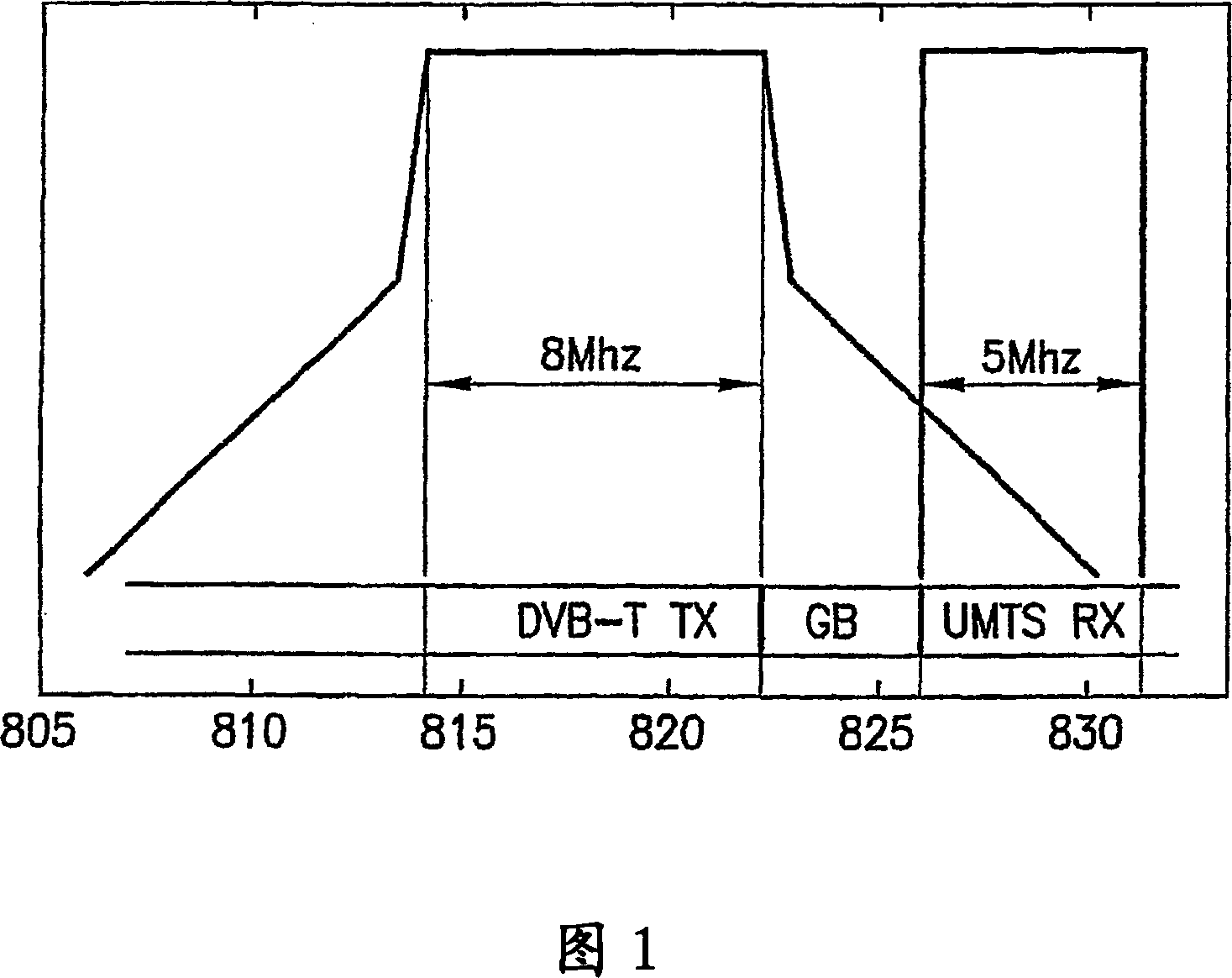
A method and a device used for displaying wideband information to a user has a return channel made through a cellular mobile terminal (CMT) providing interactivity. The device (10) has a first antenna (12) and a second antenna (20), a receiver (14, 16) that is coupled to the first antenna and a transmitter (24) that is coupled to the second antenna. The method includes receiving information in a bit-wise manner with the receiver in a first band of RF frequencies; generating a notification of an occurrence of a burst transmission from the transmitter; and in response to the notification, terminating the reception of the information for a portion of one bit time corresponding to a duration of the burst transmission. The method may include an optional step, further in response to the notification, of reducing power consumption by turning off at least a portion of the receiver for a period of time corresponding to the duration of the burst transmission. In one embodiment the first band of radio frequencies is a DVB-T 470-862MHz reception band, and the second band of radio frequencies is a GSM 880-915MHz transmission band. In another embodiment the first band of radio frequencies is a DTV 794-806MHz reception band, and the second band of radio frequencies is a CMT 824-849MHz transmission band.
Need to check novelty before this filing date? Find Prior Art

Description

technical field

[0001] The present invention relates generally to methods and apparatus for operating digital video / data receivers in close proximity to potential interfering transmitters, and more particularly to terrestrial digital video broadcast (DVB- T) Method and apparatus for a receiver, the cellular phone transmitter may be a Time Division Multiple Access (TDMA) Global System for Mobile Communications (GSM) transmitter, for example for providing data sources received via a DVB-T receiver return channel. Background technique

[0002] DVB-T was first adopted as a standard in 1997 and is currently developing rapidly in Europe, Australia and Asia. DVB-T provides a data transmission capacity of approximately 24 Mb / s to stationary receivers and approximately 12 Mb / s to mobile receivers using omnidirectional antennas. Some of the salient technical features of DVB-T include the following: DVB-T provides network net bit rates (R) per frequency channel in the range of approx...

Examples

Embodiment Construction

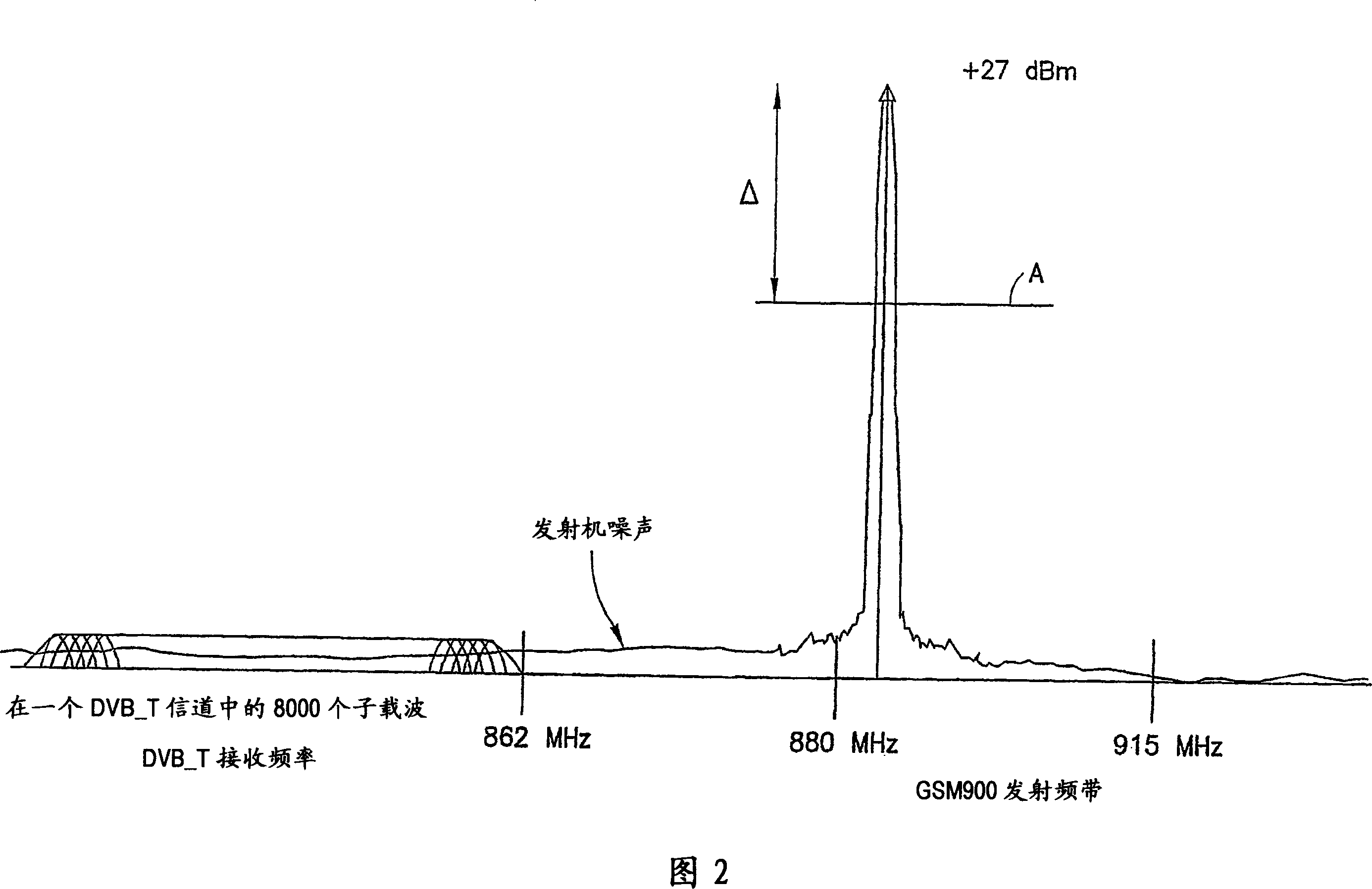
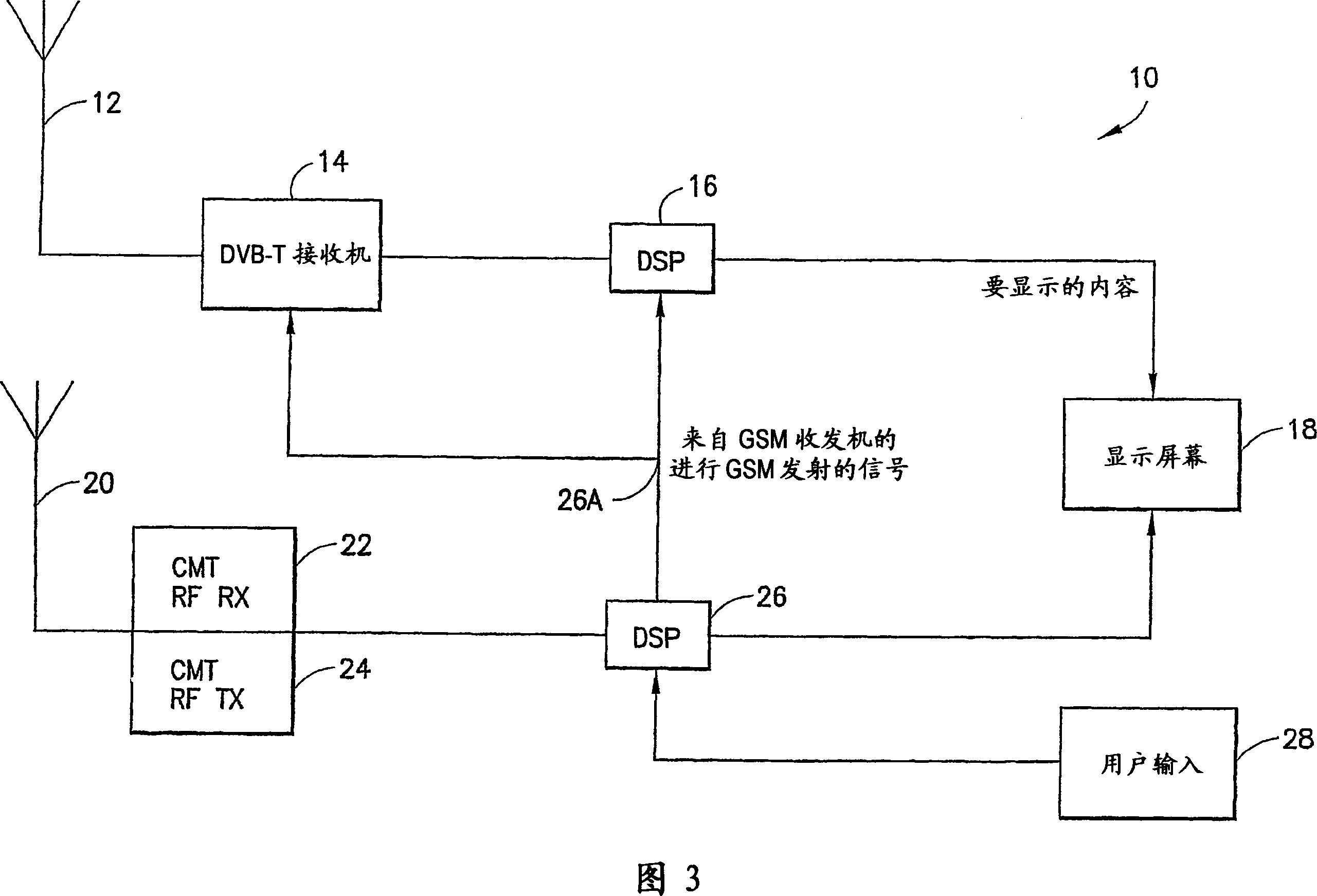
[0023] 3 is a block diagram of an embodiment of a portable device 10 comprising a DVB-T antenna 12, a DVB-T receiver 14, an associated DVB-T signal processor such as a DVB-T digital signal processor (DSP) 16, and A display screen 18 for displaying user data, such as video or Internet data, received from a DVB-T transmitter (not shown) to the user. Device 10 also includes a cellular mobile terminal (CMT) including a CMT antenna 20 , a CMT RF receiver (RX) 22 , a CMT RF transmitter (TX) 24 and a CMT DSP 26 . CMTDSP 26 may also be connected to display screen 18 for displaying information received from a remote CMT transmitter (not shown). In one non-limiting example, the DVB-T system operates in the UHF range of 470MHz-862MHz and the CMT system is a GSM system, specifically it is a GSM 900MHz system with the low end of the transmitter spectrum at 880MHz (see Fig. 2).

[0024] It is to be noted that typically device 10 includes some type of user input device 28, such as a keypad...