Methods of identifying patients responsive to immunotherapeutic strategies
a technology of immunotherapy and patient, applied in the direction of microbiological testing/measurement, biochemistry apparatus and processes, etc., can solve the problems of high immunotherapy cost and uncontrolled growth, and achieve high mutator phenotype, high mutator phenotype, and high mutator phenotype
- Summary
- Abstract
- Description
- Claims
- Application Information
AI Technical Summary
Benefits of technology
Problems solved by technology
Method used
Image


Examples
example 1
Exome Sequencing of USC.
[0089]Fifty-seven patients with uterine serous carcinoma were studied. Their clinical features are presented in Table 2.
[0090]
TABLE 2Clinical features of uterine serous carcinoma patientsPairID / Chemo-SampleIDSample typeStatusAgeEthinicity[1]Stage[2]Histology[3]therapy[4]ARK-15NCell lineMatched67EIIICPUREYESARK-17Cell lineMatched59EIIIAPURENOARK-18Cell lineMatched62AIIBPURENOARK-19Cell lineMatched65EIAPUREYESARK1Cell lineMatched62AIVAPURENOARK11Cell lineMatched80AIIICMIXEDNOARK13NCell lineMatched67EIVBMIXEDYESARK2Cell lineMatched63AIVBPURENOARK6Cell lineMatched48EIBMIXEDNOARK7Cell lineMatched75EIICPURENOARK8Cell lineMatched88EIIIAPURENOARK9Cell lineMatched73AIIICMIXEDNOFF-1Fresh frozen tissueMatched67EIIICPURENOFF-10Fresh frozen tissueMatched69EIVAPURENOFF-11Fresh frozen tissueMatched58AIAMIXEDNOFF-12Fresh frozen tissueMatched80EIIBMIXEDNOFF-13Fresh frozen tissueMatched75EIICPURENOFF-14Fresh frozen tissueMatched59EREC*PUREYESFF-16Fresh frozen tissueMatched54EI...
example 2
Tumors with Hypermutator Phenotype.
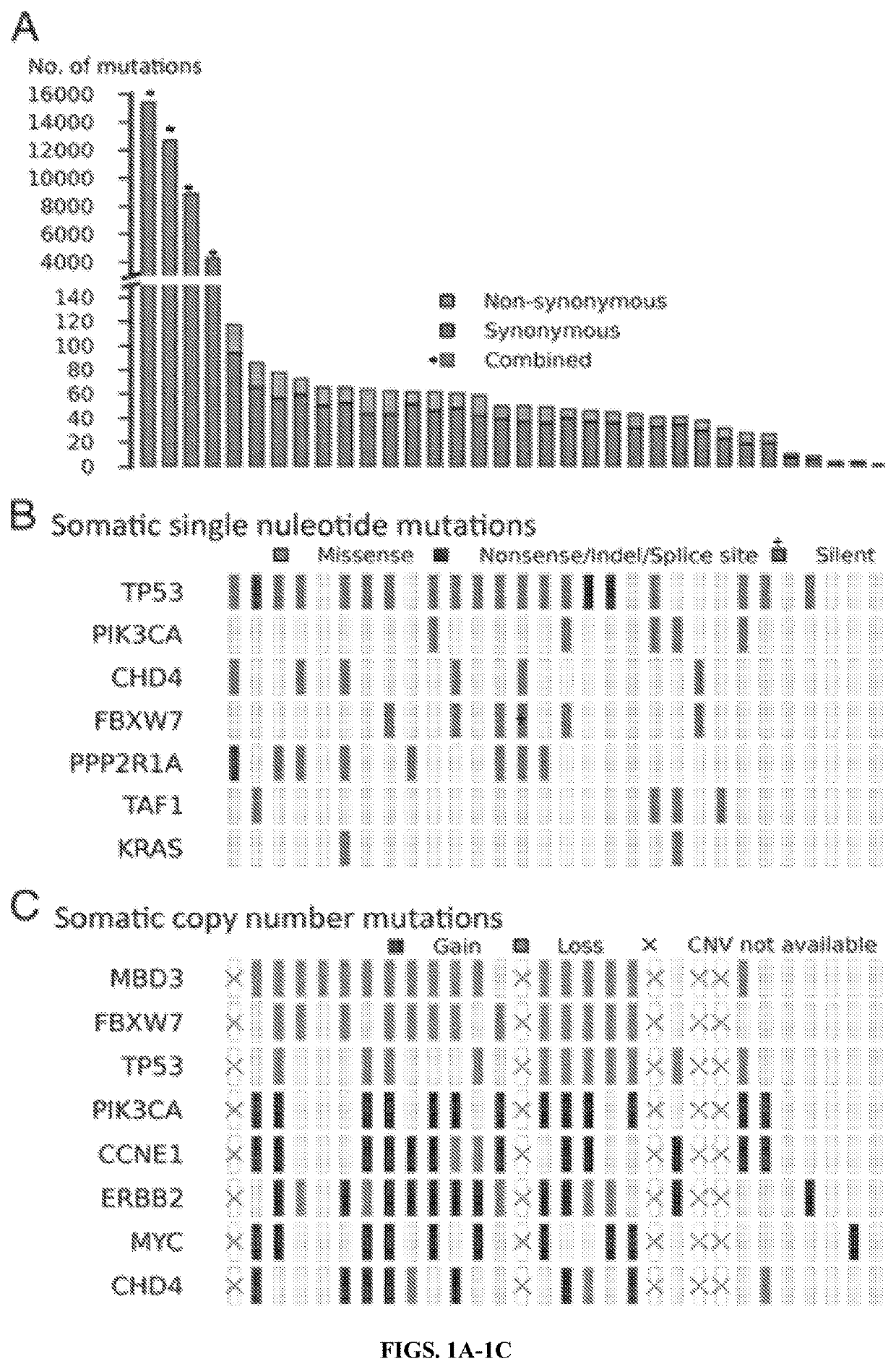
[0094]The number of protein-altering somatic mutations per tumor markedly deviated from a normal distribution (FIG. 1A). In the discovery set of 34 USC with matched normal DNA, 30 tumors had fewer than 100 protein-altering somatic mutations (median 36), whereas 4 had more than 3,000 somatic mutations each. Only one of these tumors was from a cell line (with limited propagation), and none came from patients who had received chemotherapy before sample acquisition. These tumors with high mutation burden were also notable for having no LOH segments or copy-number variants (CNVs), a feature found in only five other tumors. These features suggest a hypermutator phenotype due to deficiency of mismatch repair (MMR) or polymerase 6 (POLE) genes (Loeb et al., Nat Rev Cancer 11(6):450-457 (2011); Yoshida et al., Eur J Hum Genet 19(3): 20-325 (2011)). Consistent with this, these hyper-mutated tumors showed a paucity of T:A>A:T or C:G>A:T transversions (FIG. 7)...
example 3
Analysis of Single-Nucleotide Variants.
[0097]Among somatic mutations in the 30 remaining matched tumors, recurrences of somatic mutations at the same positions were identified. Accounting for the rate of protein-altering somatic mutations in these tumors (1.1×10⁻⁶) and the size of the exome, the likelihood of seeing the mutation twice by chance at any position among these tumors is −3. Six genes with recurrent somatic mutations were identified (Table 1).
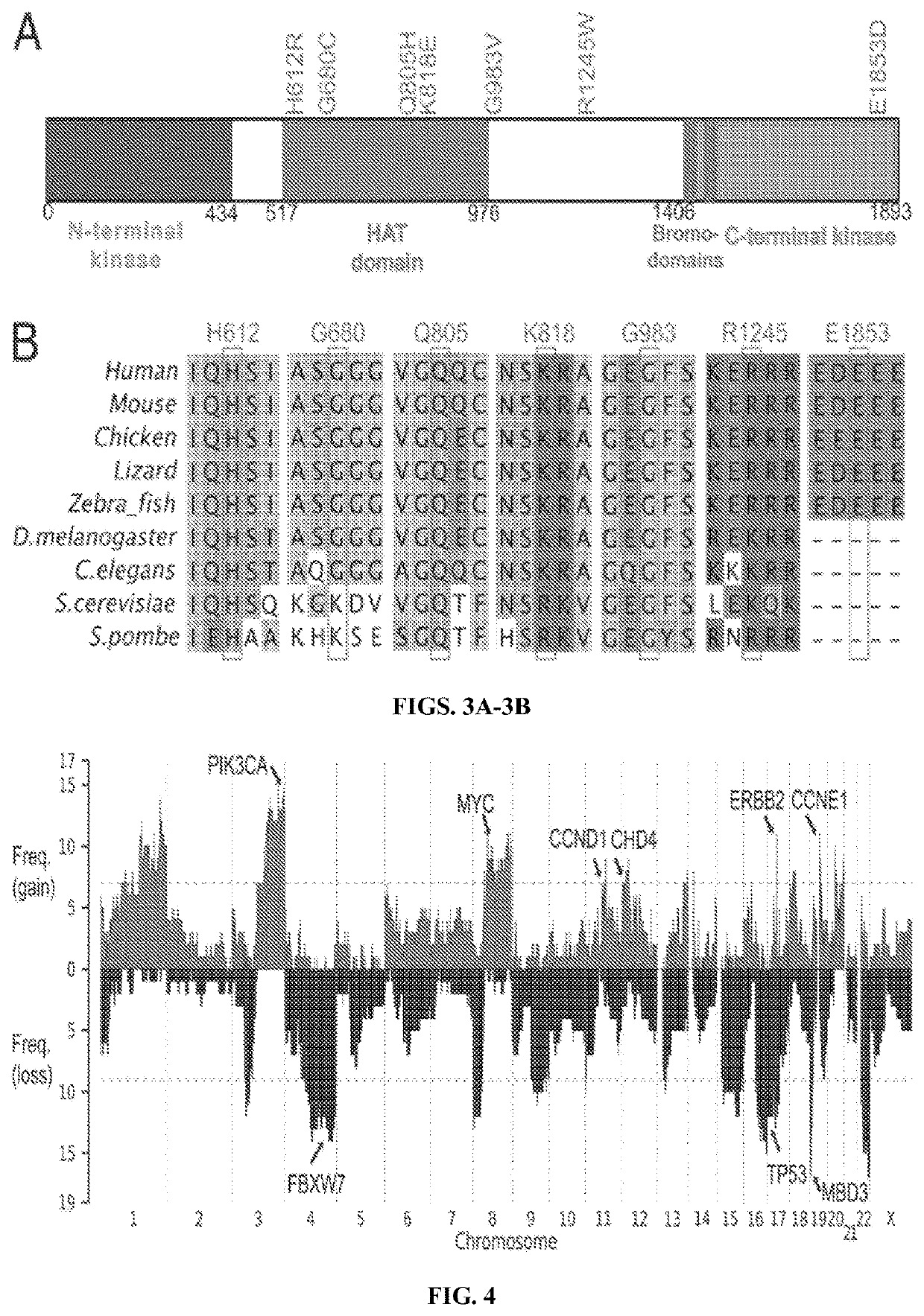
[0098]These included well-established activating mutations in PIK3CA, the catalytic subunit of phosphoinositide-3 kinase (five tumors); the well-established G12V mutation in KRAS (three tumors) (Boguski and McCormick, Nature 366(6456):643-654 (1993)); and a mutation at R465 in FBXW7 in four tumors. FBXW7 is the targeting component of a SCF-type 3 ubiquitin ligase, and R465 occurs in the WD40 domain involved in substrate recognition; mutation at this site prevents targeting of cyclin E for ubiquitination and degradation (FIG. 8) (Welc...
PUM
| Property | Measurement | Unit |
|---|---|---|
| temperature | aaaaa | aaaaa |
| volume | aaaaa | aaaaa |
| volume | aaaaa | aaaaa |
Abstract
Description
Claims
Application Information
 Login to View More
 - R&D
- Intellectual Property
- Life Sciences
- Materials
- Tech Scout
- Unparalleled Data Quality
- Higher Quality Content
- 60% Fewer Hallucinations
Browse by: Latest US Patents, China's latest patents, Technical Efficacy Thesaurus, Application Domain, Technology Topic, Popular Technical Reports.
© 2025 PatSnap. All rights reserved.Legal|Privacy policy|Modern Slavery Act Transparency Statement|Sitemap|About US| Contact US: help@patsnap.com