
Fast filtering processor for a highly integrated network device
a network device and processor technology, applied in the field of devices, software applications and networks, can solve the problems of not being as easily used by some implementers or some support solutions
- Summary
- Abstract
- Description
- Claims
- Application Information
AI Technical Summary
Benefits of technology
Problems solved by technology
Method used
Image

Examples
Embodiment Construction
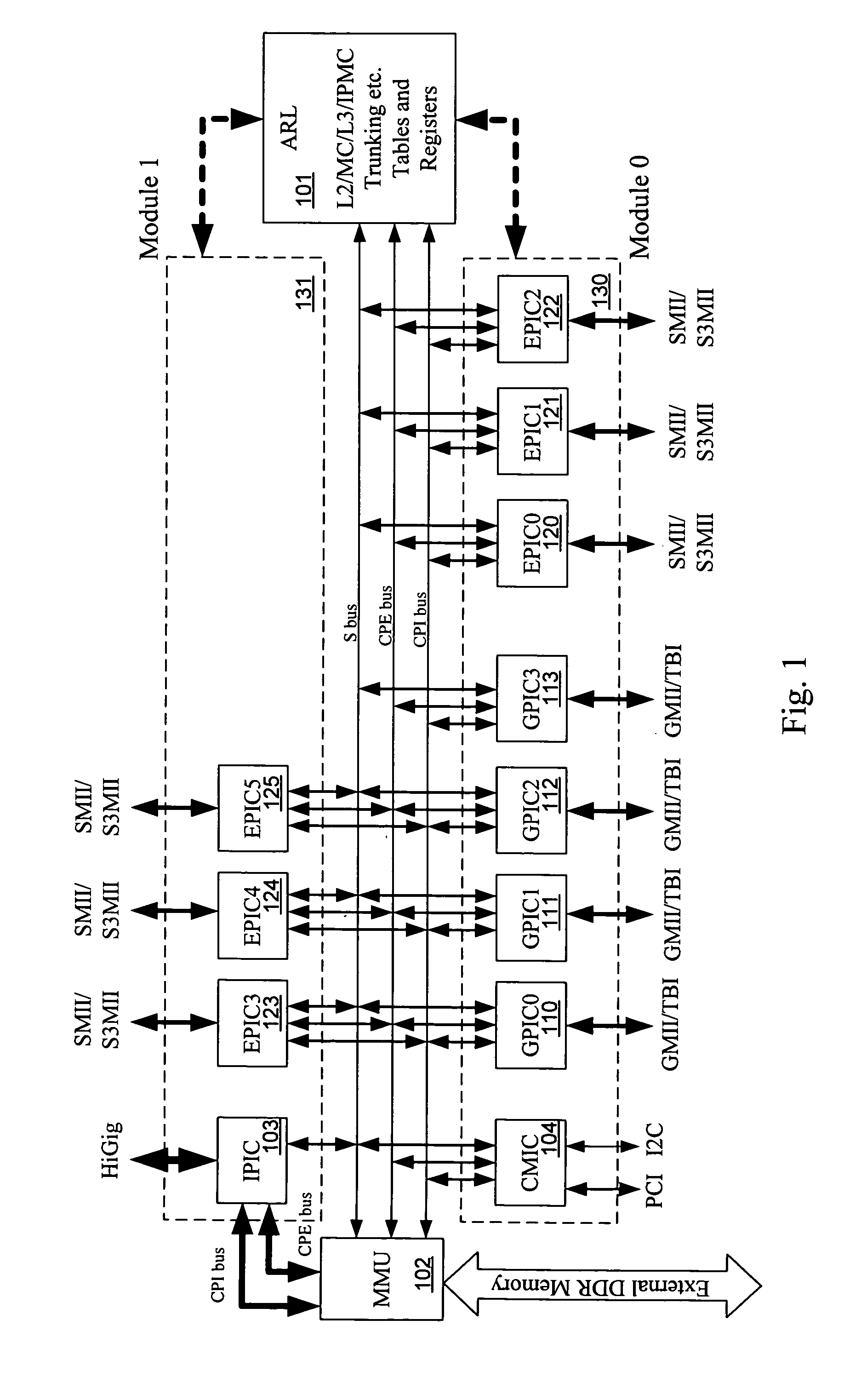
The present invention is directed to a network device that receives data and process that data and may forward that data onto a destination based on attributes of that data. A general schematic of the network device is illustrated in FIG. 1. The device has an address resolution module (ARL) 101 that provides support for Layer 2 (L2), Multicast (MC), Layer 3 (L3), Internet Protocol Multicast (IPMC) switching, as well as Trunking, through various tables and registers. The ARL is connected to elements of the network switch divided into different modules. The ARL is also connected through a bus made up of channels, with data transferred on the CPI bus, protocols transferred therewith on the CPE bus and the S bus which is a sideband bus and is used to transfer signals between portions of the network device.
The bus provides connections between the Memory Management Unit (MMU) and other interface modules. The interface modules include Ethernet Port Interface Controllers (EPICs) 120-125,...
PUM
 Login to View More
 Abstract
Description
Claims
Application Information
 Login to View More