Method and apparatus for electromagnetic modification of brain activity
Inactive Publication Date: 2005-06-09
JOUAN
View PDF3 Cites 144 Cited by
Summary
Abstract
Description
Claims
Application Information
AI Technical Summary
This helps you quickly interpret patents by identifying the three key elements:
Problems solved by technology
Method used
Benefits of technology
Benefits of technology
[0044] The invention is based on the knowledge, that behavioral models quantify the correspondence of behavior and the dynamics of brain activity indexes, and that suitable individualized brain act
Problems solved by technology
At the current state of the art model-based controlled or regulated, respectively, electromagnetic modification of brain activity in vivo is not possible (the human brain consists of approximately 1011 neurons and 1015 connections between these neurons), and has so far neither been considered nor attempted.
To apply linear control to a nonlinear respectively stochastic system (like e.g. a human brain), is not only inadequate, but also potentially dangerous, because in linear control the control force is proportional to the desired change.
It may therefore become very large.
For a controlled or regulated, respectively, electromagnetic modification of brain activity in vivo current control methods are not applicable, because several of the following effects accumulate: between high and unachievable high demands on storage space and processor speed, potentially infinitely long waiting times until the target orbit is reached, in systems with stochastic elements intermittent departures from the target orbit, restrictions on the range of control in systems, in which only aggregated behavior is measurable, restrictions on the range of control in systems, in which the control force is smeared, unknown amplitude of the control force within heterogeneous systems.
Therefore the MED approach based on this paradigm is hampered by a seemingly inexplicable randomness of its clinical results (for transcranial magnetic stimulation see [3] as an overview).
Method used
the structure of the environmentally friendly knitted fabric provided by the present invention; figure 2 Flow chart of the yarn wrapping machine for environmentally friendly knitted fabrics and storage devices; image 3 Is the parameter map of the yarn covering machine
View more
Image
Smart Image Click on the blue labels to locate them in the text.
Viewing Examples
Smart Image
Click on the blue label to locate the original text in one second.
Reading with bidirectional positioning of images and text.
Smart Image
Examples
Experimental program
Comparison scheme
Effect test
example 1
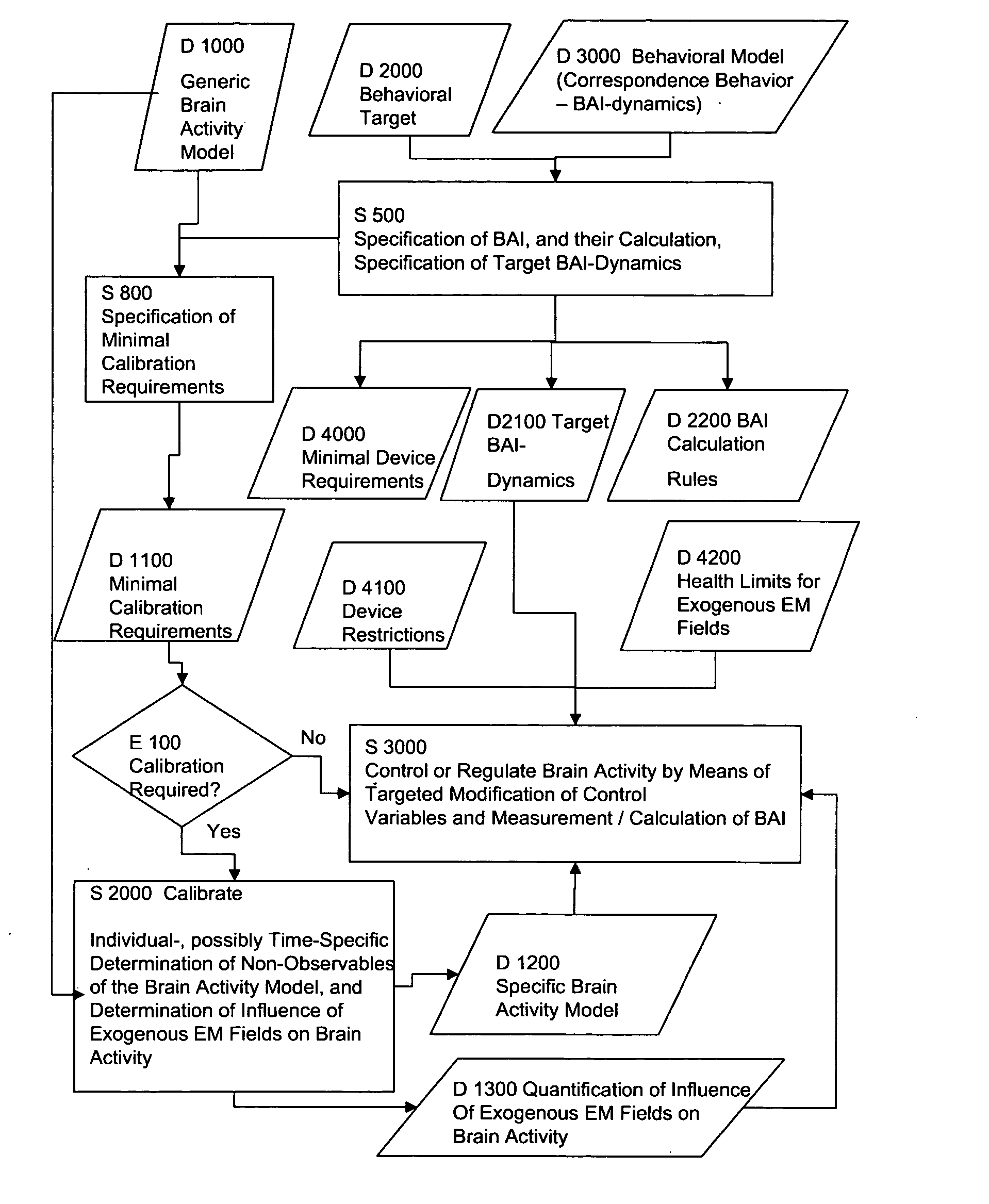
[0174]FIG. 20:
[0175] D 2000 (Behavioral Target):
[0176] Amplification of positive emotions for the duration of the application
[0177] D 3000 (Behavioral Model):
[0178] The following correspondence is called “reduced Davidson-model” (see e.g. [11]): positive emotions correspond to a higher quotient of beta to alpha activity in the left-frontal cortex (beta=13-30 Hz, alpha=8-12 Hz).
[0179] S 500 (BAI Specification and Calculation, Specification of Target BAI-Dynamics):
[0180] The Davidson-model is based on the power-spectrum of EEG-signals. A suitable BAI is therefore a sequence of squared moduli of Fourier coefficients, to be calculated via Fast Fourier Transformation, for example for frequencies between 1 and 50 Hz. Derived BAI is Pos:=∑i=1330fi2 / ∑i=812fi2
[0181] (Assumption: only integer frequencies, Fourier-window e.g. 500 milliseconds, fi modulus of the Fourier coefficient of the i-Hertz-mode. To cover the frequencies from 1 to 50 Hz, according to Nyquist at least 100 data po...
example 2
(Steps Will Be Explained Only in Extracts):
[0380]FIG. 20:
[0381] D 2000 (Behavioral Target):
[0382] Amplification of positive and reduction of negative emotions for the duration of the application
[0383] D 3000 (Behavioral Model):
[0384] Davidson-model (see e.g. [11]): positive emotions correspond to a higher quotient of beta to alpha activity in the left-frontal cortex (beta=13-30 Hz, alpha=8-12 Hz), negative emotions correspond to a higher quotient of beta to alpha activity in the right-frontal cortex.
[0385] S 500 (Specify BAI, Specify Target BAI Dynamics):
[0386] In analogy to example 1. Derived BAI are Pos:=∑i=1330fi,12 / ∑i=812fi,12
for one left-frontal sensor S1, and for Neg:=∑i=1330fi,22 / ∑i=812fi,22
a right-frontal sensor S2. (fij coefficient of the i-Hertz mode of the sensor j). Pos shall be increased, e.g. Pos(t, with influence)>2*Pos(t, without influence). Neg shall be decreased, e.g. Neg(t, with influence)>0.5*Neg(t, without influence). These requirements determin...
example 3
[0443] Example 3 shall not be presented as comprehensively as the previous examples (e.g. all modes, local calibration of all sensor-transmitter-pairs, etc), but shall mainly highlight essential differences with respect to the previous examples.
[0444]FIG. 20:
[0445] D 2000 (Behavioral Target):
[0446] Prolongation of focused attention on mental activities for the duration of the application.
[0447] D 3000 (Behavioral Model):
[0448] Based on e.g. [20] and [21]), FmΘ(frontal midline theta), i.e. 6-7 Hz activity in the vicinity of the Fz-electrode (see [16]), corresponds to focused attention on mental activities. This fact shall in the following be called Ishihara-Yoshii-model.
[0449] Neurons near the cranium, within the detection range of the Fz-sensor, are directly connected with some other areas, in particular subcortical driving was detected. The power spectrum is calculated as before. Instead of Pos and Neg there is now for each sensor Att:=∑i=67fi2 / ∑i=8maxfi2 (max=50).
[0450...
the structure of the environmentally friendly knitted fabric provided by the present invention; figure 2 Flow chart of the yarn wrapping machine for environmentally friendly knitted fabrics and storage devices; image 3 Is the parameter map of the yarn covering machine
Login to View More
PUM
Login to View More
Abstract
A method and an apparatus for the electromagnetic modification of brain activity, in particular for the model-based controlled or regulated, respectively, electromagnetic modification of brain activity in vivo, as well as to the resulting modification of behavior is disclosed. A brain activity model (which describes the influence of exogenous electric and / or magnetic fields on a brain activity) is used, and a behavioral model (which describes the correspondence between brain activity and behavior) is used. Thereby it becomes possible, for the first time ever, to influence the behavior of a person by means of exogenous input in a controlled way. Intra-individual and / or time-dependent non-observables, as well as to determining individual, is provided, if necessary intra-individual and / or time-dependent translation operators from extracranial signal to control force, whereby a secure and controlled intervention as part of a open or closed control loop is created, which in turn results in achieving a brain activity target in a reliable way. Using a behavioral model ensures that achieving a brain activity target corresponds to achieving the individual behavioral target of the user.
Description
RELATED APPLICATIONS [0001] This application is a Continuation of PCT application serial number PCT / EP03 / 03545 filed on Apr. 4, 2003 (which was published in German under PCT Article 21(2) as International Publication No. WO 03 / 085546 Al), which claims priority to German Application Nos. DE 102 34 676.3 filed on Jul. 30, 2002 and DE 102 15 115.6 filed on Apr. 5, 2002, all three applications being incorporated herein by reference in their entirety. [0002] This application is related to U.S. Application No.: (Attorney Docket No. 0001.0013US1 (US-5440)) filed on even date herewith by Oliver Holzner, entitled “Method and Apparatus for the Prevention of Epileptic Seizures,” which is also incorporated herein by reference in its entirety.BACKGROUND [0003] Definitions: [0004] MODEL-BASED controlled or regulated, respectively, modification means alteration or sustenance of brain activity, based on: a behavioral target, a behavioral model, and a brain activity model. [0005] Regulated means, th...
Claims
the structure of the environmentally friendly knitted fabric provided by the present invention; figure 2 Flow chart of the yarn wrapping machine for environmentally friendly knitted fabrics and storage devices; image 3 Is the parameter map of the yarn covering machine
Login to View More
Application Information
Patent Timeline
Application Date:The date an application was filed.
Publication Date:The date a patent or application was officially published.
First Publication Date:The earliest publication date of a patent with the same application number.
Issue Date:Publication date of the patent grant document.
PCT Entry Date:The Entry date of PCT National Phase.
Estimated Expiry Date:The statutory expiry date of a patent right according to the Patent Law, and it is the longest term of protection that the patent right can achieve without the termination of the patent right due to other reasons(Term extension factor has been taken into account ).
Invalid Date:Actual expiry date is based on effective date or publication date of legal transaction data of invalid patent.


 Login to View More
  Login to View More