
System and method for separating code sharing and active applications in an OSGi service platform
a service platform and code sharing technology, applied in the field of osgi service platform, can solve the problems of inability to meet the requirements of the service platform, and inability to complete the framework restart to address this issue, etc., to achieve the effect of reducing the number of dependencies between bundles
- Summary
- Abstract
- Description
- Claims
- Application Information
AI Technical Summary
Benefits of technology
Problems solved by technology
Method used
Image

Examples
Embodiment Construction
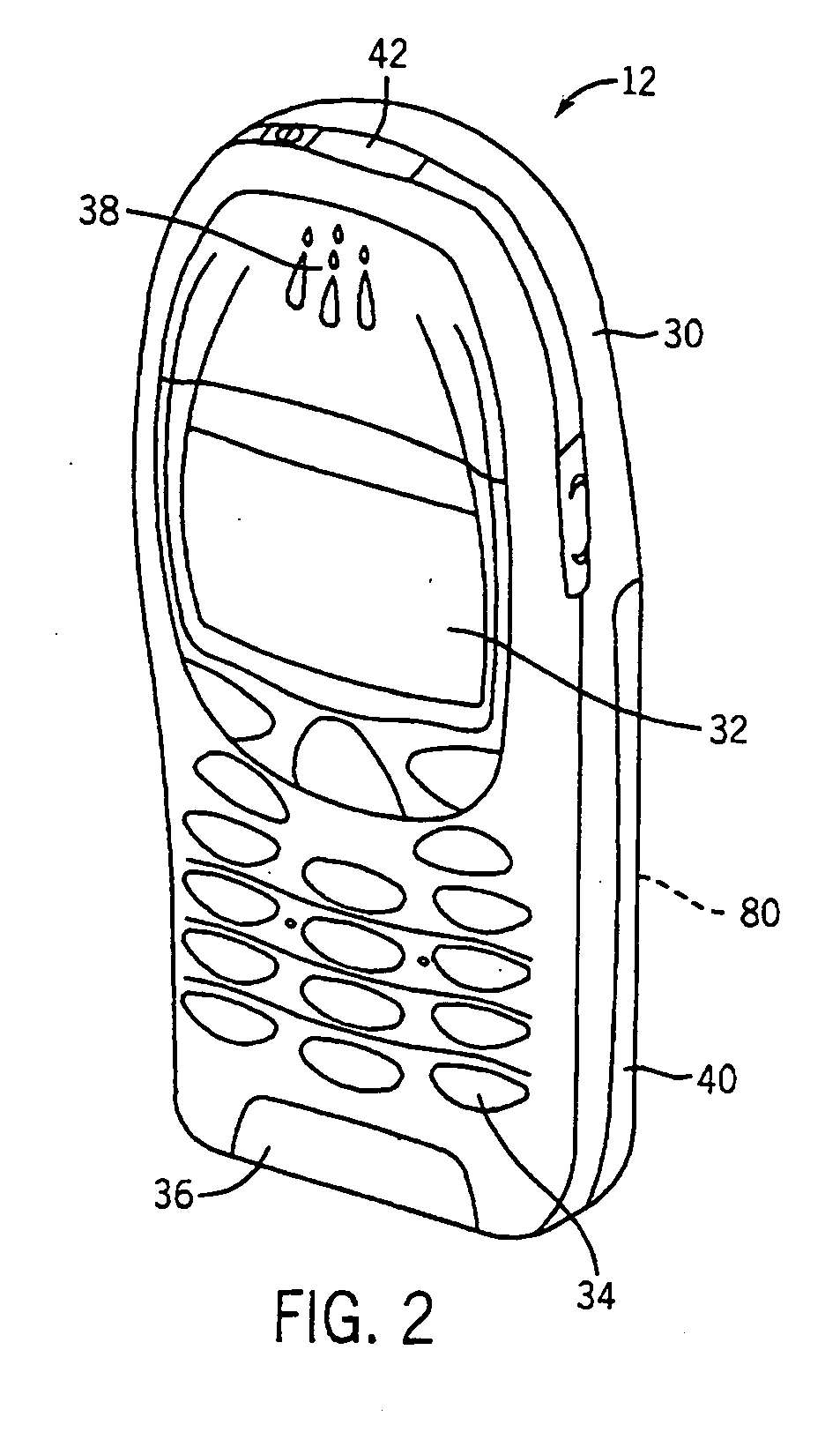
[0028]FIGS. 2 and 3 show one representative mobile telephone 12 within which the present invention may be implemented. It should be understood, however, that the present invention can be implemented into a wide variety of electronic devices, including personal computers, personal digital assistants, integrated messaging devices, and other electronic devices where a Java VM and an OSGi implementation is or will be available. The mobile telephone 12 of FIGS. 2 and 3 includes a housing 30, a display 32 in the form of a liquid crystal display, a keypad 34, a microphone 36, an ear-piece 38, a battery 40, an infrared port 42, an antenna 44, a smart card 46 in the form of a UICC according to one embodiment of the invention, a card reader 48, radio interface circuitry 52, codec circuitry 54, a controller 56 and a memory 58. Individual circuits and elements are all of a type well known in the art, for example in the Nokia range of mobile telephones.
[0029] According to the principles of the ...
PUM
 Login to View More
 Abstract
Description
Claims
Application Information
 Login to View More