[0008] The present invention provides a camera having an image-stabilizing function, in which the user can confirm the extent by which the image-stabilizing function is performed before a photographing operation, and moreover, hand-shake and deterioration in the user's attentiveness toward hand-shake can be effectively prevented.
[0009] According to an aspect of the present invention, a camera having an image-stabilizing function is provided, including an image-stabilizing mechanism which corrects image blur that occurs due to hand shake of the camera; a shutter-release operating member; and an image-stabilizer operating member which is operably movable between an image-stabilizer-activated position and an image-stabilizer-deactivated position, the image-stabilizer operating member being provided separately from the shutter-release operating member on a camera body of the camera. The image-stabilizing mechanism is activated so as to be capable of image stabilization while the image-stabilizer operating member is positioned at the image-stabilizer-activated position. The image-stabilizing mechanism is deactivated so as to be incapable of image stabilization while the image-stabilizer operating member is positioned at the image-stabilizer-deactivated position. The image-stabilizer operating member is biased toward the image-stabilizer-deactivated position so as to be positioned at the image-stabilizer-deactivated position in a
free state.
[0013] In an embodiment, a camera having an image-stabilizing function is provided, including an image-stabilizing mechanism which corrects image blur that occurs due to hand shake of the camera; a shutter-release operating member; and an image-stabilizer operating member which is operably movable between an image-stabilizer-activated position and an image-stabilizer-deactivated position, the image-stabilizer operating member being provided separately from the shutter-release operating member on a camera body of the camera. The image-stabilizing mechanism is activated so as to be capable of image stabilization while the image-stabilizer operating member is positioned at the image-stabilizer-activated position. The image-stabilizing mechanism is deactivated so as to be incapable of image stabilization while the image-stabilizer operating member is positioned at the image-stabilizer-deactivated position. The shutter-release operating member and the image-stabilizer operating member are provided on the camera body at opposite sides thereof with respect to an approximate center of the camera body.
[0020] According to the present invention, the user can confirm whether or not the image-stabilizing function is effectively functioning via operating an image-stabilizing operation button which is provided as a separate member from the shutter-release button. Furthermore, the user can easily maintain attentiveness in regard to hand-shake, and hence, facilitate secure handling of the camera, and unintentional hand-shake can be reduced to a minimum. Moreover, the user can confirm the extent by which the image-stabilizing function operates before the shutter-release button is depressed (before the shutter is released). Therefore, if a photographic operation is performed with the image-stabilizing function activated, a sharp image having no (negligible) blur is easier to achieve compared to that of a camera having an image-stabilizing function of the prior art.
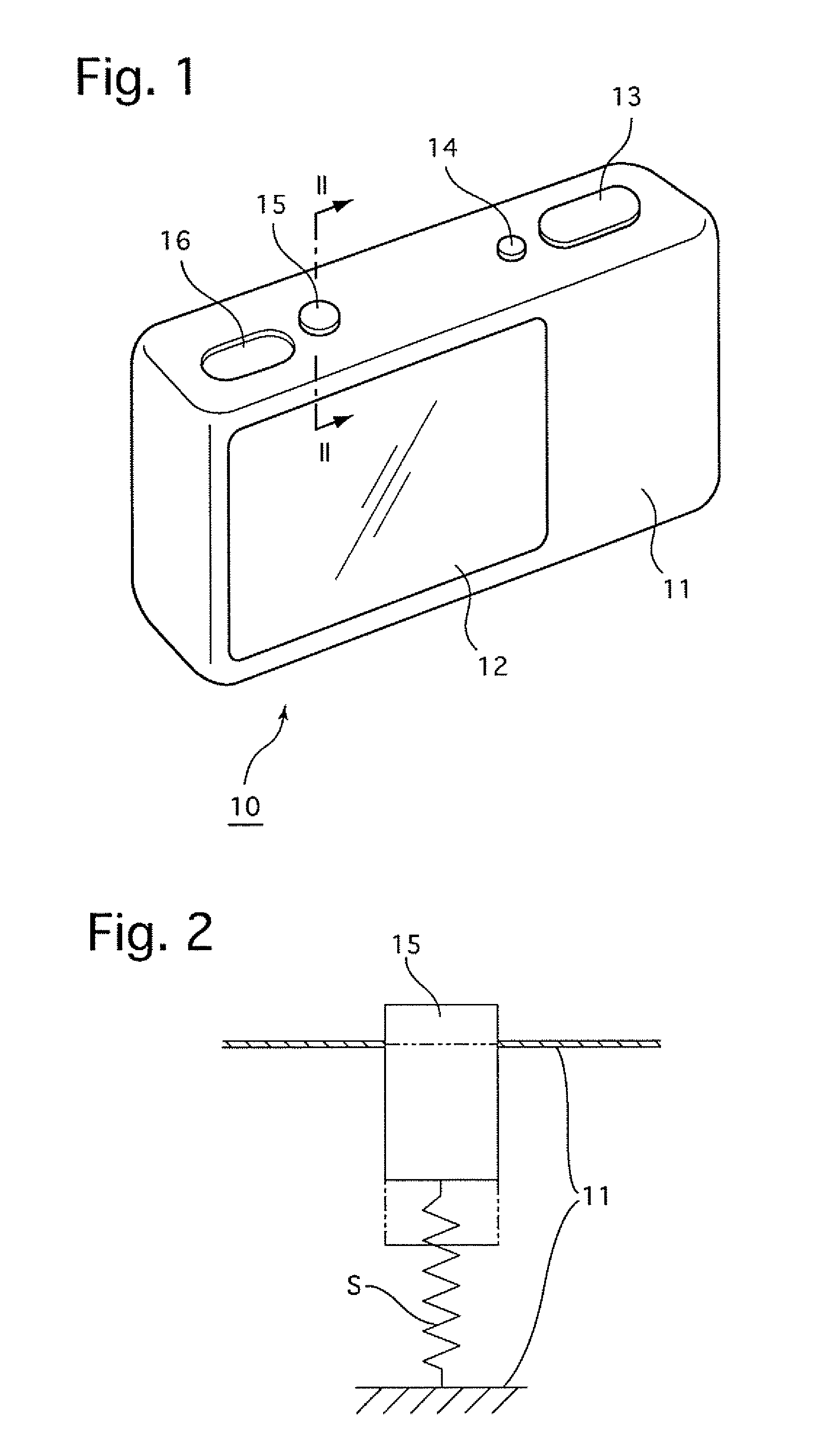
[0021] Furthermore, if the image-stabilizer operating member is constructed so as to be movably biased toward the image-stabilizer-deactivated position by the biasing device, since the image-stabilizing function is only activated while the user holds the image-stabilizer operating member in the image-stabilizer-activated position against the biasing force of the biasing device, the user can discern (confirm) the position of the image-stabilizer operating member not only visually, but also tactilely. Accordingly, the user can more reliably discern whether the image-stabilizing function is activated or not.
[0022] In a construction wherein the shutter-release button and the image-stabilizer operating member are provided on mutually opposite sides with respect to an approximate center of the camera body, the user naturally holds the camera at both sides thereof (at the shutter-release button side and the image-stabilizer operating member side). Since image blur is greatly reduced if the camera body is held in such a manner, if the image-stabilizing function is activated during a photographic operation, a photographic image having no blurring is achieved.


 Login to View More
  Login to View More