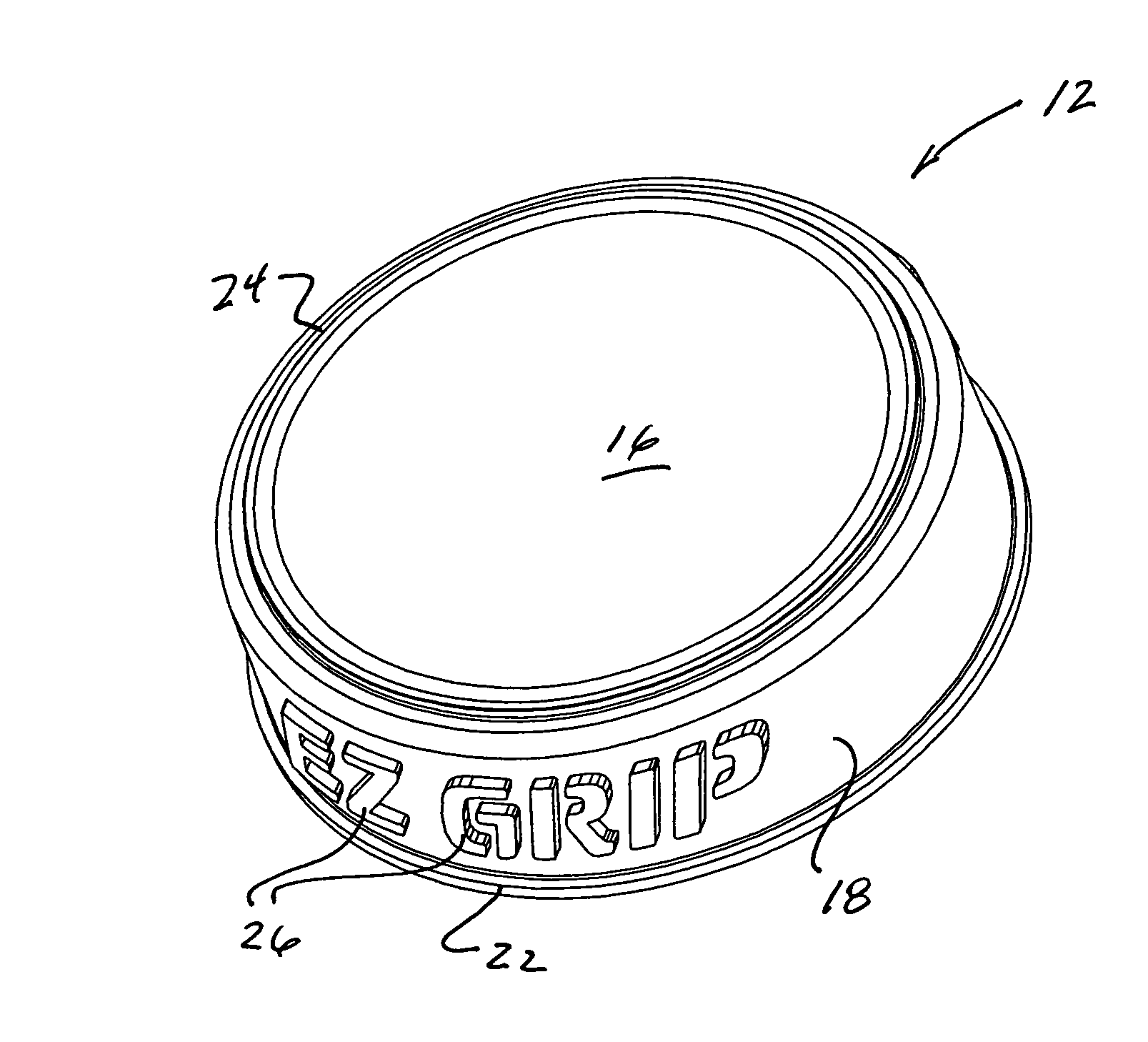
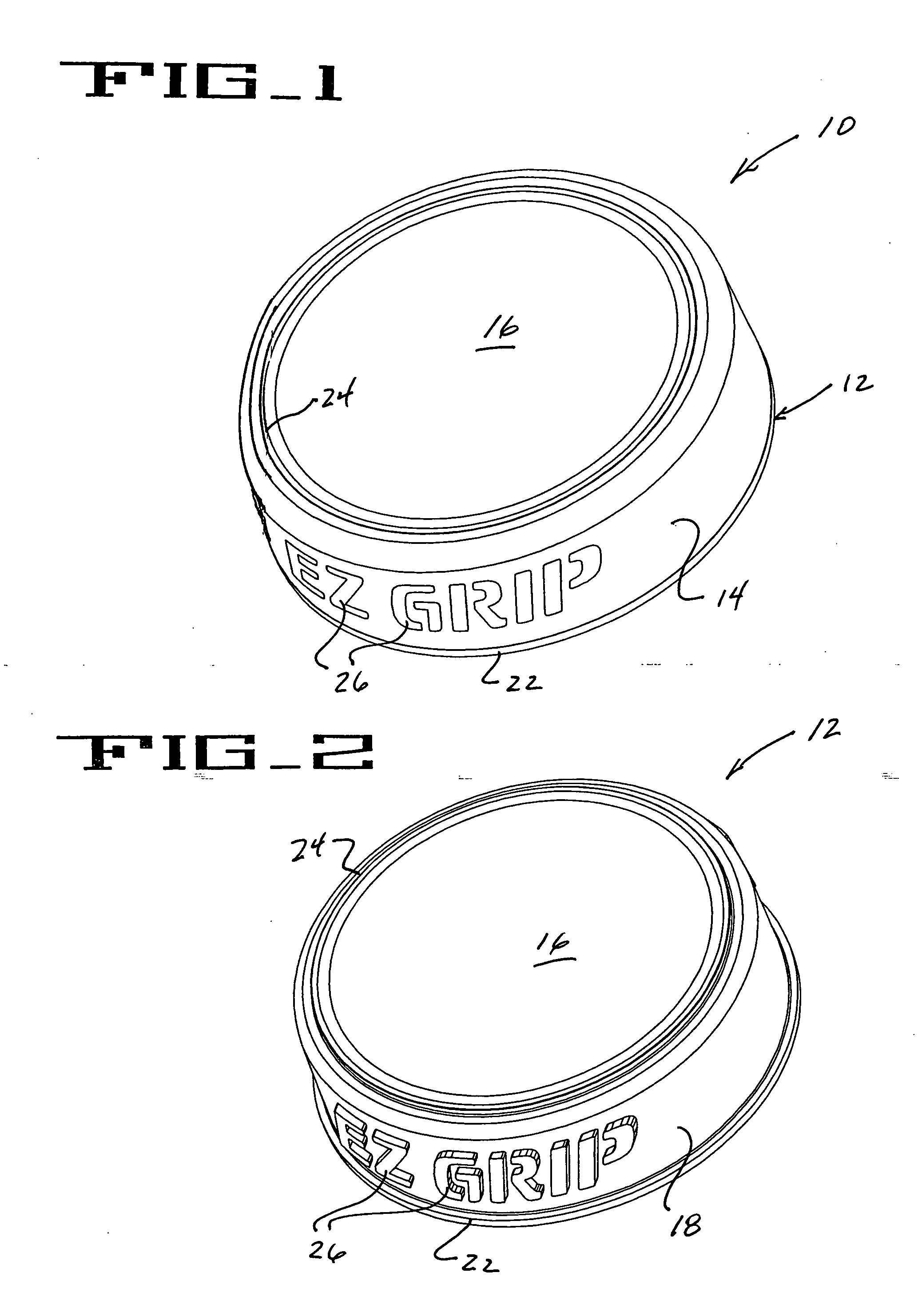
[0005]The present invention is directed to a composite closure having an integral outer gripping layer of relatively pliable plastic material to facilitate enhanced gripping and manipulation of the closure by consumers. Notably, the outer gripping layer extends at least about the periphery of a skirt portion of the closure, thus greatly facilitating removal of the closure from an associated threaded container or the like. Notably, the closure is configured for enhanced presentation of graphical elements, which extend through the outer gripping layer, with the closure further including specifically provided features to facilitate handling of the composite closures by automated equipment, while avoiding damage to the closures attendant to normal packaging, storage, and shipment.
[0006]In accordance with the illustrated embodiment, the present composite closure includes a molded closure cap having a top wall portion, and a depending, internally threaded, annular skirt portion. In accordance with the present invention, the closure further includes an outer gripping layer applied to at least an outer periphery of the skirt portion of the closure cap. The outer gripping layer, which can be formed by over-molding on the closure cap, or by co-injection molding as is known in the art, is desirably formed from plastic material which is relatively soft, and thus provides the closure with a
peripheral surface which is readily and easily gripped and manipulated by consumers.
[0007]Further in accordance with the present invention, the closure cap of the present composite closure includes at least one projecting portion which extends to at least the surface of the outer gripping layer. In one aspect of the present invention, the projecting portion extends through the outer gripping layer, and is configured in the form of one or more graphical elements which project through, and are visibly distinct generally within the outer gripping layer. Configuring the closure cap and outer gripping layer from suitably contrasting colors enhances the aesthetic appeal of the graphical elements. Disposition of the graphical elements so as to extend generally through the outer gripping layer further facilitates gripping and manipulation of the composite closure.
[0008]In another aspect of the present invention, the projecting portion of the closure cap extends beyond the outer gripping layer, with the projecting portion thus desirably acting to facilitate handling of the closure by automated equipment. In particular, because the outer gripping layer can exhibit a relatively high
coefficient of friction, or “tackiness”, the layer can undesirably impede feeding and / or transport of closures by automated equipment. The projecting portion of the closure cap, by virtue of extending beyond the outer gripping layer, desirably provides a sliding surface for engagement with handling equipment, while avoiding disruption that can otherwise occur as the relatively soft, outer gripping layer engages the equipment. Moreover, the integrity and appearance of the gripping layer is desirably maintained.
[0010]In order to avoid undesirable damage, such as
scratching or nicking, to the relatively soft, outer gripping layer, the present composite closure preferably includes an inner
free edge of the skirt portion which defines a
radius which is sufficient to avoid damage to the outer gripping layer of other like ones of the composite closures during handling. This
radius is preferably provided and arranged from about 0.050 inches to about 0.090 inches, most preferably about 0.070 inches.
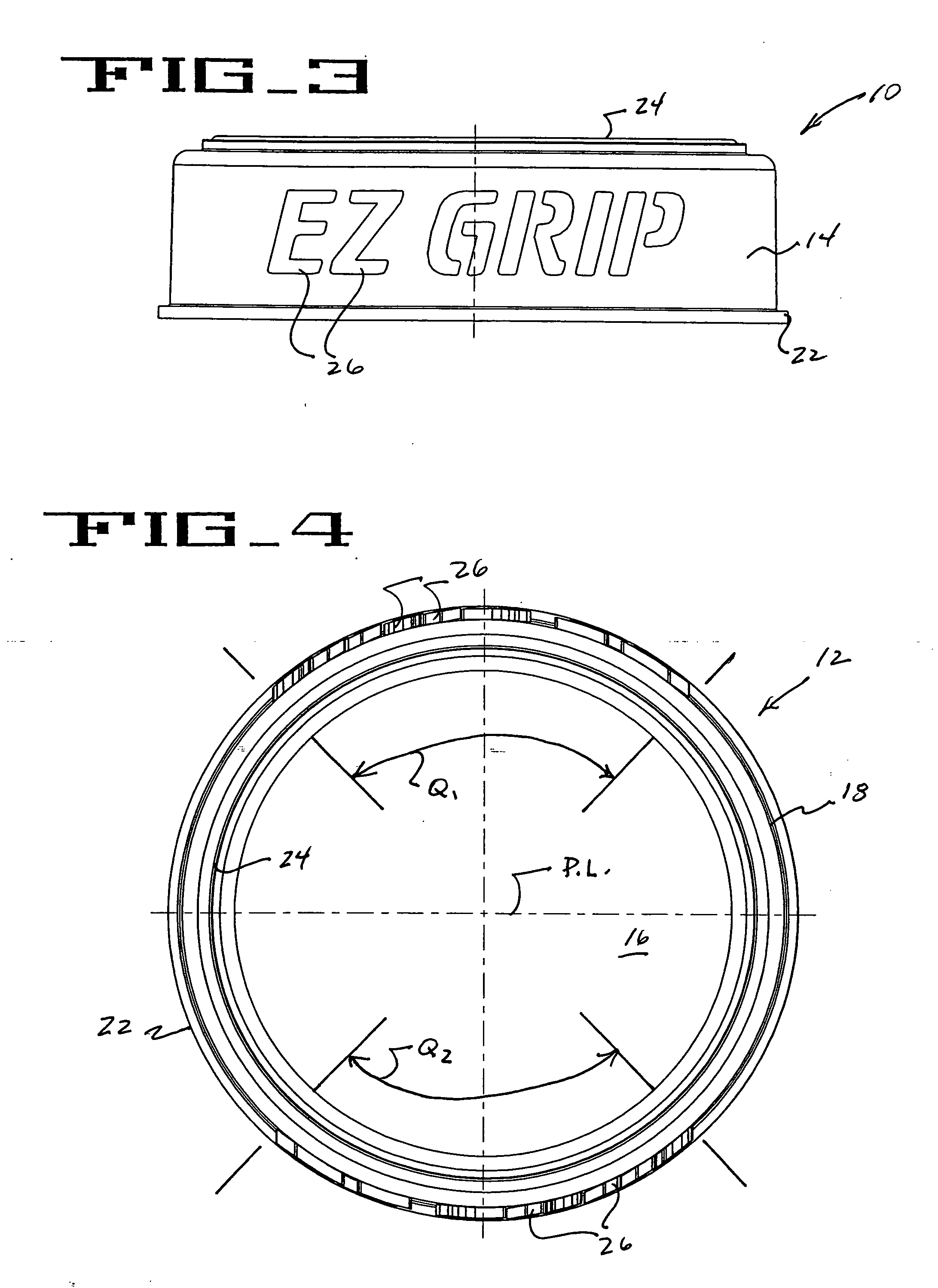
[0011]Manufacture of the present composite closure, including projecting portions in the form of graphical elements on the outer periphery of the skirt portion, is facilitated by configuring and positioning the graphical elements in a preferred form with respect to a mold parting line defined by the closure. As will be recognized by those familiar with the art, the exterior of the closure cap of the composite closure of the present invention can be efficiently formed by a two-part mold, with the closure defining a mold parting line at which the mold portions mate. To facilitate molding of the graphical elements of the present closure, while enhancing their visual appeal, side surfaces of the graphical elements are preferably configured to extend perpendicularly to the mold parting line.


 Login to View More
  Login to View More