Method for determining the thickness of a coating on a composite material

a composite material and thickness measurement technology, applied in the direction of mechanical measuring arrangements, instruments, mechanical means, etc., can solve the problems of low electric conductivity, inability to use reliable methods for determining the thickness of coatings on composite materials, and inability to accurately measure the thickness of coatings

Inactive Publication Date: 2008-04-03
AIRBUS OPERATIONS SL
View PDF12 Cites 5 Cited by
  • Summary
  • Abstract
  • Description
  • Claims
  • Application Information

AI Technical Summary

Benefits of technology

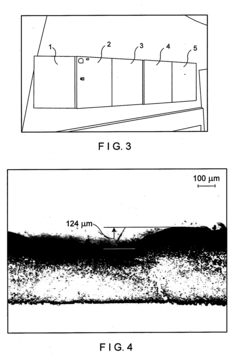
This method provides reliable and precise thickness measurements of coatings on composite materials, validated by comparison with micrographic cut measurements, suitable for a wide range of thicknesses from 20 μm to 300 μm, with minimal interference from textured surfaces.

Problems solved by technology

However, currently there is no reliable method for the application of induced currents in the measurement of thicknesses on composite materials, such as carbon fiber, because this material, although it is a conductor, has a very low electric conductivity.
Other type of techniques, such as ultrasound techniques, have currently been proposed as non-destructive test methods for determining the thicknesses on composite materials, although this type of techniques use very complex equipment and have not provided reliable results.

Method used

the structure of the environmentally friendly knitted fabric provided by the present invention; figure 2 Flow chart of the yarn wrapping machine for environmentally friendly knitted fabrics and storage devices; image 3 Is the parameter map of the yarn covering machine
View more

Image

Smart Image Click on the blue labels to locate them in the text.
Viewing Examples
Smart Image
  • Method for determining the thickness of a coating on a composite material
  • Method for determining the thickness of a coating on a composite material
  • Method for determining the thickness of a coating on a composite material

Examples

Experimental program
Comparison scheme
Effect test

examples

[0028]The results obtained in a specific embodiment of the invention are set forth below, using a multichannel Zetec MIZ-40 A as an induced current equipment, a Leica Q 550 MW Image Analyzer as micrographic equipment, and an absolute Donut Nortec / R / 100 Hz-1 kHz / 0.50-1.00 inches, P / N 9215653 / S / N FO4173, type probe with the following characteristics as a measuring probe:

[0029]Frequency: 950 Hz

[0030]Angle: 233°

[0031]Gain: 41 dB

[0032]Horizontal scale: 2.0 V / D

[0033]Vertical scale: 0.4 V / D

[0034]Drive: 16

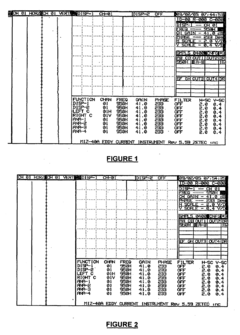
[0035]Firstly, the zero calibration is carried out using to that end a paint-free carbon fiber test piece, which is the coating measured in this specific case. As can be seen in FIG. 1, showing the on-screen display of the equipment and in which the impedance vector angle or phase has been adjusted to 233° in order to obtain a vertical representation given that the lift-off effect is being measured, the descending vertical line is located in the first height square of the screen, therefore...

the structure of the environmentally friendly knitted fabric provided by the present invention; figure 2 Flow chart of the yarn wrapping machine for environmentally friendly knitted fabrics and storage devices; image 3 Is the parameter map of the yarn covering machine
Login to View More

PUM

PropertyMeasurementUnit
thicknessaaaaaaaaaa
thicknessaaaaaaaaaa
thicknessesaaaaaaaaaa
Login to View More

Abstract

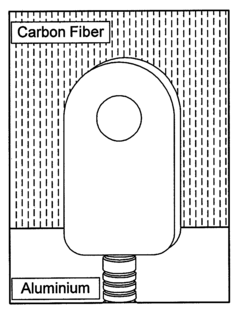
The invention relates to a method for determining the thickness of a coating on a composite material by applying induced currents characterized in that the composite material together with its coating is placed on a conducting material, in which circulating electric currents induced by an alternating magnetic field are created, an indirect measurement being subsequently carried out based on the measurement of the lift-off effect that the coating, together with the composite material, offers in induced currents against the mentioned conducting material.

Description

FIELD OF THE INVENTION[0001]The present invention relates to a method for determining the thicknesses of coatings on composite materials by means of the application of induced currents.BACKGROUND OF THE INVENTION[0002]Induced currents or Eddy currents (also known as parasitic currents or Foucault currents) are circulating electric currents induced by an alternating magnetic field in an insulated conductor. Eddy currents are not induced on an insulating material, the alternating magnetic field traversing the mentioned non-conducting material.[0003]The use of induced currents is currently well known as a non-destructive test method for determining the thicknesses of a non-conducting coating on a conducting metal, or the thickness of a non-magnetic metal coating on a magnetic metal. However, currently there is no reliable method for the application of induced currents in the measurement of thicknesses on composite materials, such as carbon fiber, because this material, although it is a...

Claims

the structure of the environmentally friendly knitted fabric provided by the present invention; figure 2 Flow chart of the yarn wrapping machine for environmentally friendly knitted fabrics and storage devices; image 3 Is the parameter map of the yarn covering machine
Login to View More

Application Information

Patent Timeline
no application Login to View More
Patent Type & AuthorityApplications(United States)
IPC IPC(8): G01B7/06
CPCG01B7/105
InventorFUENTE SOUVIRON, ANTONIOPASCUAL FERNANDEZ, JOAQUIN
OwnerAIRBUS OPERATIONS SL