
Rifaximin compositions and method of use
a technology of rifaximin and composition, applied in the field of rifaximin compositions and methods of use, can solve the problem of not providing for in situ reduction
- Summary
- Abstract
- Description
- Claims
- Application Information
AI Technical Summary
Benefits of technology
Problems solved by technology
Method used
Image

Examples
example 1
Preparation of Raw Rifaximin α and of Dried Raw Rifaximin
[0064]In a three-necked flask equipped with mechanic stirrer, thermometer and reflux condenser, 120 ml of demineralized water, 96 ml of ethyl alcohol, 63.5 g of rifamycin O and 27.2 g of 2-amino-4-methylpyridine are loaded in succession at room temperature. After loading, the mass is heated at 47±3° C., is kept under stirring at this temperature for 5 hours, then is cooled to 20±3° C. and, in 30 minutes, is added with a mixture, prepared separately, consisting of 9 ml of demineralized water, 12.6 ml of ethyl alcohol, 1.68 g of ascorbic acid and 9.28 g of aqueous concentrated hydrochloric acid. When the addition is over, the mass is kept under stirring for 30 minutes at an inner temperature of 20±3° C. and then, at the same temperature, 7.72 g of concentrated hydrochloric acid are dropped until pH 2.0.
[0065]When the addition is over, the mass is kept under stirring, still at an inner temperature of 20° C., for 30 minutes, then ...
example 2
Preparation of Rifaximin γ
[0067]163 ml of ethyl alcohol and 62.2 g of dried raw rifaximin are loaded at room temperature into a three-necked flask equipped with mechanic stirrer, thermometer and reflux condenser. The suspension is heated at 57±3° C. under stirring until complete dissolution of the solid and at this temperature 70 ml of demineralized water are added in 30 minutes. When the addition is over the temperature is brought to 30° C. in 40 minutes and is kept at this value until abundant crystallization, then the temperature is further lowered to 0° C. during 2 hours and kept at this value for 6 hours. The suspension is then filtered and the solid is washed with 180 g of demineralized water.
[0068]After drying under vacuum at room temperature until constant weight, 52.7 g of pure rifaximin γ are obtained with a 1.5% water content.
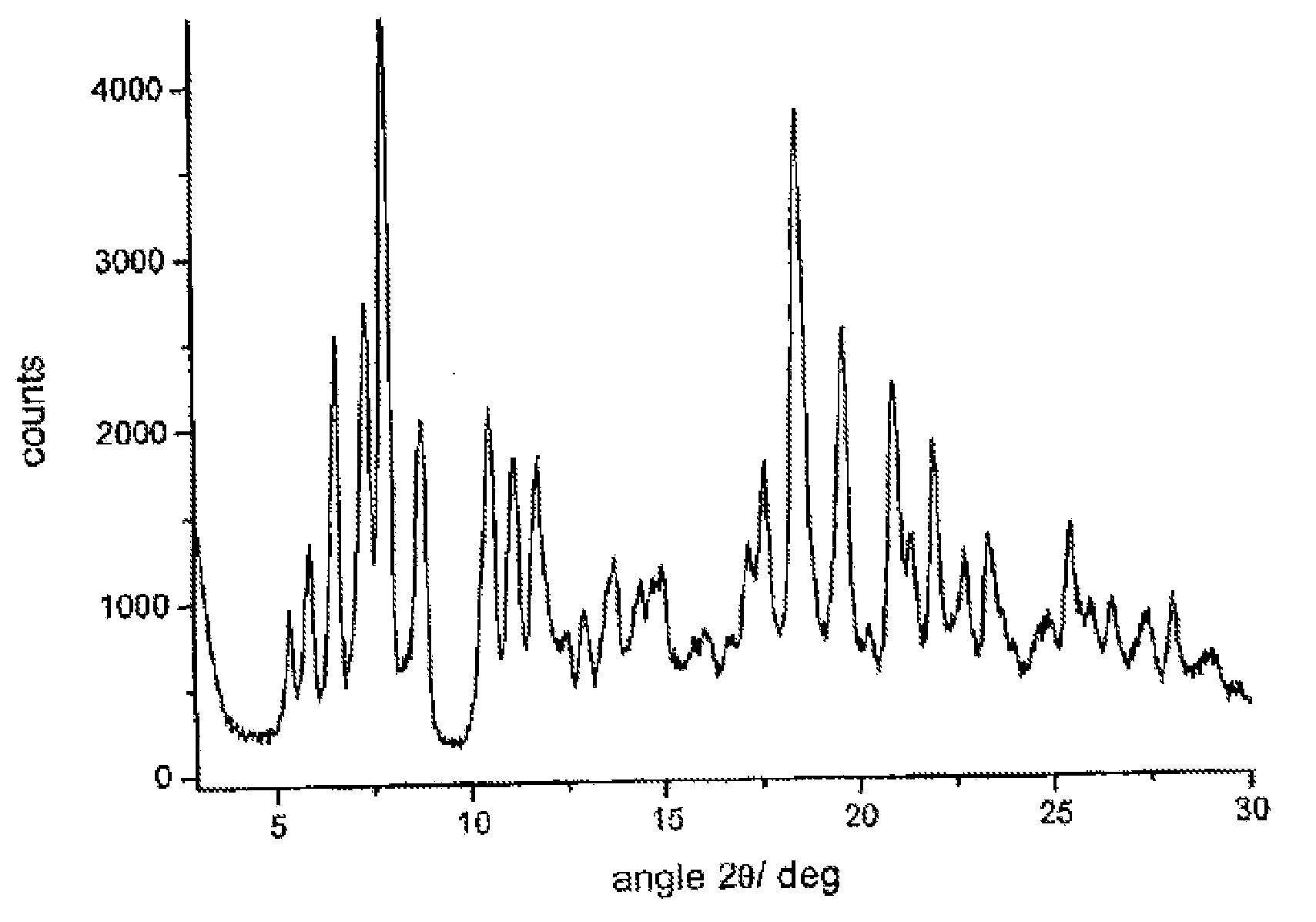
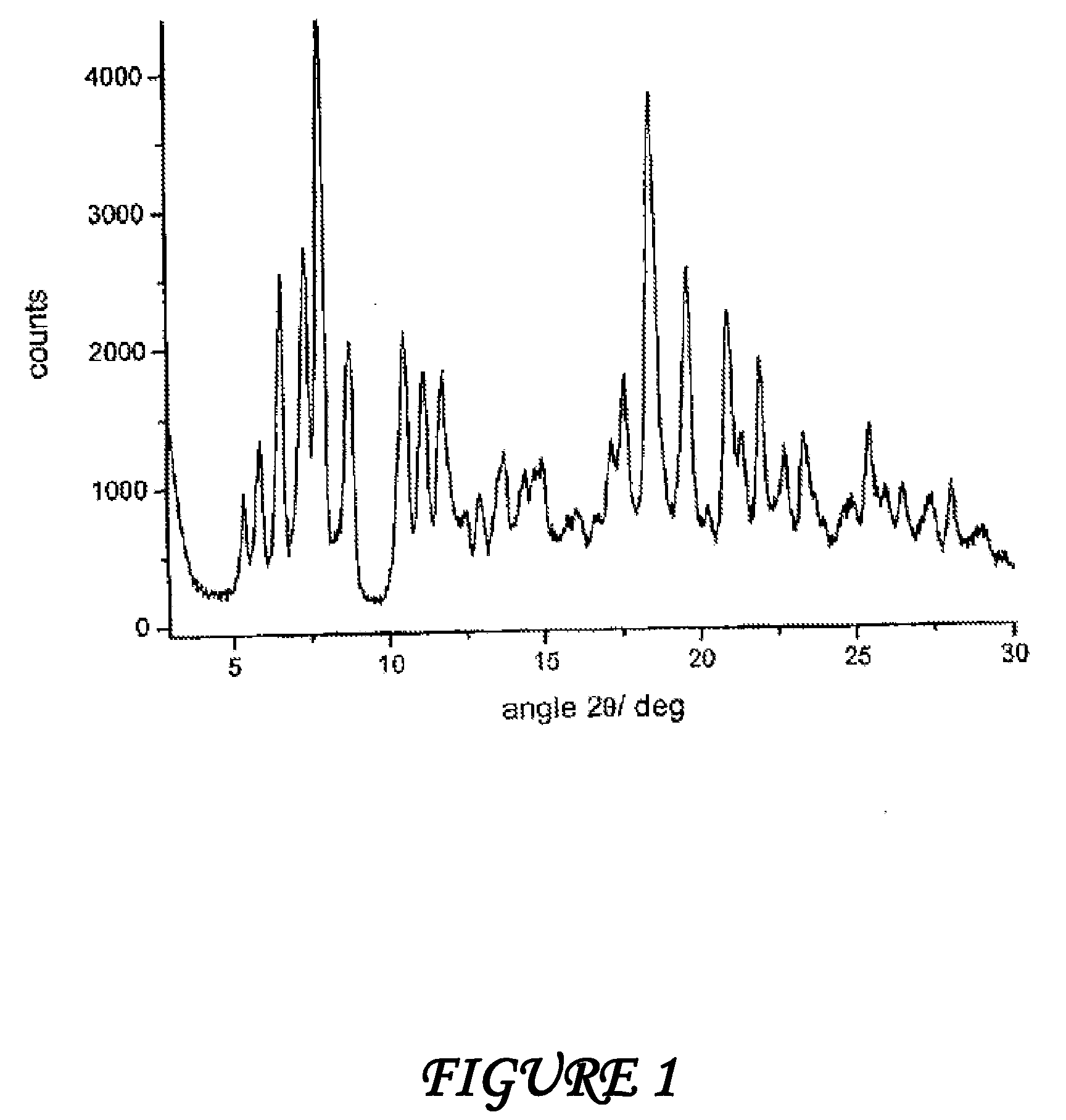
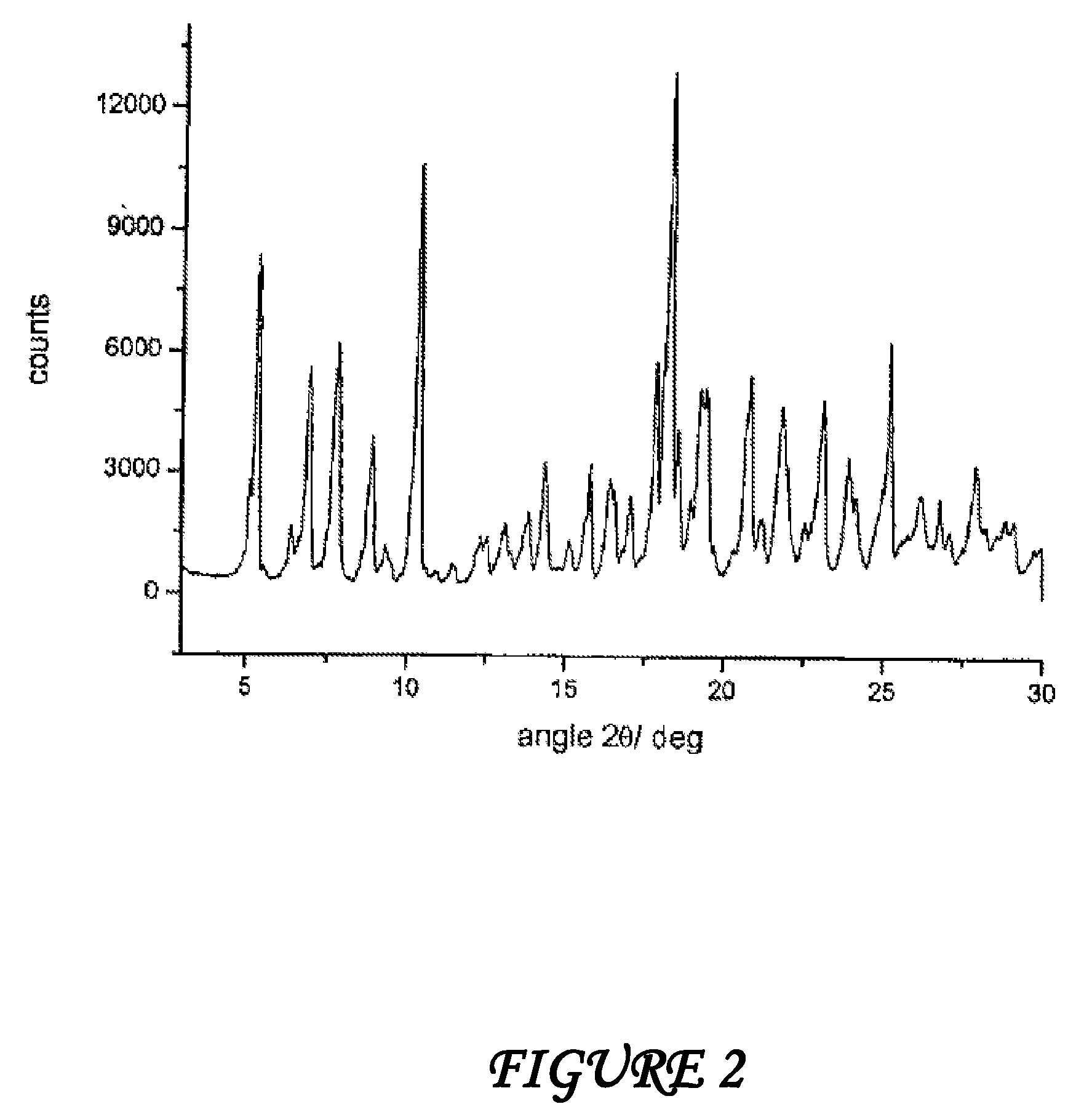
[0069]Form γ is characterized by a powder X-ray diffractogram showing significant peaks at diffraction angles 2θ of 5.0°; 7.1°; 8.4°.
example 3
Preparation of Rifaximin α
[0070]62.2 g of dried raw rifaximin and 163 ml of ethyl alcohol are loaded at room temperature into a three-necked flask equipped with mechanic stirrer, thermometer and reflux condenser. The suspension is heated at 57±3° C. until complete dissolution of the solid and then 70 ml of demineralized water are added at this temperature during 30 minutes. When addition is over the temperature is taken to 30° C. for 40 minutes and is kept at this value until abundant crystallization. The suspension temperature is then taken to about 40° C. and kept at this value during 20 hours under stirring; then the temperature is taken to 0° C. in 30 minutes and the suspension is immediately filtered. The solid is washed with 180 ml of demineralized water and dried under vacuum at room temperature until constant weight; 51.9 g of rifaximin form α are obtained with a 2.5% water content and a powder X-ray diffractogram showing peaks at values of angles 2θ of 6.6°; 7.4°; 7.9°; 8.8...
PUM
| Property | Measurement | Unit |
|---|---|---|
| Temperature | aaaaa | aaaaa |
| Fraction | aaaaa | aaaaa |
| Fraction | aaaaa | aaaaa |
Abstract
Description
Claims
Application Information
 Login to View More