Fast compression method for scientific data

a data compression and scientific data technology, applied in the field of data compression, can solve problems such as inability to achieve the effect of an algorithm

US20090256732A1Active Publication Date: 2009-10-15INNOVATIONS IN MEMORY LLC
18 Cites 1 Cited by

Patent Information

Authority / Receiving Office
US · United States
Patent Type
Applications(United States)
Current Assignee / Owner
Publication Date
2009-10-15

Smart Images

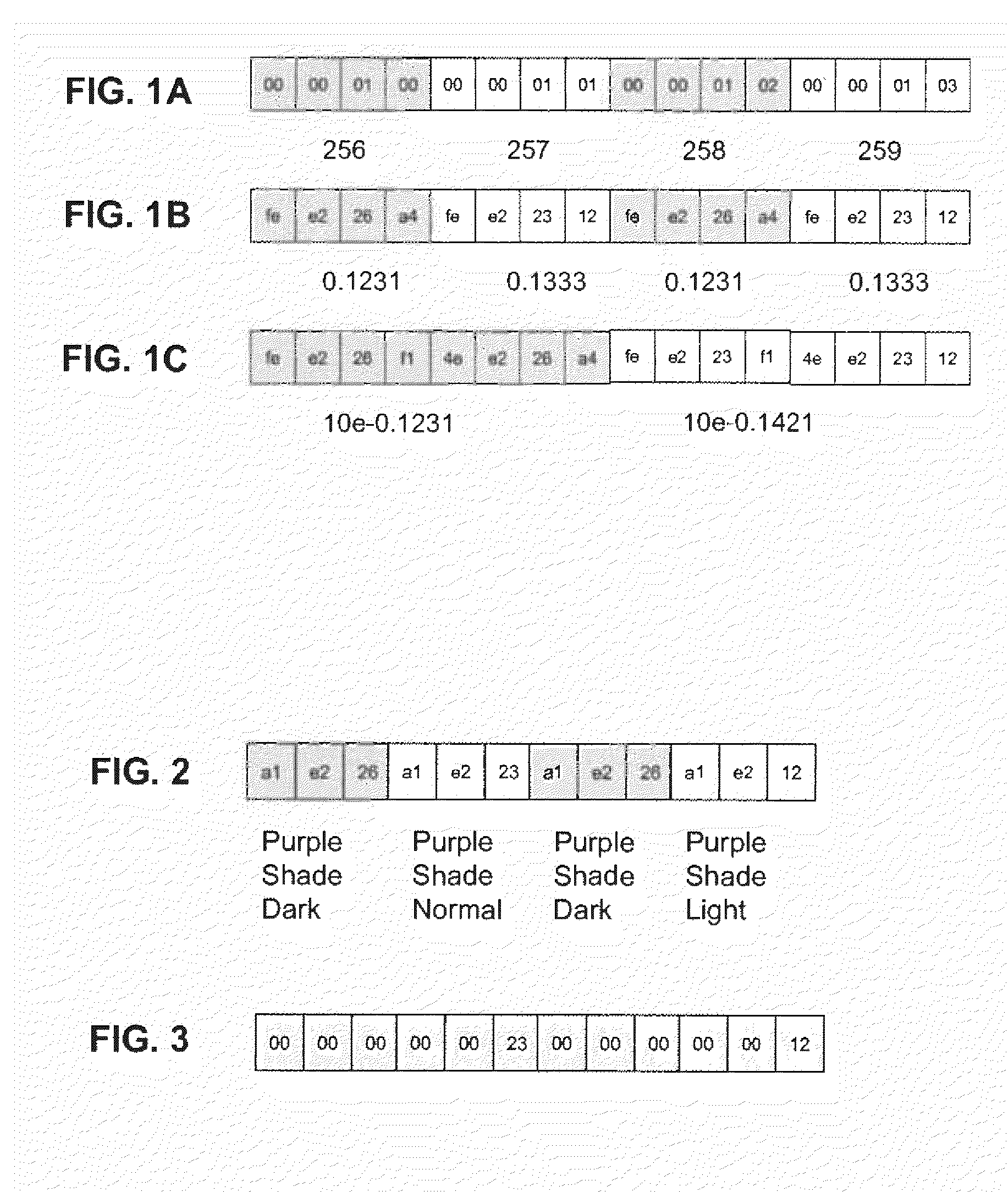
  • Figure 1
    Figure 1
  • Figure 2
    Figure 2
  • Figure 3
    Figure 3
Patent Text Reader

Abstract

A method and system allows for fast compression and decompressing of data using existing repetitive interleaved patterns within scientific data (floating point, integer, and image). An advantage of the method and system is that it is so fast that it can be used to save time due to a lower amount of data transferred / stored in scenarios like network transfer, disk or memory storage, cache storage or any other real-time applications where time plays a crucial role.
Need to check novelty before this filing date? Find Prior Art

Description

CROSS-REFERENCE TO RELATED APPLICATIONS

[0001] This application is a divisional of U.S. patent application Ser. No. 10 / 956,377, filed Sep. 30, 2004, now U.S. Pat. No. 7,554,464 issued Jun. 30, 2009 to Matthias Oberdorfer entitled “Method and System for Processing Data Having A Pattern of Repeating Bits” of which is expressly incorporated herein by reference.FIELD OF THE INVENTION

[0002] The present invention relates generally to data compression, and in particular to a method of fast data compression for representations of numbers such as floating point numbers, integer numbers and image data.BACKGROUND OF THE INVENTION

[0003] Generally, data compression involves taking “symbols” from an input “text”, processing the symbols, and writing “codes” to a compressed file. Most data compression methods in common use today fall into one of two categories: (1) Dictionary-based schemes; and (2) Statistical methods. Both existing known compression methods have usually two key objectives: (1) reduce ...

Examples

Embodiment Construction

[0020]The present invention will now be described in detail with reference to the drawings, which are provided as illustrative examples of the invention so as to enable those skilled in the art to practice the invention. Notably, the figures and examples below are not meant to limit the scope of the present invention to a single embodiment, but other embodiments are possible by way of interchange of some or all of the described or illustrated elements. Moreover, where certain elements of the present invention can be partially or fully implemented using known components, only those portions of such known components that are necessary for an understanding of the present invention will be described, and detailed descriptions of other portions of such known components will be omitted so as not to obscure tire invention. In the present specification, an embodiment showing a singular component should not necessarily be limited to other embodiments including a plurality of the same compone...