
Interference cancellation method and apparatus between terminals in wireless access system supporting full-duplex radio scheme
a wireless access system and full-duplex radio technology, applied in the direction of electrical equipment, transmission monitoring, network traffic/resource management, etc., can solve the problems of mutual interference, ue, etc., and achieve the effect of reducing the error of data transmission and reception and increasing the data throughput of user equipmen
- Summary
- Abstract
- Description
- Claims
- Application Information
AI Technical Summary
Benefits of technology
Problems solved by technology
Method used
Image

Examples
Embodiment Construction
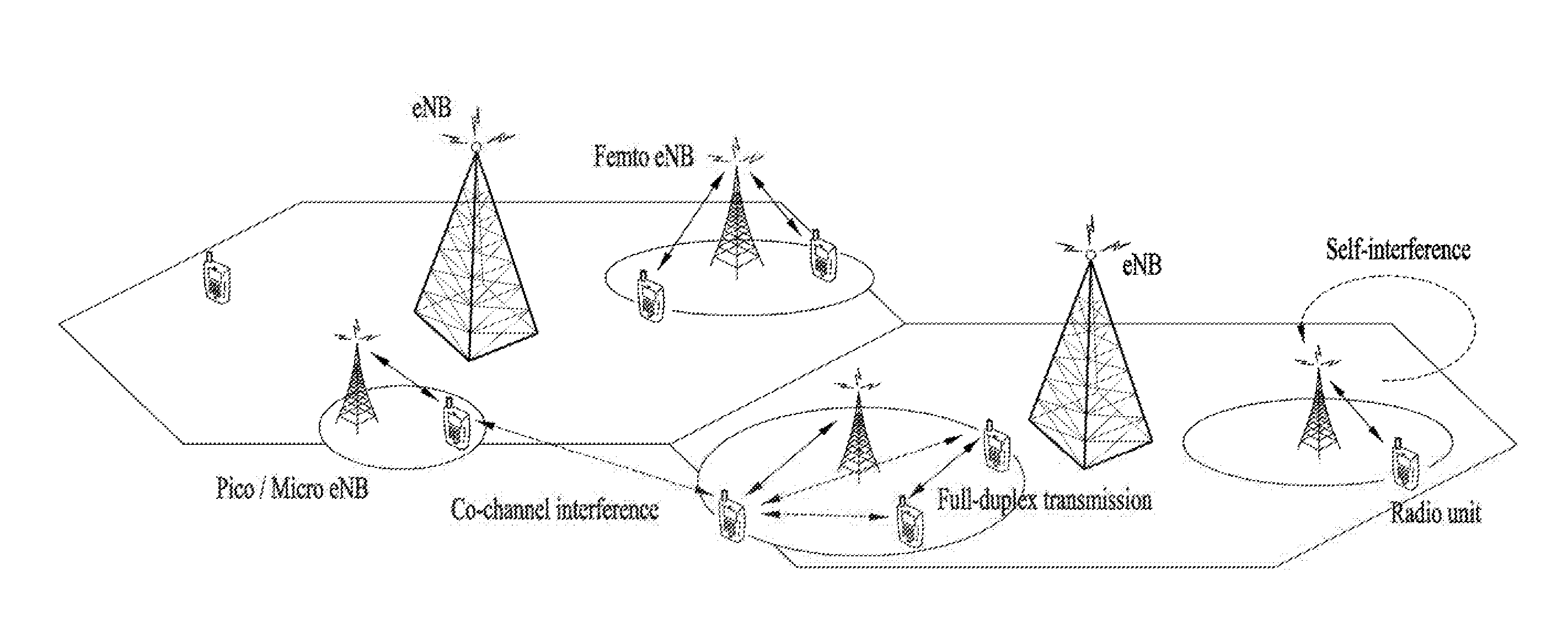
[0046]The present invention described hereinafter relates to methods and apparatus for cancelling interference between user equipments in a full duplex radio (FDR) system.
[0047]The embodiments of the present invention described below are combinations of elements and features of the present invention in specific forms. The elements or features may be considered selective unless otherwise mentioned. Each element or feature may be practiced without being combined with other elements or features. Further, an embodiment of the present invention may be constructed by combining parts of the elements and / or features. Operation orders described in embodiments of the present invention may be rearranged. Some constructions or elements of any one embodiment may be included in another embodiment and may be replaced with corresponding constructions or features of another embodiment.
[0048]In the description of the attached drawings, a detailed description of known procedures or steps of the presen...
PUM
 Login to View More
 Abstract
Description
Claims
Application Information
 Login to View More