Reentry catheters and methods for traversing chronic total occlusions

a technology catheter, which is applied in the field of chronic total occlusion catheter and catheter traversing, can solve problems such as vessel damag

Pending Publication Date: 2020-10-08
TRAVERSE VASCULAR INC
View PDF13 Cites 3 Cited by
  • Summary
  • Abstract
  • Description
  • Claims
  • Application Information

AI Technical Summary

Benefits of technology

The present invention provides a reentry catheter for crossing vascular occlusions. The catheter has a flexible tubular body with at least one lumen extending through it. The tubular body has a reentry zone with at least two exit apertures that are rotationally offset from each other. The catheter can be advanced over a guidewire to cross the occlusion, and the guidewire can be withdrawn. The catheter can also have a balloon and a stent to maintain patency across the occlusion. The invention also includes a method for using the catheter to cross a chronic total occlusion. The catheter has the advantage of being able to cross a vascular occlusion that is long and difficult to reach.

Problems solved by technology

It is believed that one drawback of this system is the requirement to rotate the catheter to the correct position while under fluoroscopic imaging otherwise an incorrect orientation of the cannula could cause failure to reenter the parent lumen and potentially cause damage to the vessel.
It is believed that this system also suffers from a similar drawback in that the lateral port of the cannula must be oriented in the correct direction towards the true lumen while under fluoroscopy.

Method used

the structure of the environmentally friendly knitted fabric provided by the present invention; figure 2 Flow chart of the yarn wrapping machine for environmentally friendly knitted fabrics and storage devices; image 3 Is the parameter map of the yarn covering machine
View more

Image

Smart Image Click on the blue labels to locate them in the text.
Viewing Examples
Smart Image
  • Reentry catheters and methods for traversing chronic total occlusions
  • Reentry catheters and methods for traversing chronic total occlusions
  • Reentry catheters and methods for traversing chronic total occlusions

Examples

Experimental program
Comparison scheme
Effect test

Embodiment Construction

[0056]Referring to FIG. 1, there is disclosed a catheter 10 in accordance with one aspect of the present invention. Although primarily described in the context of a reentry catheter with a single central lumen, catheters of the present invention can readily be modified to incorporate additional structures, such as permanent or removable column strength enhancing mandrels, two or more lumen such as to permit drug or irrigant infusion or to supply inflation media to an inflatable balloon, or combinations of these features, as will be readily apparent to one of skill in the art in view of the disclosure herein.

[0057]The catheters disclosed herein may readily be adapted for use throughout the body wherever it may be desirable to create an extravascular access or a neo lumen, such as to traverse a CTO or otherwise exit and reenter the lumen. For example, catheter shafts in accordance with the present invention may be dimensioned for use throughout the coronary and peripheral vasculature,...

the structure of the environmentally friendly knitted fabric provided by the present invention; figure 2 Flow chart of the yarn wrapping machine for environmentally friendly knitted fabrics and storage devices; image 3 Is the parameter map of the yarn covering machine
Login to View More

PUM

No PUM Login to View More

Abstract

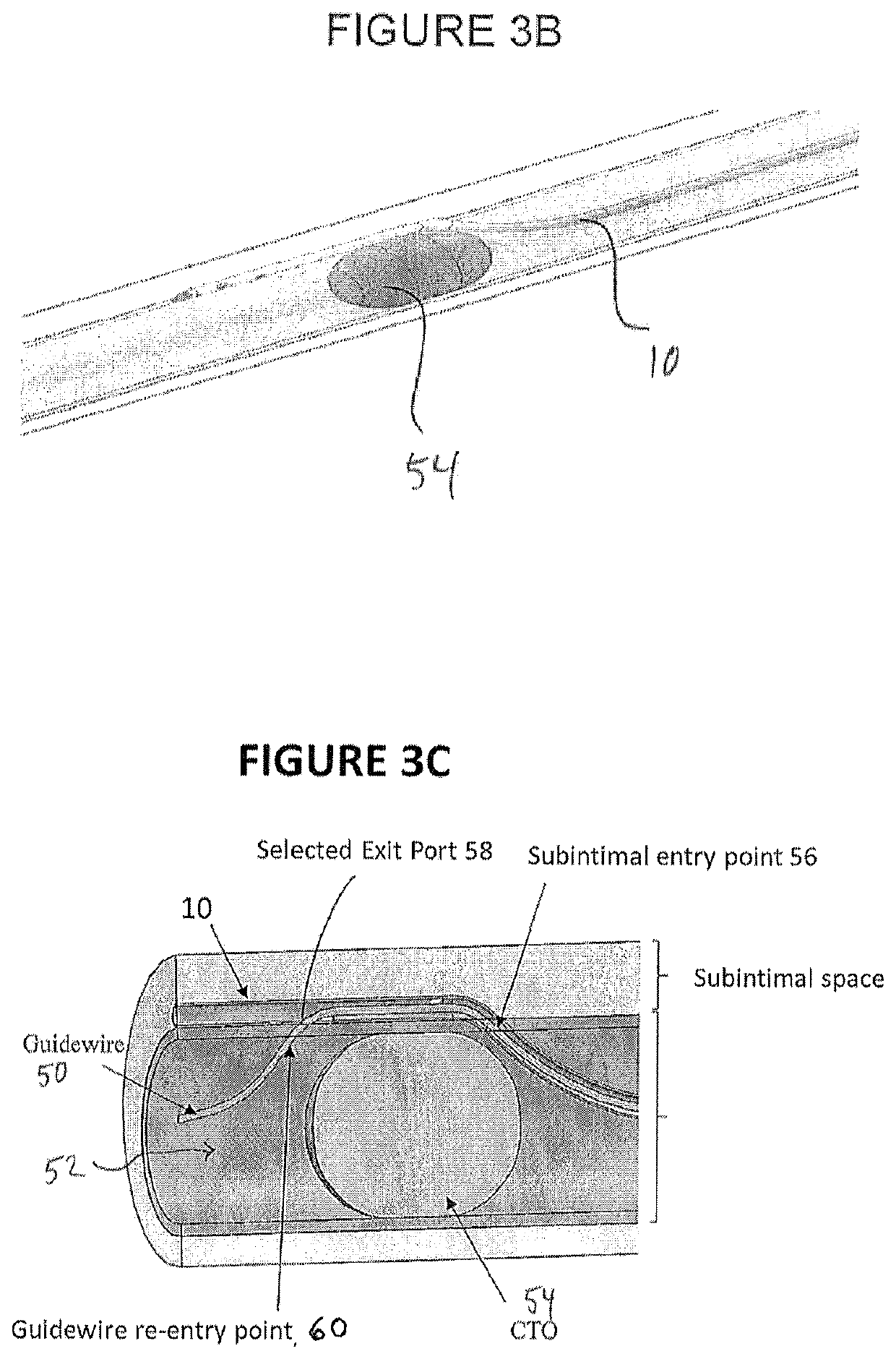
A reentry catheter for crossing a vascular occlusion includes an elongate flexible tubular body, having a proximal end, a distal end and at least one lumen extending there through. A reentry zone on the tubular body includes at least two and preferably three sets of opposing pairs of axially spaced exit apertures in communication with the lumen. The apertures are rotationally offset from each other and aligned in a spiral pattern around the tubular body. A method of crossing a chronic total occlusion includes the steps of advancing the reentry catheter across the occlusion via a channel formed in the subintimal space, and advancing a guidewire via a selected exit port into the native lumen distally of the occlusion. The catheter may be removed, leaving the guidewire across the occlusion to guide further interventional devices.

Description

CROSS-REFERENCE TO RELATED APPLICATIONS[0001]This application claims priority to U.S. Provisional Patent Application No. 62 / 830,199, filed Apr. 5, 2019, and U.S. Provisional Patent Application No. 62 / 907,299, filed Sep. 27, 2019, the entire contents of both of which are incorporated herein by reference in their entireties.BACKGROUND OF THE INVENTION[0002]An interventional guide wire or other interventional device is often used in medical procedures that attempt to establish a pathway through a heavily stenosed or chronically occluded vessel. A chronically occluded vessel is referred to as containing a chronic total occlusion or CTO. During these procedures, the guide wire or device can only be of clinical benefit to establish vessel patency if it is advanced distally into the vessel true lumen.[0003]One technique for restoring patency across a CTO involves advancing a guide wire through the intimal layer of the vessel wall and into the subintimal plane or space, where it can be furt...

Claims

the structure of the environmentally friendly knitted fabric provided by the present invention; figure 2 Flow chart of the yarn wrapping machine for environmentally friendly knitted fabrics and storage devices; image 3 Is the parameter map of the yarn covering machine
Login to View More

Application Information

Patent Timeline
no application Login to View More
IPC IPC(8): A61B17/22A61F2/958
CPCA61B17/22A61B2017/22079A61B2017/22002A61B2017/22038A61B2017/22095A61F2/958A61B2017/22071A61B2017/306A61B2217/005A61M2025/0197A61M25/0194A61M2025/09133A61M2025/09141A61M25/0052A61M25/007A61M2025/09175A61M25/04A61M25/0053A61M25/0108A61M2025/09166A61F2/82
InventorNICHOLSON, BILLKLOS, BRADHOWARD, STEVEMATSUURA, DAVID
OwnerTRAVERSE VASCULAR INC