
Capillary array and related methods
a capillary array and array technology, applied in the field of diagnostics, can solve the problems of large number of such genes, limited efficiency, and ineffectiveness of conventional array approaches, and achieve the effect of increasing the speed at which assays can be run, and improving the efficiency of target analyte-binding partner binding
- Summary
- Abstract
- Description
- Claims
- Application Information
AI Technical Summary
Benefits of technology
Problems solved by technology
Method used
Image

Examples
example 1
Capillary-Based Array Hybridization System
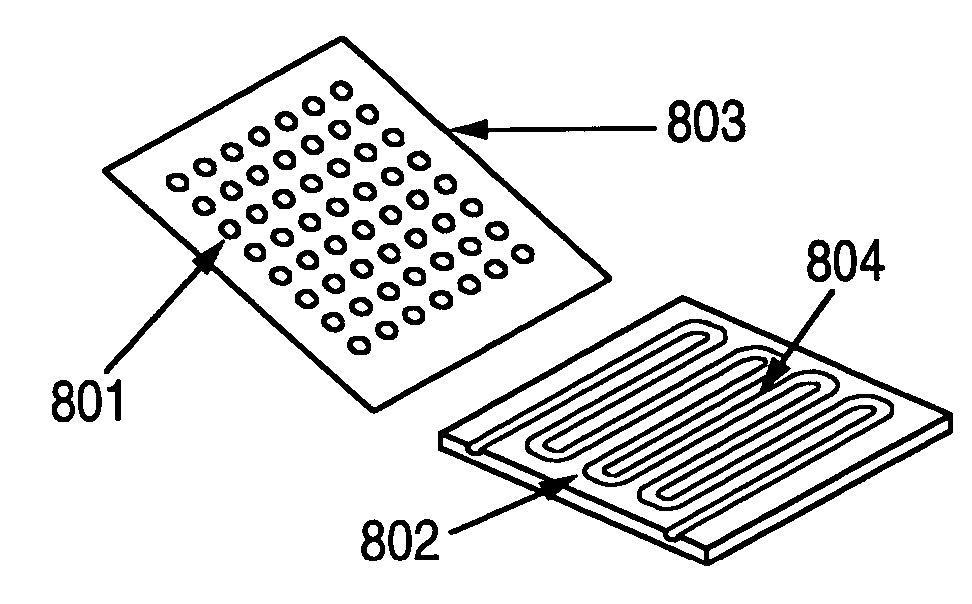
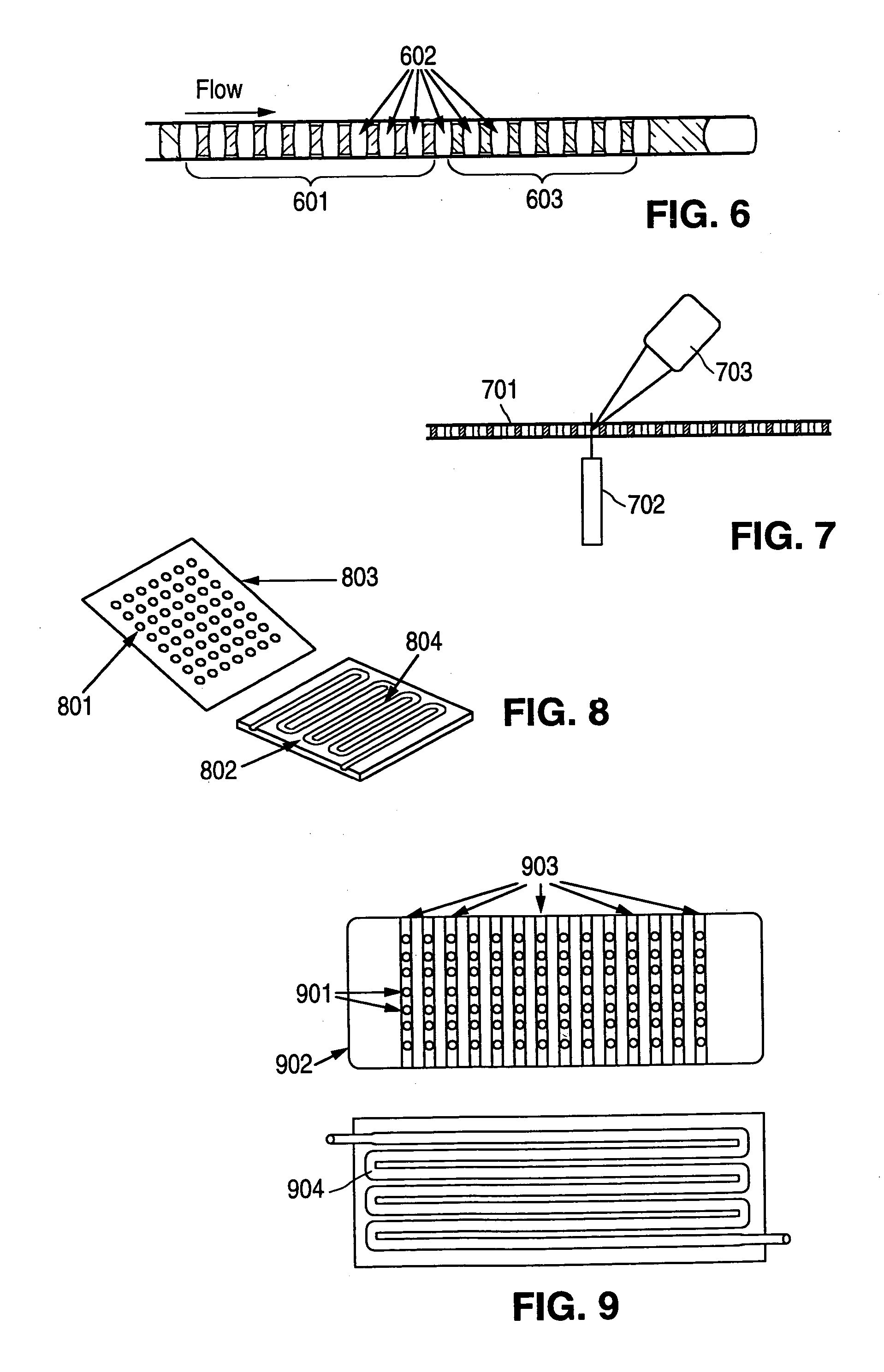
[0179]A capillary channel-based array hybridization system is illustrated in FIG. 8. The channel substrate 802 is composed of molded PDMS (polydimethylsiloxane) material, which can be molded with precise detail and which provides a surface readily sealed against the planar cover element (coverplate) 803. The channel 804 has a half-circular cross section. To minimize the amount of target analyte required for analysis and to minimize the distances through which target analytes must diffuse to reach binding partners, the channel has an internal diameter of 100 μm and a total length of 1 m. The channel is folded 100 times, the distance between the center of one channel segment and the center of an adjacent channel sequence is 400 μm, and the channel substrate is 4 cm×10 cm.
[0180]The coverplate is glass. Nucleic acid binding partners 801 are printed on the coverplate with using a robotic arrayer robot conventionally used for production of standar...
example 2
Capillary-Based Array Electrophoretic Hybridization System
[0182]Referring to FIG. 9, a device having the basic configuration described in Example 1 has nucleic acid binding partners 901 printed in a 2-dimensional array on a glass coverplate 902 on top of titanium-platinum electrodes 903. The electrodes 903 underlie a column of different binding partner locations in the 2-dimensional array. Each column of different binding partner locations has a long axis that is generally perpendicular to the longitudinal axis of each straight segment of the channel 904. To protect the nucleic acids from electrolysis products formed at the electrodes, the coverplate surface, including the conducting strips, are coated with a permeation layer comprised of 2% glyoxal agarose and 1 mg / ml streptavidin mixture. The nucleic acid binding partners are synthesized with a biotin attached to one end. Once the binding partners are deposited on the permeation layer, avidin / biotin binding affixes the nucleic aci...
PUM
| Property | Measurement | Unit |
|---|---|---|
| diameter | aaaaa | aaaaa |
| velocity | aaaaa | aaaaa |
| thick | aaaaa | aaaaa |
Abstract
Description
Claims
Application Information
 Login to View More