[0007]For this purpose, the method according to the invention provides that for an animal that does not leave the feeding box after an initially chosen eating period of time has elapsed, the initially chosen eating period of time beginning immediately after closing of the box, within a first
waiting time span chosen contiguously to said period of time, in which the animal is given the possibility of leaving the feeding box, the step of supplying feed to the animal in the feeding box in a chosen eating period of time is repeated at least once. The invention is based on the insight that an animal is able partially to determine its own eating period of time, the eating period of time comprising an imposed chosen eating period of time and an eating period of time to be freely determined by the animal, thus teaching the animal, on the one hand, a conscious eating behaviour and, stimulating, on the other hand, a
feed consumption without stress, respectively.
[0010]In an embodiment of a method according to the invention, for an animal that, after the chosen eating period(s) of time following the initially chosen eating period of time has / have elapsed, does not leave the feeding box within the chosen
waiting time span(s) chosen contiguously to said following chosen eating period(s) of time, in which the animal is given the possibility of leaving the feeding box, step c) is repeated in the chosen waiting time span(s). Owing to the fact that the animal is able to determine its own
eating time, the needs of the animal itself are met. The animal is offered an unlimited amount of feed in the feeding box, so that the animal will associate the feeding box with a positive experience. This will positively influence the
feed consumption.
[0011]In an embodiment of a method according to the invention, during the initially chosen eating period of time, an animal in the feeding box has no possibility of leaving the feeding box. In this manner, the method softly counteracts the formation of remaining feed in a feeding box. An animal that decides to enter the feeding box will get accustomed to the fact that this results in not being able to leave the feeding box during the initially chosen eating period of time. The undesirable behaviour of certain animals in a
herd quickly to consume tasty remaining feed from different feeding boxes is now discouraged. The animal in the feeding box is given ample opportunity to consume the supplied feed completely during the initially chosen eating period of time. The animal being confined with the feed during the chosen eating period of time will contribute to a strong reduction of the risk of remaining feed being left in the feeding box upon departure of the animal.
[0012]In an embodiment of a method according to the invention, after the initially chosen eating period of time has elapsed, the animal in the feeding box is given the possibility of leaving the feeding box and access to the feeding box remains impeded for an animal outside the feeding box. The animal is safeguarded against stress-increasing influences by other (more dominant) animals throughout its
eating time. In this manner, eating animals will no longer be jostled, which prevents stress, and possibly bad
feed consumption and the like as a result thereof.
[0018]In an embodiment of a method according to the invention, for the initially chosen eating period of time, the chosen eating period of time, the following chosen eating period(s) of time, the chosen first waiting time span, the chosen second waiting time span, the chosen third waiting time span, the chosen waiting time span(s), the chosen feed consumption rate threshold value, a value is adjustable at any moment. It is possible to program these values in a
control unit of an installation suitable for performing the method or to input these values directly into a
control unit. This makes it possible to adapt per situation to changing animal conditions and animal related matters.
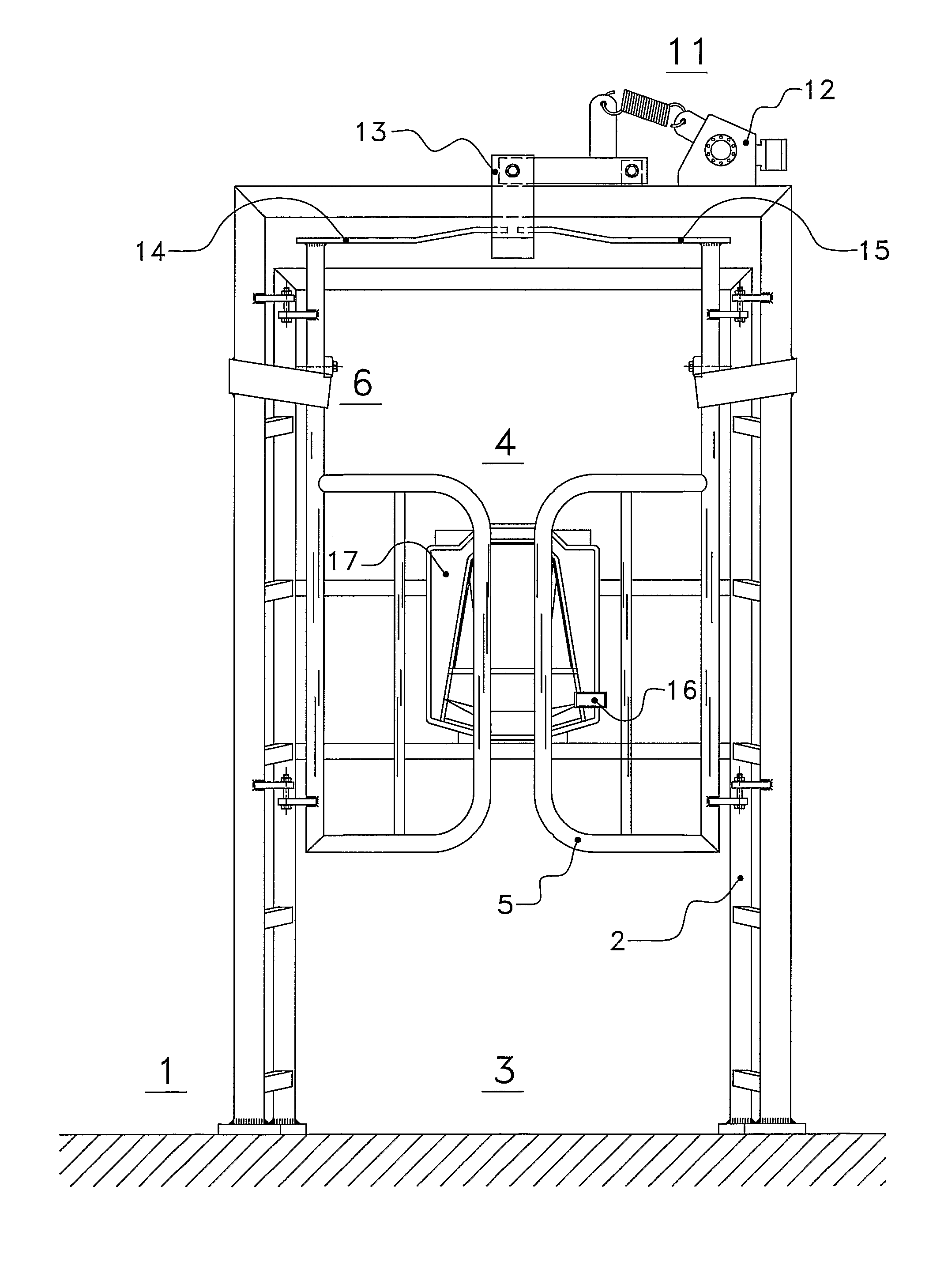
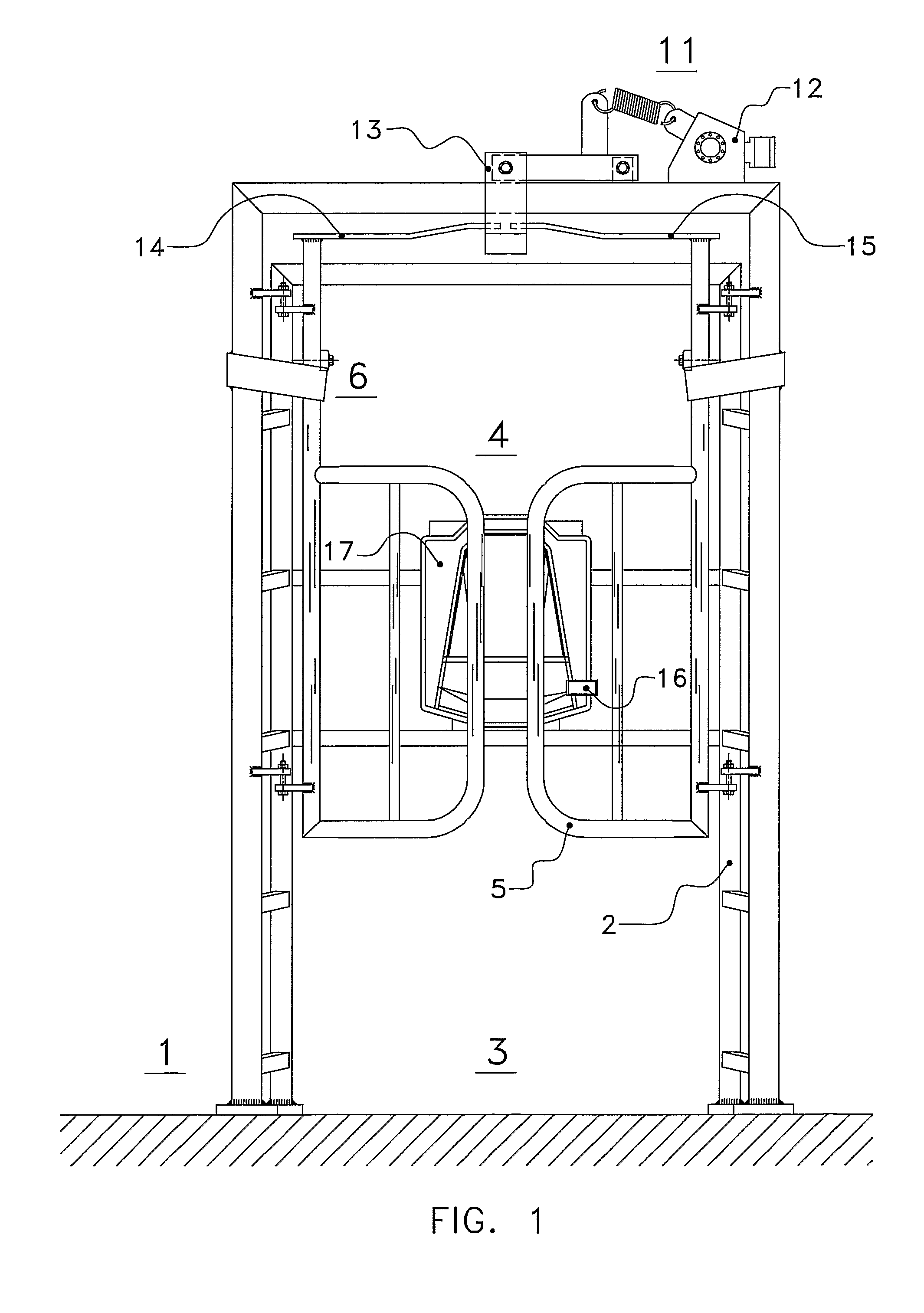
[0026]In an embodiment of an installation according to the invention, the guiding element provided with a curve path has a recess at the place of the
neutral position. This means that a moving element, relative to the situation in which no recess is provided, engages quickly. Fluctuations around the
neutral position are now counteracted. It now takes less time for the moving element to assume the
neutral position.


 Login to View More
  Login to View More