
Hard-coated film, method for production thereof and antireflection film
a technology of hard coating and antireflection film, which is applied in the direction of instruments, synthetic resin layered products, optical elements, etc., can solve the problems of insufficient adhesion of the hard coating layer directly provided thereon, insufficient surface hardness, and insufficient adhesion of the hard coating layer, so as to reduce the interference iris pattern, reduce the coloration irregularity of the surface, and reduce the effect of interference iris patterns
- Summary
- Abstract
- Description
- Claims
- Application Information
AI Technical Summary
Benefits of technology
Problems solved by technology
Method used
Image

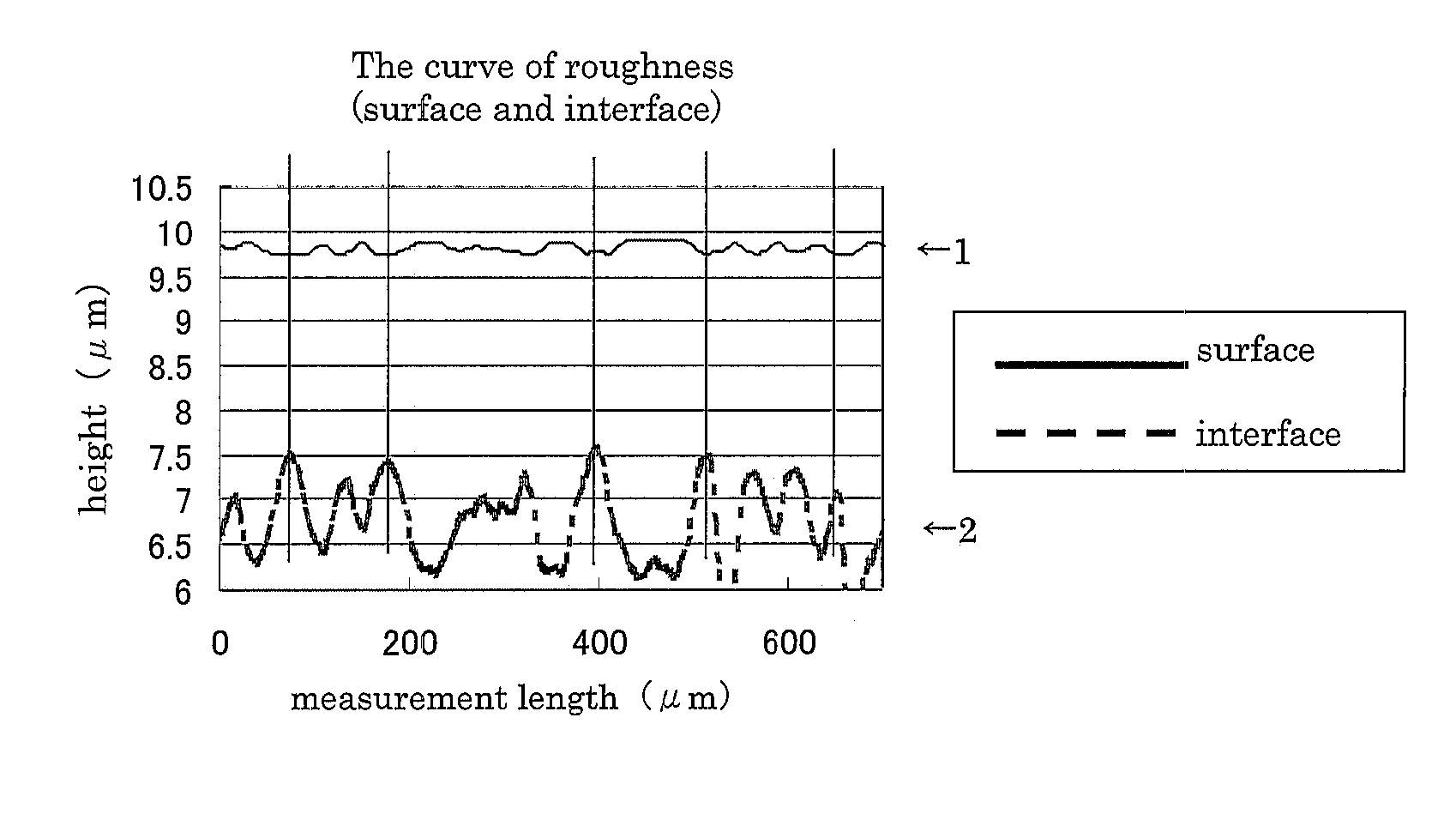
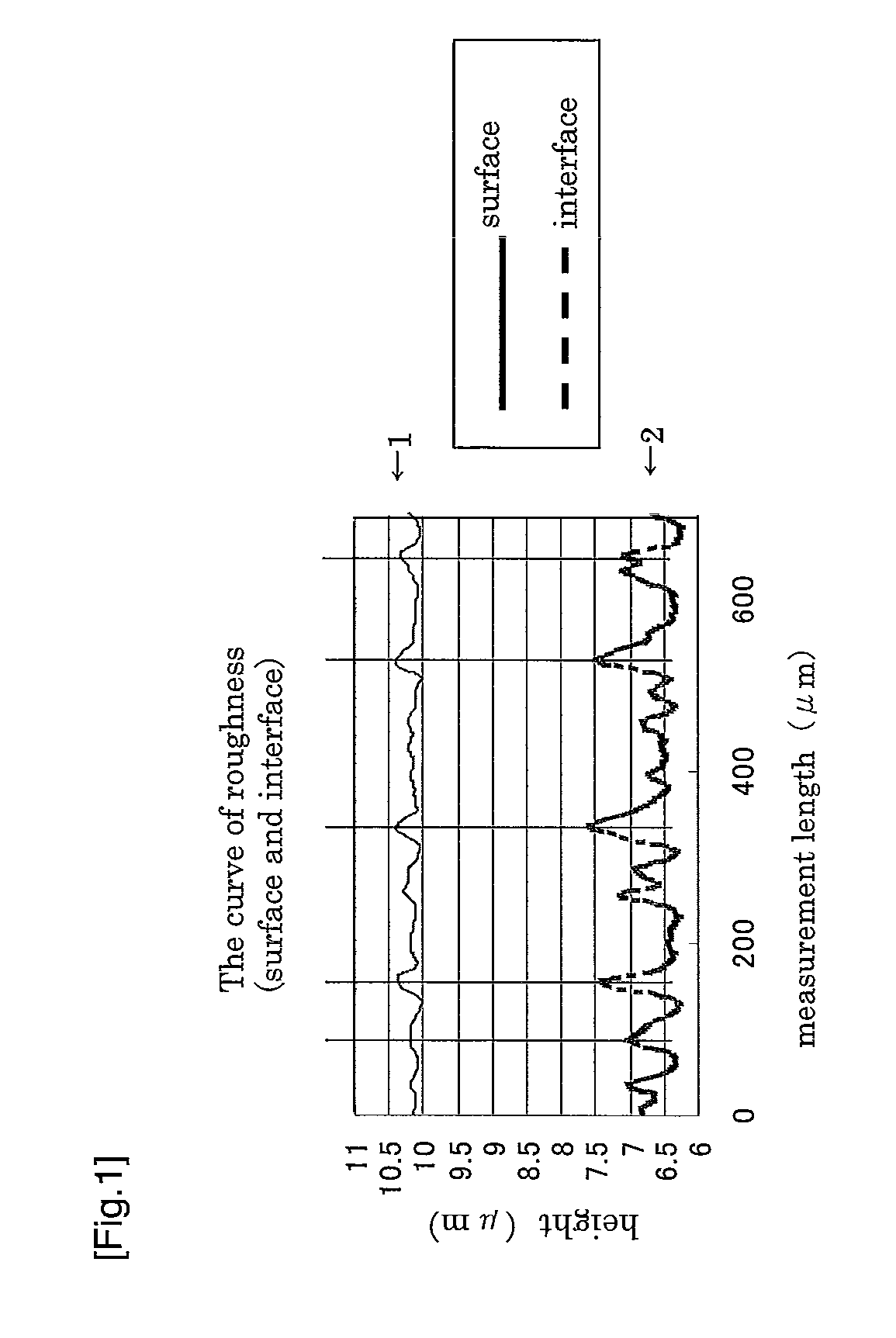
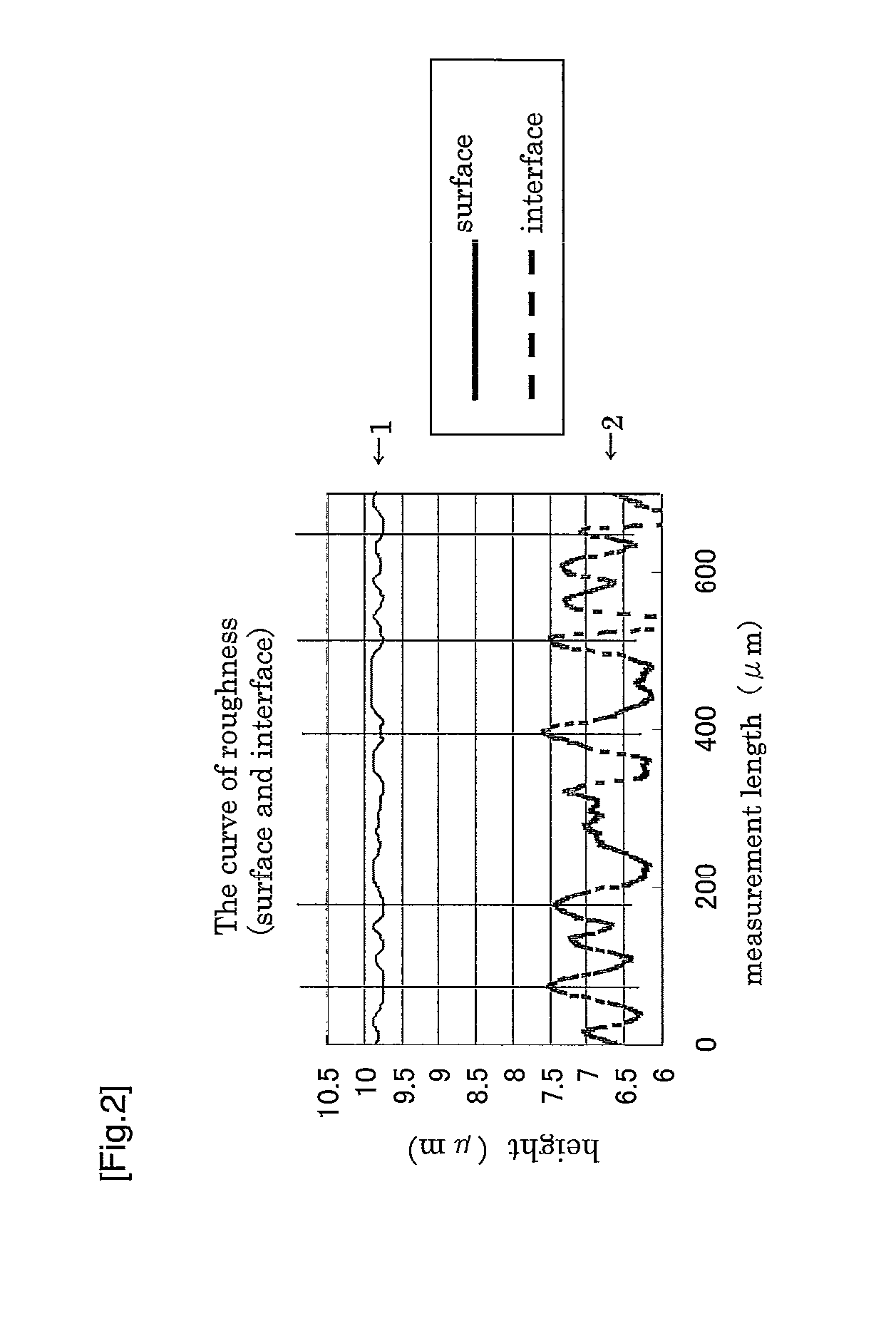
Examples
example 1
[0160]Polyethylene terephthalate (hereinafter referred to as PET, with an intrinsic viscosity of 0.65 dl / g) chips were sufficiently dried under vacuum at 180° C. for 3 hours and then fed to a melt extruder. After the chips were melted at 285° C., the melt was extruded into a sheet through a T-shaped die. The sheet was cooled and solidified on a rotating mirror-surface casting drum with a surface temperature of 20° C. by static electricity-applying casting method so that an unstretched sheet was prepared. The resulting unstretched sheet was continuously stretched in the longitudinal direction. In the longitudinal stretching process, the sheet was first preheated at 75° C. with a group of sequentially arranged rolls and then heated with a roll at 95° C. and stretched 3.5 times, while the film surface was heated with a radiation heater. The drum surface side of the film had a refractive index of 1.645 and a crystallinity of 19% as measured by Raman method. The hard coat layer-forming c...
examples 2 and 3
[0165]Hard-coated films were prepared using the process of Example 1, except that the hard coat layer-forming coating composition H-2 (Example 2) or H-4 (Example 3) was used instead. In the hard-coated films, Sa and Sku of the hard coat surface was 18 nm and 1.6 (Example 2), respectively, and 56 nm and 1.9 (Example 3), respectively. Example 2 was slightly inferior in surface hardness and interference iris pattern but sufficiently free from practical problems. These films were used to form antireflection films in the same manner as in Example 1. As shown in Table 2, the antireflection films had properties sufficiently practical in terms of coloration irregularity, clear view properties, and suppressing of screen glittering and reflection.
[0166]The hard-coated film of Example 3 was used to form antireflection films B and C. As shown in Table 2, the antireflection films were slightly reduced in the reflection-suppressing effect but practically free from problems.
example 9
[0176]A hard-coated film was prepared using the process of Example 1, except that the PET chips were replaced with PET (with an intrinsic viscosity of 0.63 dl / g) chips containing 0.8 wt % of Cyasorb (registered trademark) 3638 (manufactured by Cytec Industries Inc.) as an ultraviolet ray-absorbing agent. As shown in Table 1, the hard-coated film had satisfactory Sa and Sku of the hard coat surface and also had a transmittance of 2.6% at a wavelength of 380 nm. The hard-coated film was used to form an antireflection film A in the same manner as in Example 1. As shown in Table 2, all the characteristics of the antireflection film reached a practical level, and the antireflection film had the effect of blocking ultraviolet rays.
[0177]
TABLE 1RelationshipbetweenPresencePresence orPresence orsurface / interfaceHeator absenceabsence ofabsence ofirregularitiesInter-shrinkageAbra-ofinterfacesurfaceProjections / Surfacefaceratio atsioninter-irregularitiesirregularitiesdepressions: ASaSa150° C. fo...
PUM
| Property | Measurement | Unit |
|---|---|---|
| heat shrinkage ratio | aaaaa | aaaaa |
| surface height distribution | aaaaa | aaaaa |
| surface height distribution | aaaaa | aaaaa |
Abstract
Description
Claims
Application Information
 Login to View More