Adaptive OFDM synchronization method using quadratic search step sizes

US9419840B1Active Publication Date: 2016-08-16THE UNITED STATES OF AMERICA AS REPRESENTED BY THE SECRETARY OF THE NAVY
7 Cites 4 Cited by

Patent Information

Authority / Receiving Office
US · United States
Current Assignee / Owner
Publication Date
2016-08-16

Smart Images

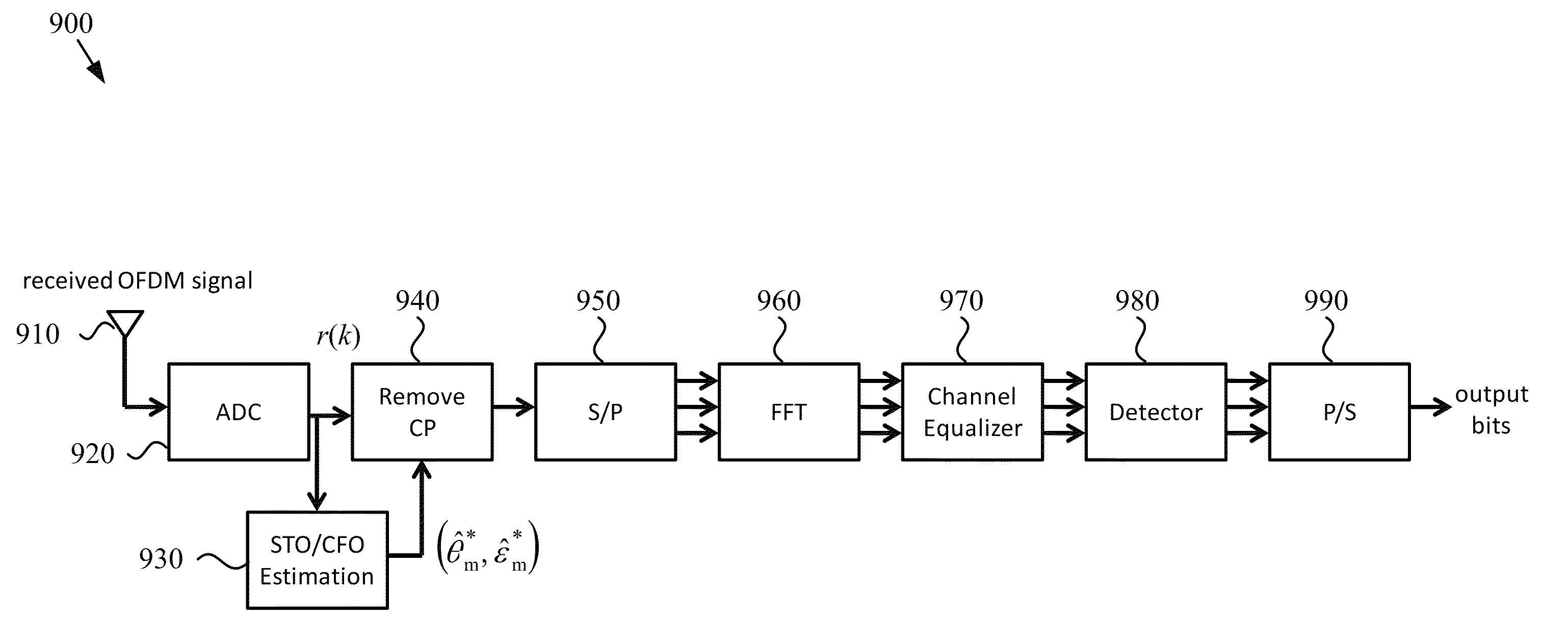
  • Figure 1
    Figure 1
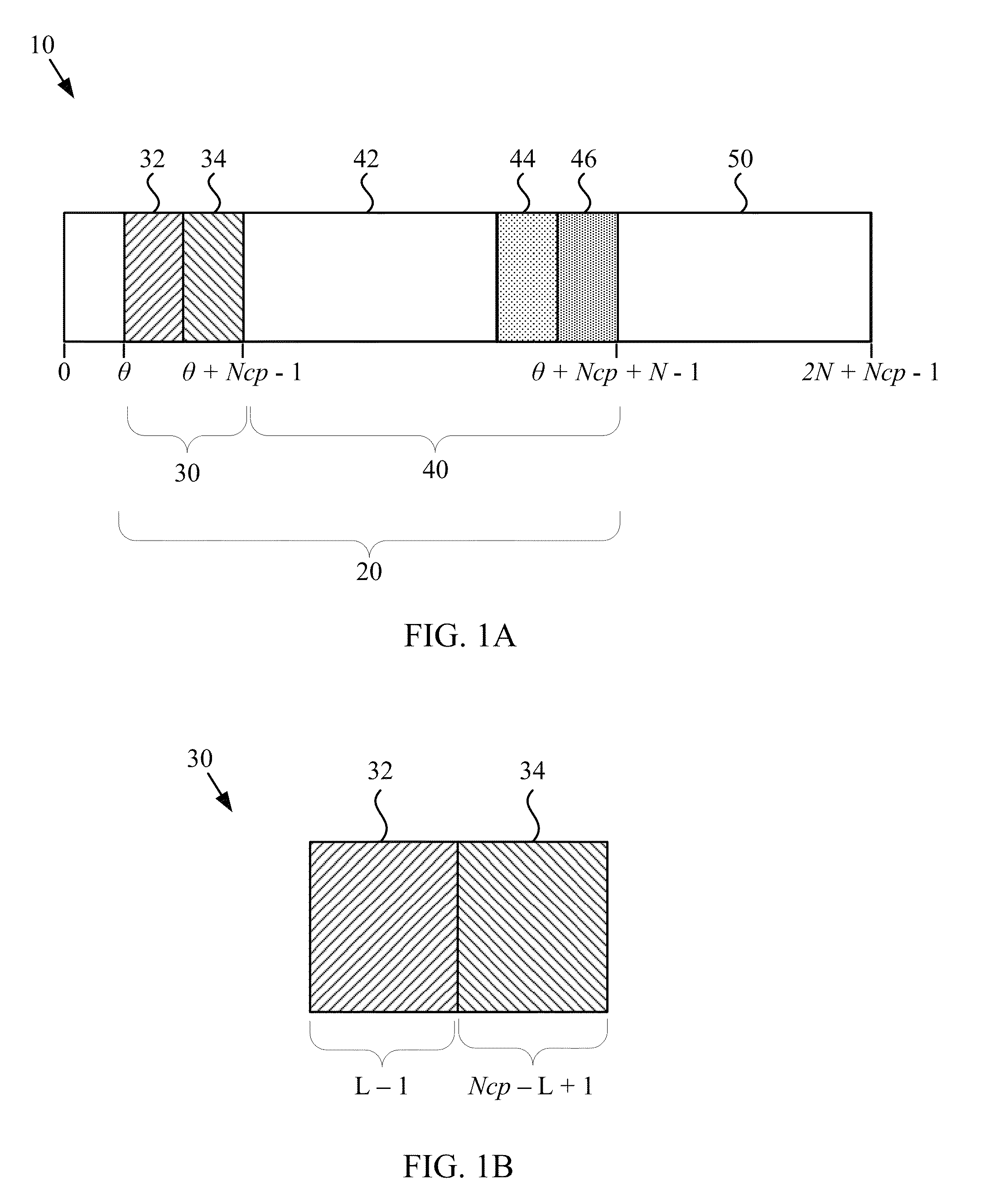
  • Figure 2
    Figure 2
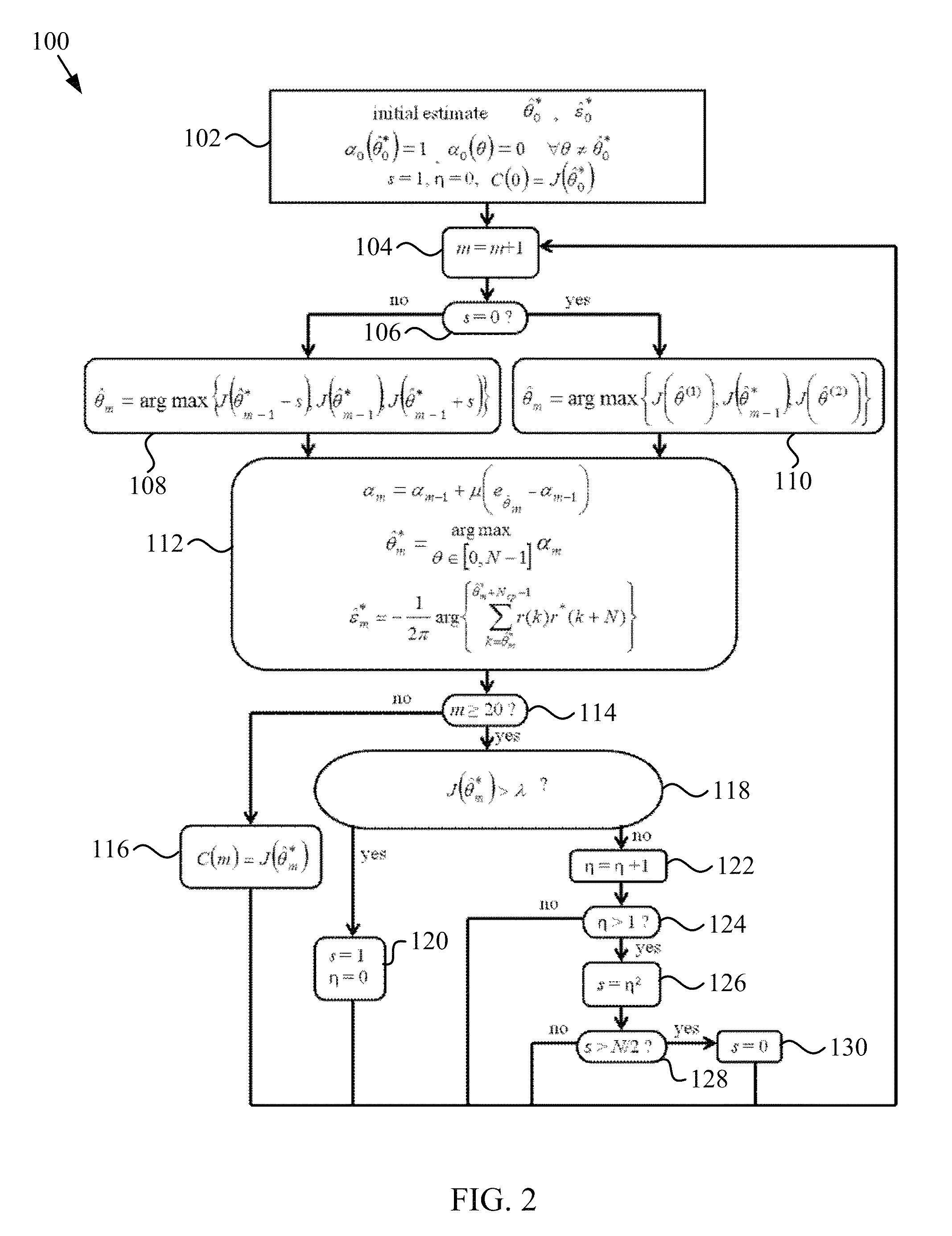
  • Figure 3
    Figure 3
Patent Text Reader

Abstract

A system and method involve receiving a plurality of samples of at least one orthogonal frequency division multiplex (OFDM) signal, the samples containing at least one complete OFDM symbol including data samples and a cyclic prefix, using an initial symbol timing offset (STO) estimate to initialize an N×1 vector of occupation probabilities α, where Nis the number of sub-carriers of the OFDM signal, and, for each subsequent set m of OFDM samples received containing at least one complete OFDM symbol, determining a STO estimate from a set of candidate STO estimates, updating the vector of occupation probabilities α, and determining a final STO estimate. The final STO estimate is used to determine a carrier frequency offset and may be determined using the STO estimate with the highest occupation probability.
Need to check novelty before this filing date? Find Prior Art

Description

CROSS-REFERENCE TO RELATED APPLICATIONS

[0001] This application is a continuation-in-part of U.S. Non-Provisional patent application Ser. No. 14 / 091,048 filed Nov. 26, 2013, entitled “Non-Data-Aided Joint Time and Frequency Offset Estimate Method for OFDM Systems Using Channel Order Based Regression”, the content of which is fully incorporated by reference herein.FEDERALLY-SPONSORED RESEARCH AND DEVELOPMENT

[0002] The Adaptive OFDM Synchronization Method Using Quadratic Search Step Sizes is assigned to the United States Government and is available for licensing for commercial purposes. Licensing and technical inquiries may be directed to the Office of Research and Technical Applications, Space and Naval Warfare Systems Center, Pacific, Code 72120, San Diego, Calif., 92152; voice (619) 553-5118; email ssc_pac_T2@navy.mil; reference Navy Case Number 102677.BACKGROUND

[0003] Orthogonal frequency division multiplexing (OFDM) is a prevalent multicarrier modulation method that has been adopted ...

Examples

Embodiment Construction

[0017]The subject matter disclosed herein involves a blind, real-time, low complexity, and adaptive synchronization method for OFDM systems. The embodiments of the method utilize a quadratically increasing search step size to track large changes in symbol time offset (STO), and a joint estimate of the STO and carrier frequency offset (CFO) is produced as each symbol is received, resulting in better tracking accuracy in terms of mean squared error (MSE) than existing adaptive and non-adaptive algorithms. The disclosed embodiments also achieve more robust tracking with quicker convergence times than existing adaptive algorithms.

[0018]In general, the low-pass frequency-selective channel model is given by

[0019]h⁡(t)=∑l=0L-1⁢hl⁢δ⁡(t-lTs)(Eq.⁢1)

where L is the order of the channel, hl is the complex amplitude of the l-th multipath arrival, and Ts is the sampling period. The channel is assumed to stay unchanged over the duration of a couple of OFDM symbols. The transmitted OFDM symbol s(n) ...