
Method for preparing syndiotactic poly1,2-butadiene thermoplastic elastomer
A thermoplastic elastomer, butadiene technology, applied in the field of syndiotactic polymerization, can solve problems such as peroxide vulcanization
Patent Information
- Authority / Receiving Office
- CN · China
- Current Assignee / Owner
- Publication Date
- 2010-06-16
Smart Images

Figure 1 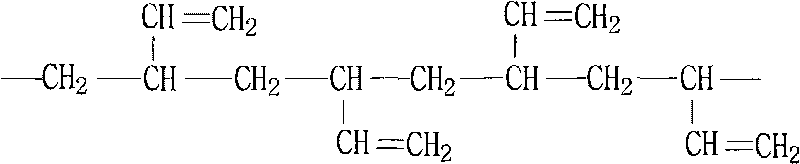
Figure 2 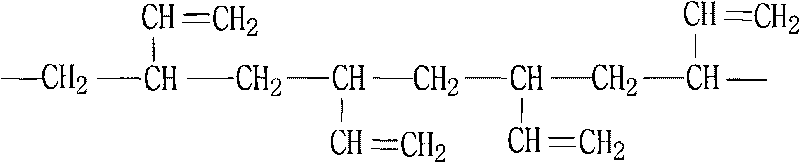
Figure 3
Abstract
Description
technical field
[0001] The invention relates to a preparation method of syndiotactic poly-1,2-butadiene thermoplastic elastomer. Background technique
[0002] The 1,3-butadiene monomer undergoes addition polymerization with 1,2-configuration units under the action of different catalysts, and high polymers with the following configurations can be obtained.
[0003] Isotactic:
[0004]
[0005] Syndiotactic:
[0006]
[0007] Atactic:
[0008]
[0009] Among them, random poly-1,2-butadiene is rubbery at room temperature, and was industrialized in the 1980s using lithium-based catalysts. Isotactic 1,2-polybutadiene has so far not been satisfactorily synthesized. Syndiotactic poly-1,2-butadiene is mainly prepared by a catalyst composed of Ti, Mo, Co, Cr, Fe and other metal element compounds and aluminum compounds.
[0010] In the 1970s, people carried out in-depth research on the synthesis catalyst and application of syndiotactic (or syndiotactic) poly-1,2-butadien...
Examples
Embodiment 1~6
[0033]The synthetic rubber added in embodiment 1 and 6 is Buna-CB24 neodymium system butadiene rubber, and the added amount is 0.3g, 75g; the added synthetic rubber in embodiment 2, 3 is high vinyl polybutadiene rubber, and the added amount is 5g . Other conditions are as follows: Add dry synthetic rubber into a 5L stainless steel kettle, replace the reactor with nitrogen with a purity of 99.99% for 5 times, then add 2500ml of dry hexane solvent oil, start stirring and heat up to 90°C, wait for the added After the micelle is completely converted into a uniform glue solution (about 24 hours), the temperature of the reactor is lowered to room temperature, and 455ml (300g) of 1,3-butadiene monomer is added thereto, and the temperature is raised to 70° C. of polymerization initiation temperature, and then Add 0.56mmol of iron isooctanoate, (3.00mmol of triisobutylaluminum+7.00mmol of triethylaluminum) and 1.67mmol of diethyl phosphite in sequence, and at the same time, use N 2 Ma...
Embodiment 7~12
[0038] In Examples 7 to 9, the order of catalyst addition is iron isooctanoate, diethyl phosphite, (triisobutylaluminum+triethylaluminum); triisobutylaluminum, iron isooctanoate, triethylaluminum, Diethyl phosphite; Triethylaluminum, iron isooctanoate, triisobutylaluminum, diethyl phosphite, other conditions are the same as in Example 4, and the main properties are shown in Table 3.
[0039] In Examples 10 to 12, the amount of catalyst added is 0.56 mmol of iron naphthenate, (2.00 mmol of triisobutylaluminum+8.00 mmol of triethylaluminum), 1.67 mmol of diethyl phosphite; 0.56 mmol of iron isooctanoate, ( Triisobutylaluminum 3.00mmol+triethylaluminum 7.00mmol), diethyl phosphite 2.24mmol; iron isooctanoate 0.56mmol, (triisobutylaluminum 5.00mmol+triethylaluminum 5.00mmol), diethyl phosphite 1.67mmol, other conditions are the same as in Example 4, and the main properties are shown in Table 3.
[0040] table 3
[0041]
[0042]
Embodiment 13
[0044] The amount of catalyst added is 0.84mmol of iron isooctanoate, 2.50mmol of diethyl phosphite, (7.50mmol of triisobutylaluminum+17.50mmol of triethylaluminum), and other conditions are the same as in Example 6. The obtained polymer was rubber with a yield of 85% and no crystalline melting peak.