
Nickel-bismuth hybridized nanowire and preparation method thereof
A nanowire and hybridization technology, which is applied in the direction of nanostructure manufacturing, nanotechnology, nanotechnology, etc., can solve the problems of demanding operability, complicated preparation process, and low gas sensitivity, and is suitable for large-scale industrial production , easy-to-implement effects
Patent Information
- Authority / Receiving Office
- CN · China
- Patent Type
- Patents(China)
- Current Assignee / Owner
- Publication Date
- 2013-04-03
- Estimated Expiration
- Not applicable · inactive patent
Smart Images
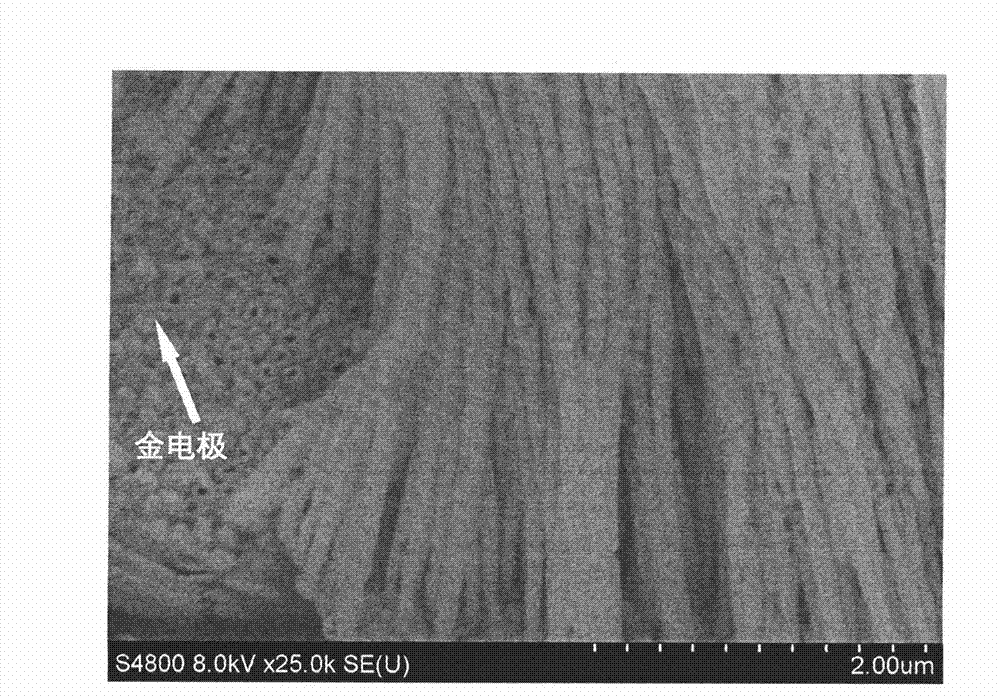
Figure 1 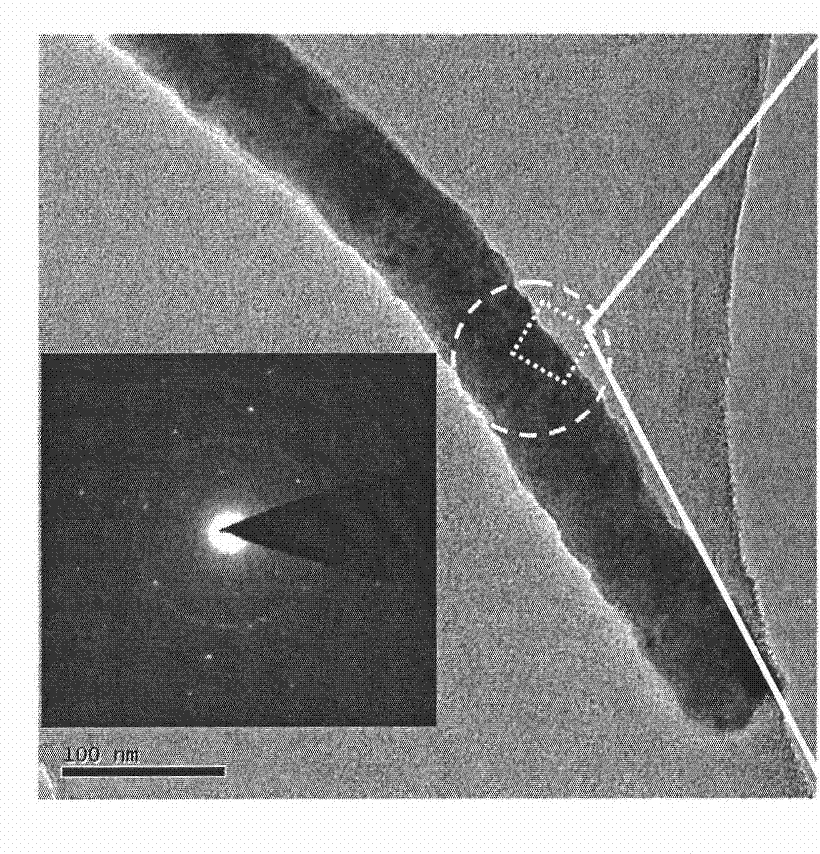
Figure 2 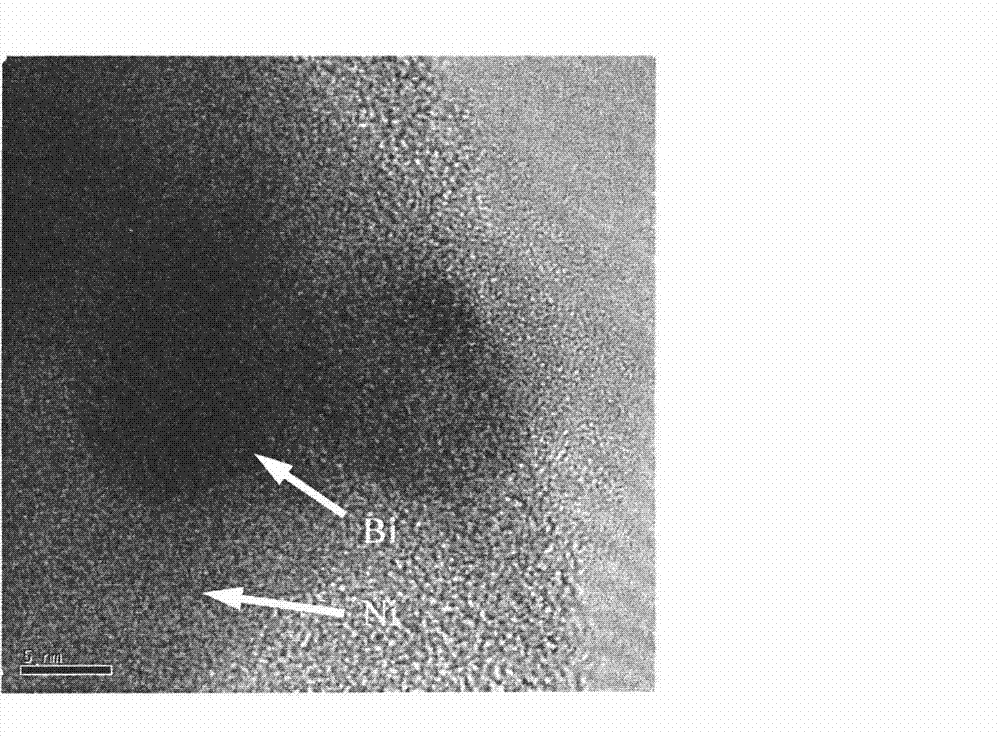
Figure 3
Abstract
Description
technical field
[0001] The invention relates to a hybrid nanowire and a preparation method thereof, in particular to a hybrid nanowire composed of semimetal bismuth and magnetic metal nickel and a preparation method thereof. Background technique
[0002] There are many common materials for preparing one-dimensional nanowires, such as semiconductor materials cadmium sulfide (CdS), zinc oxide (ZnO), single crystal silicon (Si), metal materials gold (Au), silver (Ag), copper (Cu) , nickel (Ni), etc., semi-metallic materials bismuth (Bi), antimony (Sb), and a wide variety of organic materials. At the same time, alloy nanowires with metallic properties composed of two or more metals or nonmetals have also been reported. For example, the American "Chemical Materials" magazine in 2003 reported an ordered nickel and copper alloy nanowire (Ordered Ni-Cu Nanowire Array with Enhanced Coercivity, Chem. Mater. 2003, 15, 664-667), the nanowire It is synthesized in an alumina template by...
Examples
Embodiment 1
[0056] Preparation of nickel and bismuth hybrid nanowires:
[0057] 1) Anodize the aluminum sheet, first place the aluminum sheet in a sulfuric acid solution with a concentration of 0.3M, anodize for 12 hours at a DC voltage of 10V, and then soak the aluminum sheet in a mixed solution at a temperature of 50°C for 8 hour, obtain the aluminum flake after anodic oxidation for the first time; Described mixed solution is that 4wt% phosphoric acid and 1.6wt% chromic acid mix by concentration;
[0058] 2) Anodizing for the second time, repeating the anodizing process of step 1) for the aluminum sheet obtained in step 1), and carrying out anodizing for the second time on the aluminum sheet;
[0059] 3) the aluminum flake obtained after step 2) is oxidized, first remove the unoxidized aluminum on the back side with a supersaturated tin tetrachloride solution, and then use a phosphoric acid solution with a concentration of 3wt% to corrode the aluminum oxide barrier layer at the bottom o...
Embodiment 2
[0064] Preparation of Nickel and Bismuth Hybrid Nanowires
[0065] 1) Anodize the aluminum sheet, first place the aluminum sheet in an oxalic acid solution with a concentration of 0.3M, anodize for 6 hours at a DC voltage of 40V, and then soak the aluminum sheet in a mixed solution with a temperature of 55°C for 8 hour, obtain the aluminum sheet after anodic oxidation for the first time; Described mixed solution is that concentration is that 5wt% phosphoric acid and concentration are that 1.7wt% chromic acid mixes;
[0066] 2) Anodizing for the second time, repeating the anodizing process of step 1) for the aluminum sheet obtained in step 1), and carrying out anodizing for the second time on the aluminum sheet;
[0067] 3) The aluminum sheet obtained after step 2) is oxidized, first remove the unoxidized aluminum on the back side with a supersaturated tin tetrachloride solution, and then use a phosphoric acid solution with a concentration of 3.5 wt% to corrode the aluminum oxi...
Embodiment 3
[0072] Preparation of Nickel and Bismuth Hybrid Nanowires
[0073] 1) Aluminum sheet anodizing, first place the aluminum sheet in oxalic acid solution with a concentration of 0.3M, anodize for 4 hours at a DC voltage of 50V, and then soak the aluminum sheet in a mixed solution with a temperature of 60°C for 10 hour, obtain the aluminum sheet after anodic oxidation for the first time; Described mixed solution is that concentration is that 5.5wt% phosphoric acid and concentration are that 1.8wt% chromic acid mixes;
[0074] 2) Anodizing for the second time, repeating the anodizing process of step 1) for the aluminum sheet obtained in step 1), and carrying out anodizing for the second time on the aluminum sheet;
[0075] 3) With the aluminum sheet obtained after oxidation in step 2), first remove the unoxidized aluminum on the back side with a supersaturated tin tetrachloride solution, and then use a phosphoric acid solution with a concentration of 4.5 wt% to corrode the aluminum...