
Preparation method of 3-(2-pyridine amino) ethyl propionate
A kind of technology of ethyl propionate and pyridyl amino, applied in the field of preparation of ethyl 3-propionate, can solve problems such as long synthesis steps, high production cost, complicated operation, etc., achieves short synthesis steps, low production cost and simple operation Effect
Patent Information
- Authority / Receiving Office
- CN · China
- Patent Type
- Applications(China)
- Current Assignee / Owner
- Publication Date
- 2013-06-12
- Estimated Expiration
- Not applicable · inactive patent
Smart Images
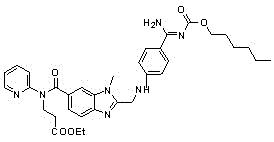
Figure 1 
Figure 2
Abstract
Description
technical field
[0001] The invention relates to a preparation method of ethyl 3-(2-pyridylamino)propionate. Background technique
[0002] 3-(Pyridin-2-ylamino) ethyl propionate is one of the important intermediates in the synthesis of direct thrombin inhibitor dabigatran etexilate (trade name: Pradaxa). Dabigatran etexilate is the first new class of oral anticoagulant drugs marketed 50 years after warfarin. Compared with warfarin, dabigatran etexilate has the characteristics of oral administration, rapid onset of action, no need for special drug monitoring, and less drug interaction. In vivo, in vitro tests and clinical studies have shown that it has good curative effect and pharmacokinetics. It has good clinical application prospect. Schematic diagram of the structure such as figure 1 The listing of dabigatran etexilate as shown is a major progress in the field of anticoagulant therapy and the prevention of potentially fatal thrombosis, which is of milestone significance...
Examples
Embodiment 1
[0028] A kind of preparation method of 3-(2-pyridine amino) propionate ethyl ester, promptly take 2-aminopyridine and ethyl acrylate as raw material, under the condition of solvent-free, take p-toluenesulfonic acid as catalyst, control temperature is 100 Reaction at ℃ for 24h, the reaction to obtain ethyl 3-(2-pyridylamino)propionate, the specific steps are as follows:
[0029] Add 2-aminopyridine (0.47g, 5mmol) and ethyl acrylate (1.0g, 10mmol) in a 25mL round bottom flask or a 15mL sealed tube, and add p-toluenesulfonic acid (0.5mmol, 10mol%) ) as a catalyst, and the temperature was controlled to react at 100°C for 24h. The resulting reaction solution is concentrated under reduced pressure at a temperature of 40-45°C and a pressure of 0.09-0.1 MPa, and the concentrated solution is passed through a silica gel column or an aluminum oxide column with a ratio of petroleum ether:ethyl acetate of 8:1 to 5 After the eluent at 1:1 was subjected to column chromatography, the eluent ...
Embodiment 2
[0034] A preparation method of ethyl 3-(2-pyridineamino) propionate, which is to use 2-aminopyridine and ethyl acrylate as raw materials, under solvent-free conditions, use nitric acid as a catalyst, and react at a controlled temperature of 100°C 24h obtains 3-(2-pyridylamino) ethyl propionate, and concrete steps are as follows:
[0035] Add 2-aminopyridine (0.47g, 5mmol) and ethyl acrylate (1.0g, 10mmol) into a 25mL round-bottom flask or a 15mL sealed tube, and use nitric acid (0.5mmol, 10mol%) as a catalyst under solvent-free conditions, React at 100°C for 24h. The resulting reaction solution is concentrated under reduced pressure at a temperature of 40-45°C and a pressure of 0.09-0.1 MPa, and the concentrated solution is passed through a silica gel column or an aluminum oxide column with a ratio of petroleum ether:ethyl acetate of 8:1 to 5 After the eluent of 1:1 was subjected to column chromatography, the eluent of 5:1 was collected, and the white solid obtained by spinni...
Embodiment 3
[0037] A kind of preparation method of 3-(2-pyridineamino) propionate ethyl ester, promptly take 2-aminopyridine and ethyl acrylate as raw material, under the condition of solvent in ethanol, take p-toluenesulfonic acid as catalyzer, control temperature is Reaction at 100°C for 24h to obtain ethyl 3-(2-pyridylamino)propionate, the specific steps are as follows:
[0038]2-Aminopyridine (0.47g, 5mmol) and ethyl acrylate (1.0g, 10mmol) were added to a 25mL round-bottomed flask or a 15mL sealed tube, and under the condition of ethanol (1mL) as a solvent, p-toluenesulfonic acid ( 0.5mmol, 10mol%) as the catalyst, the reaction temperature is controlled at 100°C for 24 hours respectively, and the obtained reaction liquid is concentrated under reduced pressure at a temperature of 40-45°C and a pressure of 0.09-0.1MPa, and the concentrated liquid is passed through a silica gel column Or aluminum oxide column is equipped with petroleum ether: the eluent of ethyl acetate ratio is 8:1 to ...