
Paeonia lactiflora 4-diphosphocytidyl-2-C-methyl-D-erythritol kinase (PLIspE) gene, and coded product and application thereof
A technology of cytidine diphosphate and methylerythromycin is applied in the field of biosynthesis of organic acids with pharmacologically active components to achieve the effect of increasing the content of terpenoids
Patent Information
- Authority / Receiving Office
- CN · China
- Patent Type
- Applications(China)
- Current Assignee / Owner
- Publication Date
- 2014-02-12
- Estimated Expiration
- Not applicable · inactive patent
Smart Images

Figure 1 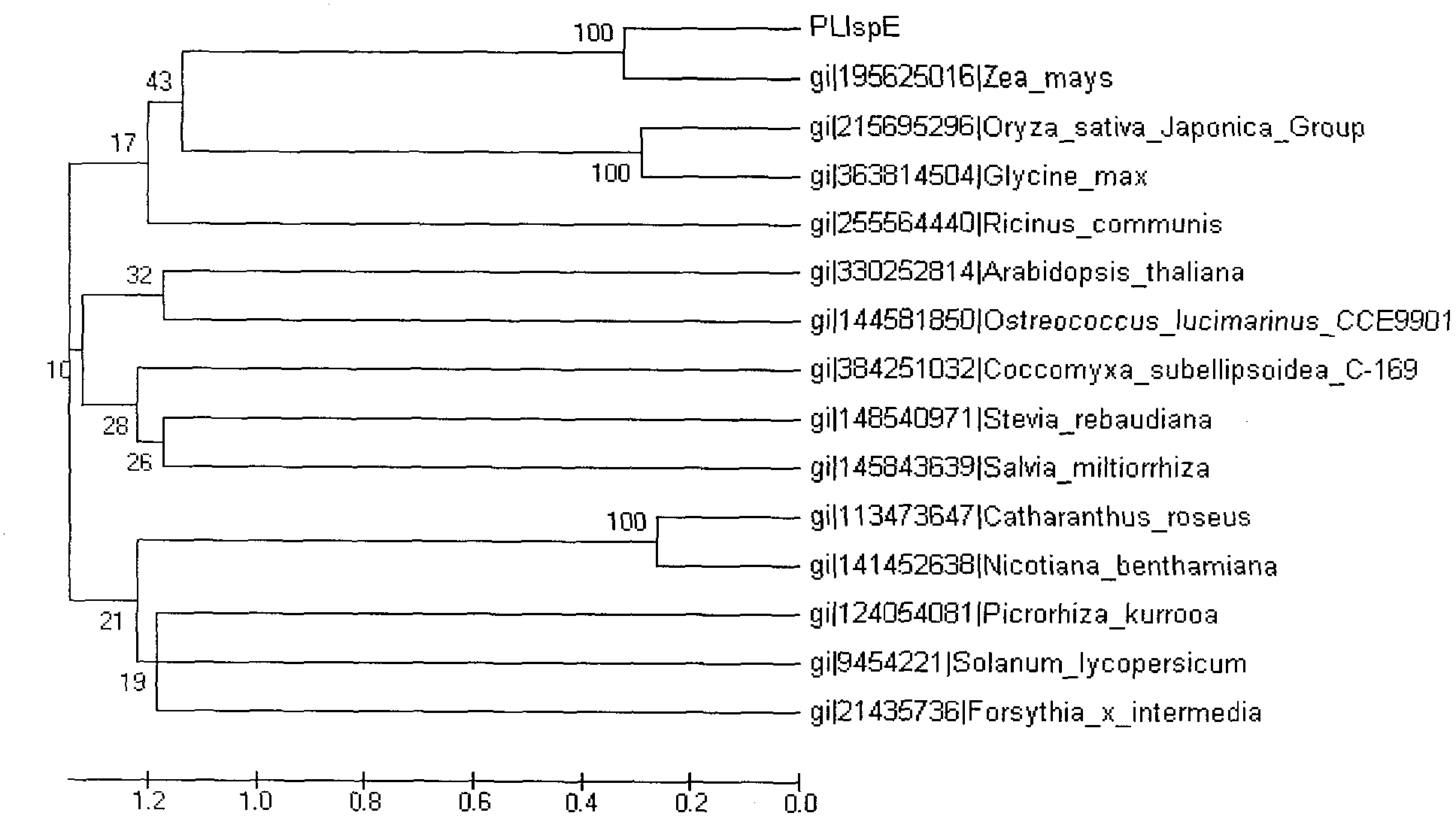
Figure 2 
Figure 3
Abstract
Description
technical field
[0001] The invention belongs to the field of biotechnology, and mainly relates to cloning 4-diphosphate cytidine-2-C-methylerythrosekinase gene and its coded product and application by using peony cDNA library, especially relates to the biosynthesis of organic acids with pharmacological active ingredients , terpenoid enzyme gene and its coded product and application, belonging to the field of genetic engineering of medicinal plants. Background technique
[0002] The formation of medicinal plant active ingredients is the product of a unique group of genes in plant secondary metabolic pathways. With the extensive and in-depth study of plant functional genomes, the study of functional genes related to secondary metabolism synthesis of medicinal plants with unique characteristics and broad application prospects has gradually become a research hotspot. It provides a theoretical basis for the biosynthetic pathway and its regulation mechanism and explains the forma...
Examples
Embodiment 1
[0018] Embodiment 1, the construction of peony cDNA library
[0019] 1. Isolation and detection of peony total RNA
[0020] Take 2 g of the root of Paeonia lactiflora, quickly grind it into powder with liquid nitrogen in a mortar, and quickly transfer it to 10 mL of extraction buffer (CTAB (W / V) 2%, Tris-HCl (pH 8 .0)100mmol·L -1 , EDTA25mmol·L -1 , NaCl 2.0mol·L -1 , PVP402%, spermidine 0.5g / L, mercaptoethanol 2%), fully shake and mix; extract twice with equal volume of chloroform, and centrifuge at 7500g for 15 minutes. Add 1 / 4 volume of 10M LiCl to the supernatant, mix well and place it at 4°C to precipitate overnight; centrifuge at 7500g for 20 minutes, and use 500 μL SSTE (SDS 0.5%, NaCl 1mol L -1 , Tris-HCl (pH8.0) 10mmol L -1 , EDTA 1mmol·L -1 , dissolved at 65°C for 5 minutes. Extract with an equal volume of chloroform, centrifuge at 13,000g for 5 minutes; add 2 times the volume of absolute ethanol to the supernatant, and store at -70°C for 2 hours; centrifuge a...
Embodiment 2
[0023] Example 2: Cloning of Paeoniae officinalis-related genes
[0024] Randomly pick 5000 single clones for colony PCR identification. Take an appropriate amount of PCR thin-walled tubes, place them on ice, and add 17.3ul of sterilized water to each tube. Use a sterilized 10ul small tip to pick up the monoclonal white spot into sterilized water, shake and mix. Add in sequence: Taq buffer 2.5μL, MgCl 2 (25mM) 1.8μL, dNTP (2.5mM) 1μL, M13+ primer (10pmol) 1μL, M13-primer (10pmol) 1μL, Taq enzyme 0.4μL. The PCR reaction conditions were 5 minutes of pre-denaturation at 94°C, 40 seconds at 94°C, 40 seconds at 54°C, 4 minutes at 72°C, 35 cycles of extension at 72°C for 10 minutes, and storage at 4°C. After the PCR reaction enters 4°C, remove the PCR thin-walled tube, take 7ul of PCR product and add 3ul of bromofinland for agarose gel electrophoresis, take a picture half an hour later, observe the gel map, and roughly identify the size of the insert fragment and small fragments ...
Embodiment 3
[0025] Embodiment 3, the bioinformatics analysis of PLIspE gene
[0026] The length of the full-length cDNA of the peony 4-diphosphate cytidine-2-C-methylerythrose kinase gene involved in the present invention is 1212bp, and the detailed sequence is shown in sequence 1 in the sequence list, wherein the open reading frame is located at 1-1212bp . The full-length cDNA sequence of Peony was searched for nucleotide homology in Non-redundant GenBank+EMBL+DDBJ+PDB and Non-redundant GenBank CDS translation+PDB+Swissprot+Superdate+PIR databases using BLAST program. The gene has high homology with IspE in other species at the amino acid level, and has a typical 4-diphosphocytidyl-2C-methyl-D-erythritol 2-phosphate synthase (IspE) domain. like figure 1 .