
Two-step preparation method of acrylamide copolymer
An acrylamide copolymer, acrylamide technology, applied in chemical instruments and methods, drilling compositions, etc., can solve the problems of large amount of stabilizer and low use efficiency, and achieve good antioxidant performance and high apparent viscosity. , the effect of good oil displacement effect
Patent Information
- Authority / Receiving Office
- CN · China
- Patent Type
- Applications(China)
- Current Assignee / Owner
- Publication Date
- 2014-05-14
Smart Images
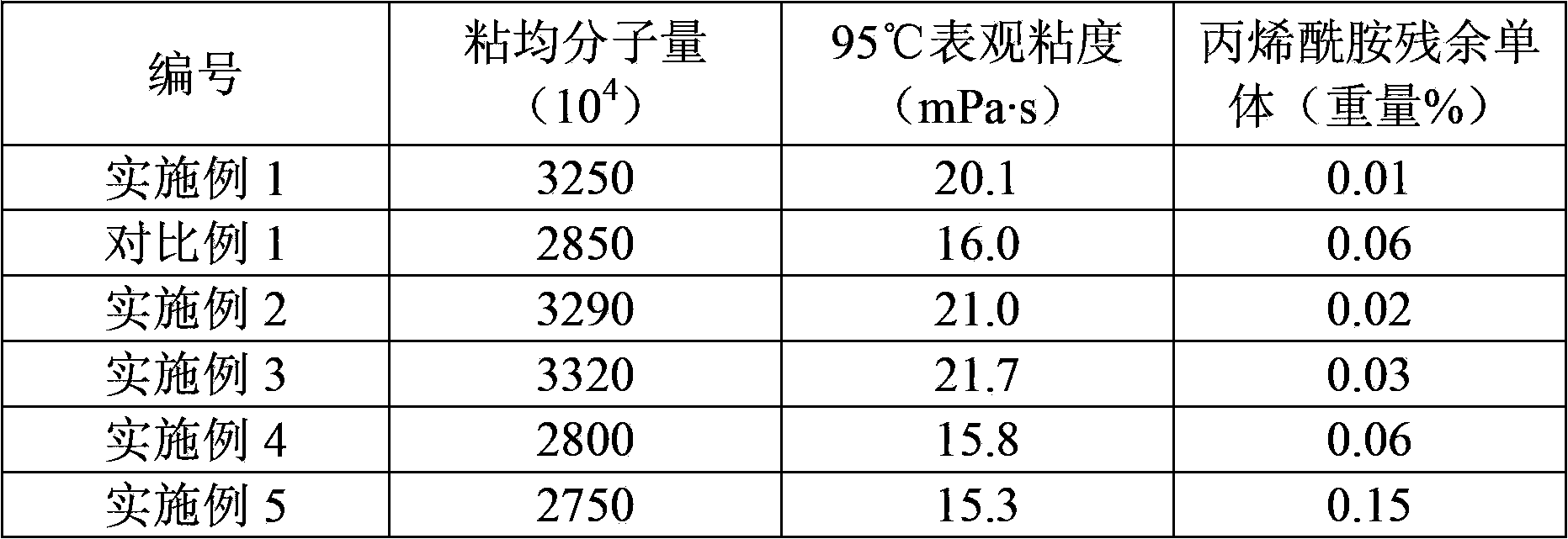
Figure 1 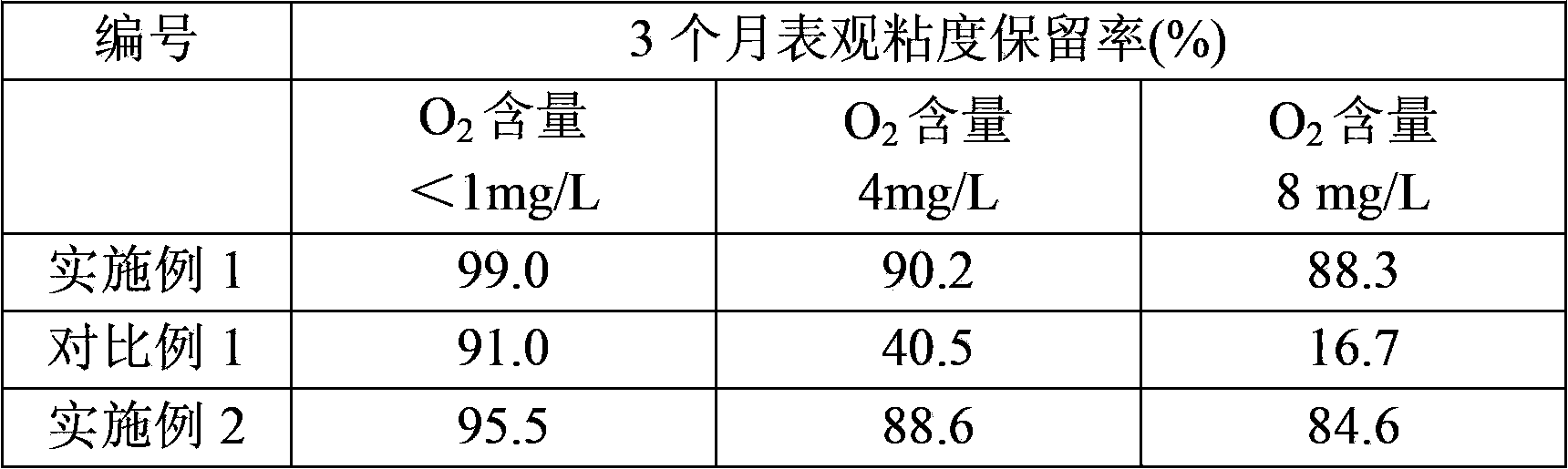
Figure 2 
Figure 3
Abstract
Description
technical field
[0001] The invention relates to a method for preparing an acrylamide copolymer. Background technique
[0002] The development of petroleum engineering and technology requires maximizing the recovery of existing oil fields. As the main polymer oil displacement agent, partially hydrolyzed polyacrylamide (HPAM) has been popularized and applied on a large scale in conventional oil reservoir EOB technology, and has played an important role in stabilizing and increasing oilfield production. With the reduction of reserves in conventional oil reservoirs, the application of HPAM in high-temperature and high-salt reservoirs faces many difficulties, mainly reflected in the combination of high temperature, high salinity and dissolved oxygen conditions in the development of high-temperature and high-salt reservoirs, which makes HPAM The viscosity of the solution is greatly reduced, resulting in insignificant HPAM flooding effect. Studies have shown that when the tempera...
Examples
preparation example Construction
[0048] In a preferred embodiment of the present invention, the preparation method of the acrylamide copolymer comprises the following steps:
[0049] (1) Mix acrylamide, 2-acrylamido-2-methylpropanesulfonic acid and allylthiourea with deionized water to make acrylamide, 2-acrylamido-2-methylpropanesulfonic acid and a solution with a total concentration of allylthiourea of 20 to 30% by weight (that is, the first monomer mixture solution), the temperature of the solution is controlled at -10 to 20°C, and the pH is adjusted to 4 to 12 with an inorganic basic compound (preferably 6-9), to obtain acrylamide, 2-acrylamido-2-methylpropanesulfonate and allylthiourea monomer solution (ie, the second monomer mixture solution);
[0050](2) Pump the monomer solution of acrylamide, 2-acrylamido-2-methylpropanesulfonate and allylthiourea obtained in step (1) into the polymerization kettle, add water-soluble azo initiator and Amine reducing agent, pass high-purity nitrogen to remove oxyge...
Embodiment 1
[0068] This example is used to illustrate the acrylamide copolymer and its preparation method according to the present invention.
[0069] Add 869.56 kg (12.233 kmol) of acrylamide, 1647.86 kg (7.951 kmol) of 2-acrylamido-2-methylpropanesulfonic acid and 23.68 kg (2.038 mol) of allylthiourea into the batching kettle, and 5929 kg of deionized Water, under stirring, control the temperature of the solution with frozen brine to -7°C, and add sodium hydroxide to adjust the pH to 6. Pump the monomer solution into the polymerization tank, add 12.706 grams of water-soluble azo initiator 2,2'-azo(2-amidinopropane) dihydrochloride and reducing agent N,N,N',N' -Tetramethylethylenediamine 12.706 grams, through high-purity nitrogen deoxygenation 0.5h, add 12.706 grams of sodium bisulfite and ammonium persulfate 12.706 grams, continue to pass nitrogen until the thermocouple in the polymerization kettle starts to heat up, and the reaction time is 10 hours to obtain Acrylamide copolymer (ie,...
Embodiment 2
[0073] This example is used to illustrate the acrylamide copolymer and its preparation method according to the present invention.
[0074] Add 1,530 kg of acrylamide, 45.752 kg of 2-acrylamido-2-methylpropanesulfonic acid, 38.477 kg of allyl sulfide, 6,457 kg of deionized water into the batching kettle, and control the temperature of the solution with frozen brine to 15°C under stirring , adding sodium hydroxide to adjust the pH to 9. Pump the monomer solution into the polymerization tank, add 807.11 grams of water-soluble azo initiator 2,2'-azo(2-amidinopropane) dihydrochloride and reducing agent N,N,N',N' -Tetramethylethylenediamine 807.11 grams, through high-purity nitrogen deoxygenation 0.5h, add 807.11 grams of sodium bisulfite and ammonium persulfate 807.11 grams, continue to pass nitrogen until the thermocouple in the polymerization kettle starts to heat up, and the reaction time is 2 hours, to obtain Acrylamide copolymer. Open the ball valve at the bottom of the reac...