
Raman spectral enhancement system and enhancement method based on photonic crystal fiber resonant cavity
A technology of photonic crystal fiber and fiber resonant cavity, which is applied in Raman scattering, material analysis through optical means, measuring devices, etc., can solve the problems of low precision and error, achieve accurate quantitative and qualitative analysis, improve sensitivity, and Raman The effect of spectral signal enhancement
Patent Information
- Authority / Receiving Office
- CN · China
- Patent Type
- Applications(China)
- Current Assignee / Owner
- Publication Date
- 2015-12-23
- Estimated Expiration
- Not applicable · inactive patent
Smart Images
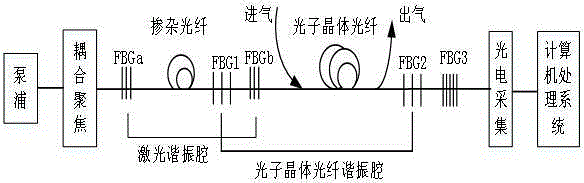
Figure 1 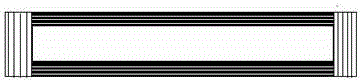
Figure 2
Abstract
Description
technical field
[0001] The invention relates to a Raman spectrum enhancement system and enhancement method based on a photonic crystal fiber resonator, which is used to enhance the Raman spectrum effect of a Raman spectrometer when gas is detected online, thereby improving the sensitivity of the Raman spectrometer and making it Accurate qualitative and quantitative analysis is carried out during the detection process. It belongs to the field of optoelectronic technology. Background technique
[0002] Raman spectroscopy is an analytical technique developed on the basis of the Raman scattering effect. Because its peak area, frequency shift, line width, and number of characteristic peaks are closely related to the structure and concentration of molecules, it has become a qualitative and quantitative method for substances. Analytical as the main tool and widely used. The timeliness and accuracy of Raman online instruments make it widely used in the qualitative and quantitative...
Examples
Embodiment
[0022] see figure 1 , the LD pumping laser diode with a wavelength of 808nm is selected to provide a light source for subsequent Raman detection. The laser frequency conversion part includes: excitation crystal, frequency doubling crystal and conduction fiber. After the light source generates excitation light, the light is focused into the excitation crystal through the focusing lens, and the 532nm green light is obtained through the frequency doubling crystal.
[0023] In order to avoid the center frequency drift of the laser due to temperature changes, the temperature control system is used to control the temperature of the laser diode, excitation crystal and frequency doubling crystal. When the temperature is too high, the cooling plate starts to work, and its temperature is controlled not to exceed a specific range. At the same time, the laser power can be adjusted by adjusting the temperature and angle of the frequency doubling crystal and the excitation crystal.
[0024...