
A kind of preparation method of 2,2'-dinitrobibenzyl
A technology of dinitrobibenzyl and nitrophenyl, which is applied in the field of preparation of intermediates, can solve problems such as increased processing costs, low product purity, and uncontrollable influence, and achieves reduced production costs, good product purity, and avoidance of The effect of high pollution
Patent Information
- Authority / Receiving Office
- CN · China
- Patent Type
- Patents(China)
- Current Assignee / Owner
- Publication Date
- 2018-02-13
Smart Images
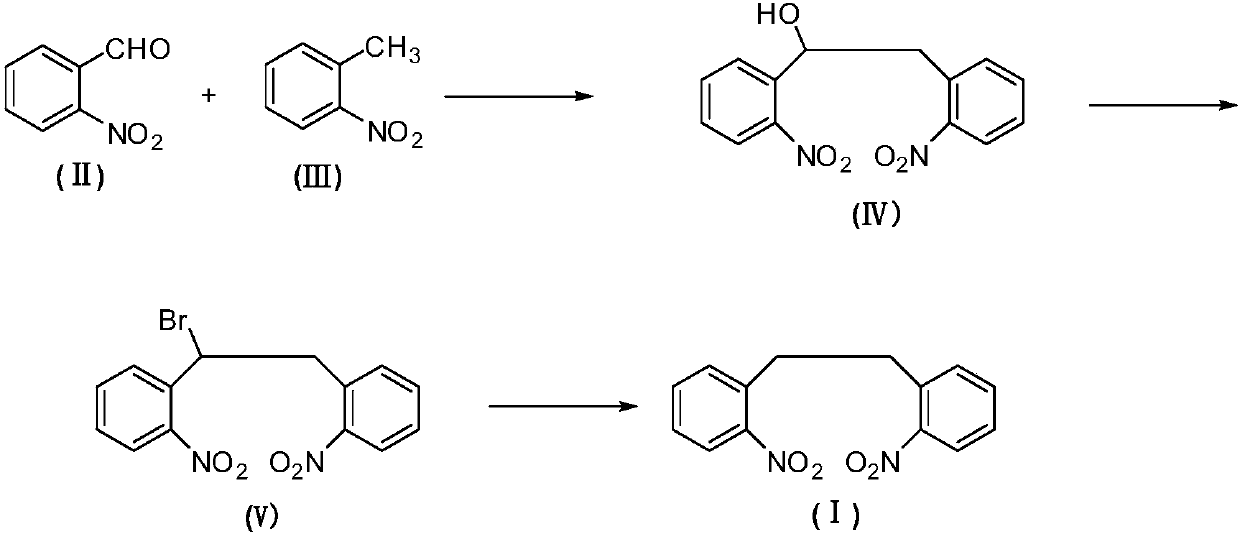
Figure 1 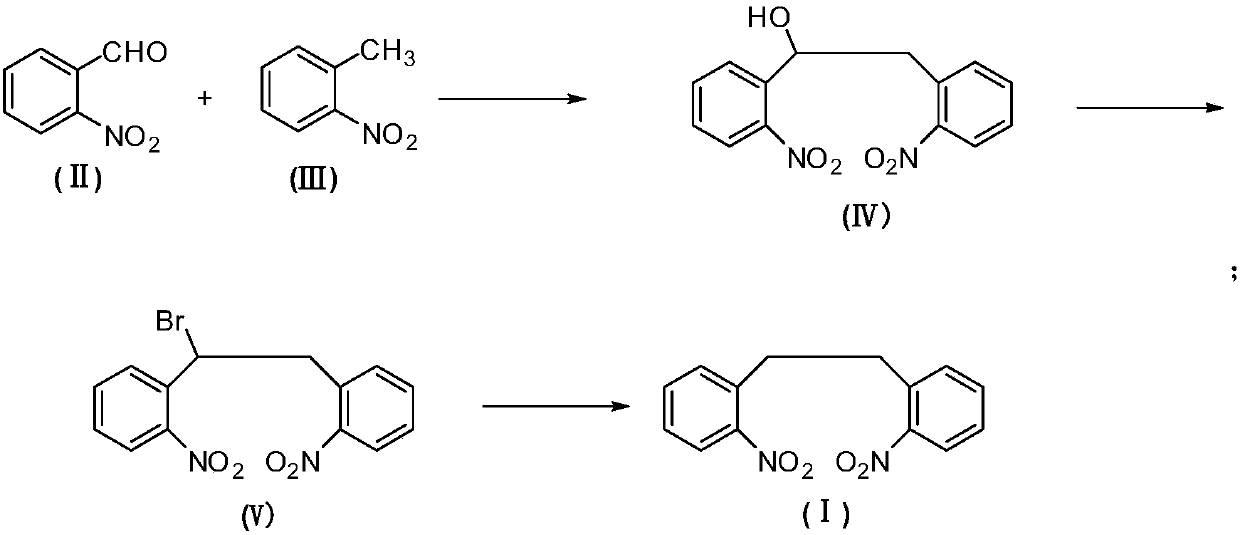
Figure 2
Abstract
Description
technical field
[0001] The invention relates to a method for preparing an intermediate of an antiepileptic drug carbamazepine, in particular to a method for preparing 2,2'-dinitrobibenzyl. Background technique
[0002] According to the results of a joint survey by the Ministry of Health and the China Anti-Epileptic Association, more than 9 million people in my country currently suffer from epilepsy, and among the patients receiving treatment, more than 52% of adult patients and 38% of children have their own " The health status is "unsatisfactory; more than 20% of patients think that epilepsy has seriously affected employment and work; nearly 15% of patients cannot get rid of their inferiority complex; about 25% of children feel that epilepsy has seriously affected their personality. Therefore, the study of antiepileptic drugs is also a hot research direction in this field.
[0003] As a first-line antiepileptic drug, carbamazepine has been widely used in the clinical treatm...
Examples
preparation example Construction
[0025] C. Preparation of 2,2'-dinitrobibenzyl (Ⅰ)
[0026] Add 1,2-bis(2-nitrophenyl)bromoethane (Ⅴ) (351g, 1.0mol) and diethylene glycol dimethyl ether (1400g) into the reactor, after stirring evenly, add boron in batches Sodium hydride (38g, 1.0mol), control the rate of addition to keep the temperature of the reaction mixture no more than 30°C during the addition process, if necessary, use a water bath to cool down, continue to stir and react at room temperature for 2 hours after the addition of sodium borohydride, after the reaction finishes, add The mixture was poured into an appropriate amount of water, and a yellow solid precipitated out, which was collected by filtration and dried to obtain crude 2,2'-dinitrobibenzyl (I), which was recrystallized from methanol (702g) to obtain a light yellow crystalline powder, 2,2 The refined product of '-dinitrobibenzyl (Ⅰ) is 251.7g, and the yield is about 92.5%.
[0027] Melting point: 120-121°C, 1 H-NMR (CDCl 3 ): δ3.09(4H),7.48...
Embodiment 2
[0029] Other steps are the same as in Example 1, except that the preparation method of 1,2-bis(2-nitrophenyl)ethanol (IV) of A step is as follows:
[0030]In the reactor, add o-nitrotoluene (II) (137g, 1.0mol) and dimethyl sulfoxide (280g), then add potassium hydroxide (56g, 1.0mol) and ionic liquid 3-methyl-1-ethane Imidazole trifluoroacetate (13.7g), stir well after addition, cool the mixture to -5-0°C with an ice-salt bath, then add o-nitrobenzaldehyde (Ⅲ) (151g) dropwise at this temperature , 1.0mol). After the dropwise addition, keep stirring and reacting at -5-5°C for 4 hours. After the reaction, naturally rise to room temperature, pour the reaction mixture into ice water, adjust the pH of the mixture to 2-3 with 5% dilute hydrochloric acid, and continue to room temperature. After stirring for 30 minutes, the precipitated yellow solid was collected by filtration. After drying, it was 217.4 g of 1,2-bis(2-nitrophenyl)ethanol (IV), with a yield of about 75.5%.
Embodiment 3
[0032] Other steps are the same as in Example 1, except that the preparation method of 1,2-bis(2-nitrophenyl)ethanol (IV) of A step is as follows:
[0033] In the reactor, add o-nitrotoluene (II) (137g, 1.0mol) and dimethyl sulfoxide (1370g), then add potassium hydroxide (58.8g, 1.05mol) and ionic liquid 3-methyl-1- Ethyl imidazole trifluoroacetate (13.7g), stir evenly after adding, cool the mixture to -5-0°C with an ice-salt bath, then add o-nitrobenzaldehyde (Ⅲ) dropwise at this temperature ( 151 g, 1.0 mol). After the dropwise addition, keep stirring and reacting at -5-5°C for 5 hours. After the reaction, naturally rise to room temperature, pour the reaction mixture into ice water, adjust the pH of the mixture to 2-3 with 5% dilute hydrochloric acid, and continue to room temperature. After stirring for 30 minutes, the precipitated yellow solid was collected by filtration, and after drying, it was 220.1 g of 1,2-bis(2-nitrophenyl)ethanol (IV), with a yield of about 76.4%. ...