
Method for detecting mycotoxin in fermented tea
A technology for mycotoxins and fermented tea, applied in measuring devices, instruments, scientific instruments, etc., can solve the problems of inability to achieve high-throughput detection of mycotoxins, food safety hazards, and pollution of Pu-erh tea.
Patent Information
- Authority / Receiving Office
- CN · China
- Current Assignee / Owner
- Publication Date
- 2017-07-14
Smart Images
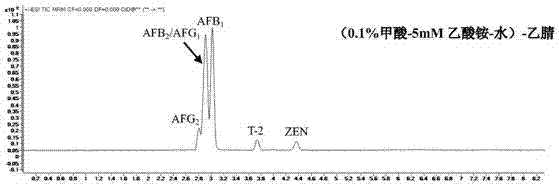
Figure 1 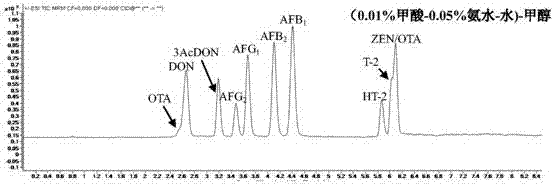
Figure 2 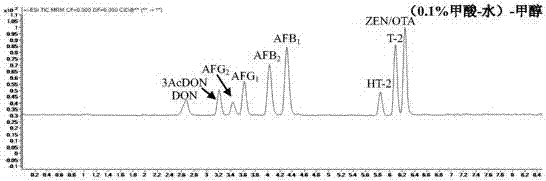
Figure 3
Abstract
Description
[0001]
Technical field
[0002] The invention relates to a method for detecting mycotoxins, in particular to a method for detecting mycotoxins in fermented tea.
[0003]
Background technique
[0004] Pu-erh tea is a popular tea variety among dark teas. In the production process of Pu-erh tea, there is a special process called "wort pile", which is the most critical step in forming the quality characteristics of Pu-erh tea. In this process, microorganisms develop play an important role. This process is carried out by natural inoculation of microorganisms in the environment or artificial addition of dominant strains to the tea piles. Studies have confirmed that the microorganisms in the stacking fermentation of Pu'er tea are mainly: Aspergillus niger, Aspergillus clavus, Aspergillus and yeast, etc. These microorganisms have two main functions in the stacking fermentation process of Pu'er tea: ①Formation of Pu'er tea The quality characteristics of tea are good, sweet and smo...
Examples
Embodiment Construction
[0050] 1. Experimental materials and methods
[0051] (1) Instruments, reagents and materials
[0052] 1290 / 6460 ultra-high performance liquid chromatography-triple quadrupole tandem mass spectrometer (UPLC-MS / MS); high-speed refrigerated centrifuge; MILLI-Q pure water machine; Mycospin400 purification column, salting-out agent (containing 4g magnesium sulfate, 1g Sodium chloride, 1g trisodium citrate and dihydrate crystalline salt and 0.5g disodium hydrogen citrate plus a hemihydrate crystalline salt), purification tube A (containing 400.1mgPSA, 400.1mgC18, 45.0mgBulkCarbogragh, 1199.8mg magnesium sulfate), Purification tube B (containing 149.9mgPSA, 900.1mg magnesium sulfate), purification tube C (containing 147.7mgPSA, 15.1mgBulkCarbogragh, 887.2mg magnesium sulfate).
[0053] Toxin Standard: Aflatoxin B 1 (AFB 1 , 1162-65-8), aflatoxin B 2 (AFB 2 , 7220-81-7), aflatoxin G 1 (AFG 1 , 1165-39-5), aflatoxin G 2 (AFG 2 , 7241-98-7), deoxynivalenol (DON, 51481-10-8), 3...