
Primer, fluorescent probes and method for detecting target nucleic acid sequence
A target nucleic acid sequence and fluorescent probe technology, applied in the field of genetic engineering, can solve the problems of interference superposition, high fluorescent background, and affecting the interpretation of melting curves, and achieve the effect of reducing the background background and clear interpretation
Patent Information
- Authority / Receiving Office
- CN · China
- Patent Type
- Applications(China)
- Current Assignee / Owner
- Publication Date
- 2018-08-03
- Estimated Expiration
- Not applicable · inactive patent
Smart Images
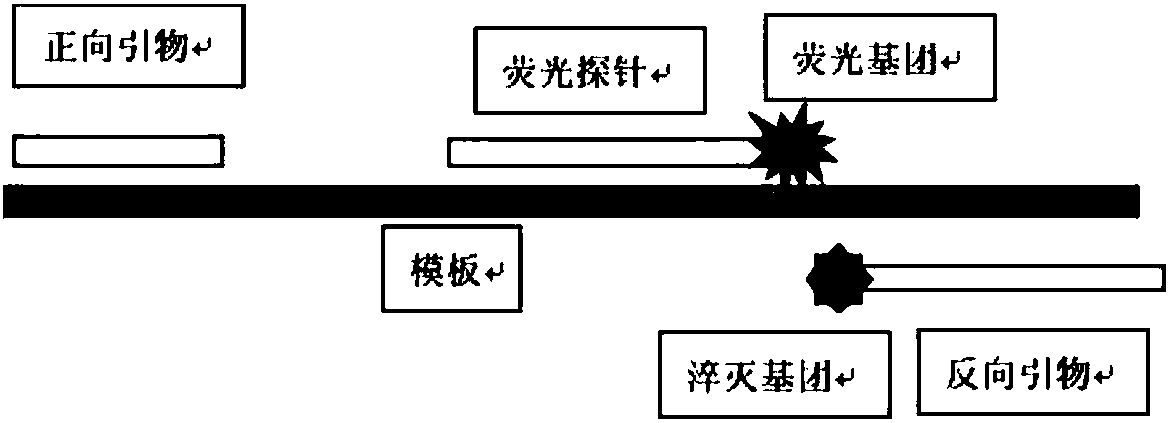
Figure 1 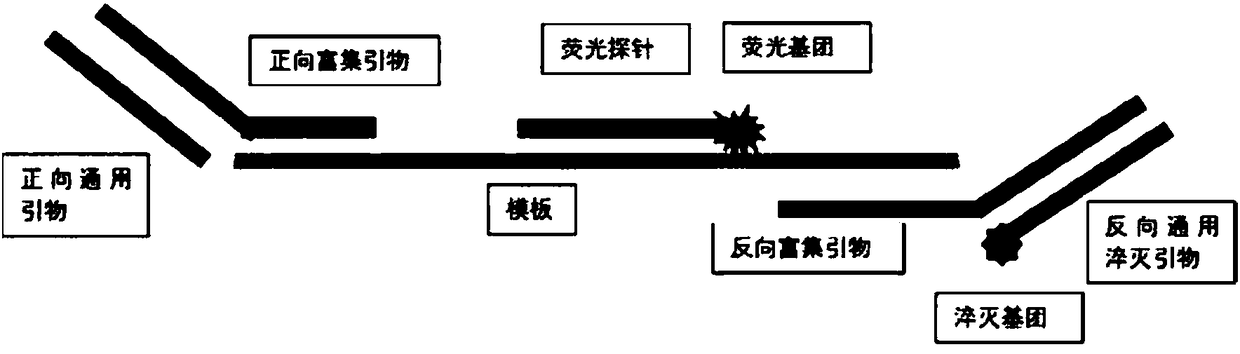
Figure 2 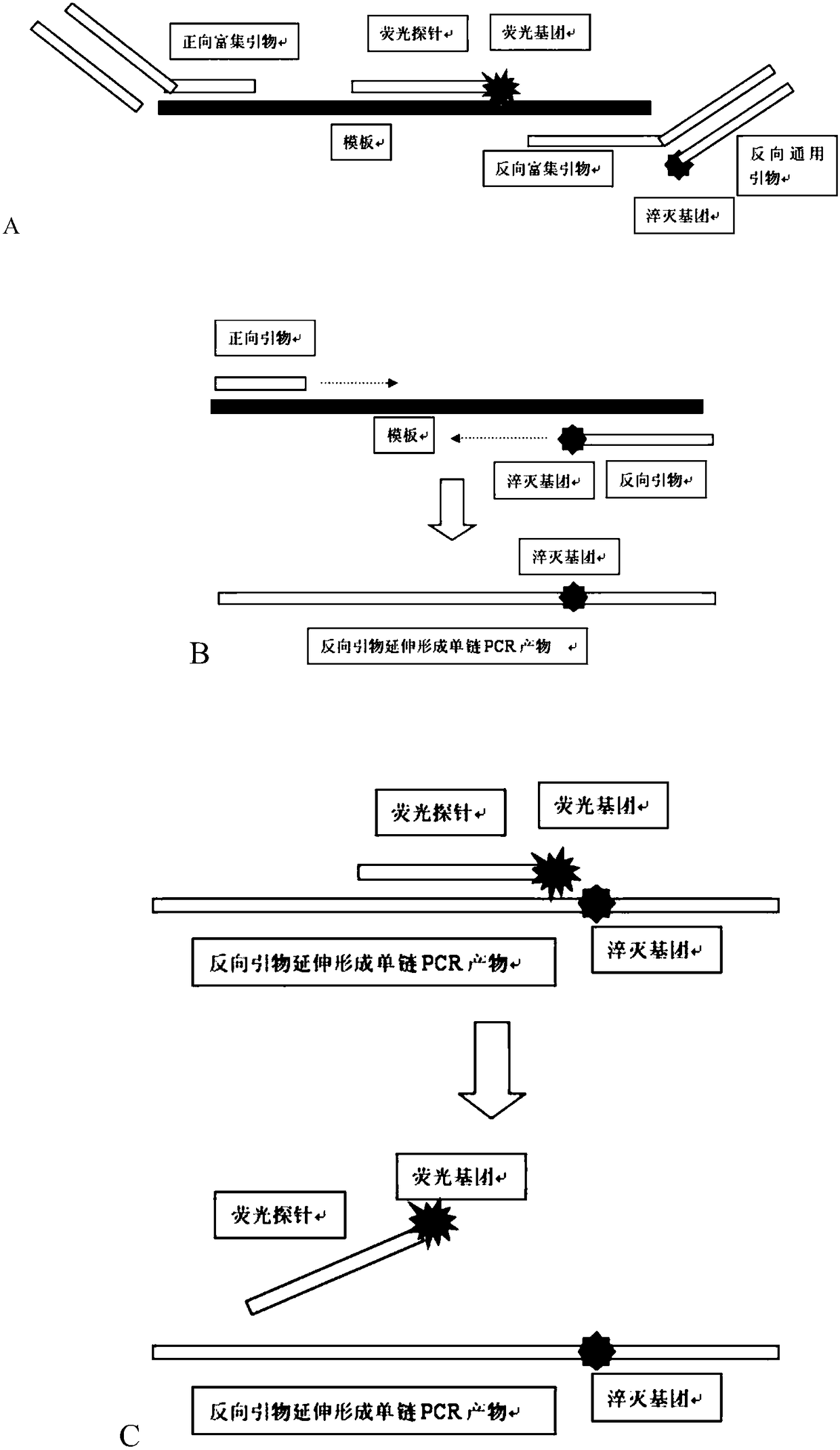
Figure 3
Abstract
Description
technical field
[0001] The invention belongs to the technical field of genetic engineering, and more specifically, the invention relates to a primer, a fluorescent probe and a method for detecting a target nucleic acid sequence. Background technique
[0002] Fluorescent PCR technology is a common technique for detecting target nucleic acid sequences. Currently, commonly used fluorescent PCR detection methods include Taqman probe method, molecular beacon (Molecular Beacon) probe method, fluorescent hybridization double probe (Hybridization Probe) method, etc. Among them, the fluorescent hybridization dual-probe method mainly uses two fluorescent probes that can hybridize with the same single strand of the target sequence, one of which is modified at the 3' end of one fluorescent group, and the other is modified at the 5' end of the other probe. A fluorescent group, when the target sequence exists, a large number of single-strands that can be reversed complementary to the two ...
Examples
Embodiment 1
[0028] Embodiment 1 Method for detecting target nucleic acid sequence based on fluorescence energy resonance transfer (FRET)
[0029] see Figure 1~2 , is a structural schematic diagram of a primer or a universal primer and a fluorescent probe for detecting a target nucleic acid sequence of the present invention.
[0030] The primer can be designed as a forward primer or a reverse primer. In this example, it is a reverse primer with a quencher group BHQ1 modified near the 3' end. The fluorescent probe is complementary to the different single strands of the primer and DNA, and the near 3' end is modified with the fluorescent group FAM, which can be quenched by the quenching group on the primer, so that the fluorescence intensity decreases ( figure 1 ).
[0031] The 3' end of the forward and reverse enrichment primers is reverse complementary to the template, and the 5' end is the binding site of the universal primer. The universal primer can be designed as a forward primer o...
Embodiment 2
[0036] Example 2 Using Quencher Modified Primers and Fluorescent Group Modified Probes to Detect Different Concentrations of Target Sequence Templates
[0037] According to the principle of Example 1 of the present invention, the method of this example is used to detect different concentrations of target sequence templates to evaluate its practicability.
[0038] The target sequence template is an artificial plasmid containing the PCR amplification region, which was synthesized by Sangon Technology (Shanghai) Co., Ltd. and diluted to 10 3 / ul, 10 4 / ul different concentrations.
[0039] The instrument used is Shanghai Hongshi Slan-96p fluorescence quantitative PCR instrument.
[0040] The primer sequences are:
[0041] STD-F: TCAGCAACTAGCTTACCATC (SEQ ID No: 1), the penultimate T at the 3' end modifies the BHQ1 quenching group
[0042] STD-R: GCTGACGTTGCAAGAAGACG (SEQ ID No: 2)
[0043] The fluorescent probe sequence is:
[0044] STD-P: TGATCATGTAATGGAAGGGGCAAGA (SEQ ID No...
Embodiment 3
[0053] Example 3 Detection of Target Sequence Templates at Different Concentrations Using Fluorophore-Modified Primers and Quencher-Modified Probes
[0054] According to the principle of Example 1 of the present invention, the method of this example is used to detect different concentrations of target sequence templates to evaluate its practicability.
[0055] The target sequence template is an artificial plasmid containing the PCR amplification region, which was synthesized by Sangon Technology (Shanghai) Co., Ltd. and diluted to 10 3 / ul, 10 4 / ul different concentrations.
[0056] The instrument used is Shanghai Hongshi Slan-96p fluorescence quantitative PCR instrument.
[0057] The primer sequences are:
[0058] STD-F: TCAGCAACTAGCTTACCATC (SEQ ID No: 1), the penultimate T-modified FAM fluorescent group at the 3' end
[0059] STD-R: GCTGACGTTGCAAGAAGACG (SEQ ID No: 2)
[0060] The fluorescent probe sequence is:
[0061] STD-P: TGTAATGGAAGGGGCAAGA (SEQ ID No: 3), BHQ1...