
A photoelectrochemical detection method for ochratoxin a based on double signal amplification
A kind of ochratoxin and photoelectrochemical technology, which is applied in the direction of measuring devices, scientific instruments, and material analysis through electromagnetic means, can solve the problems that the stability needs to be further improved, so as to hinder electron transfer, weaken the signal, and improve the recognition ability and the effect of sensitivity
Patent Information
- Authority / Receiving Office
- CN · China
- Patent Type
- Patents(China)
- Current Assignee / Owner
- Publication Date
- 2021-03-23
Smart Images
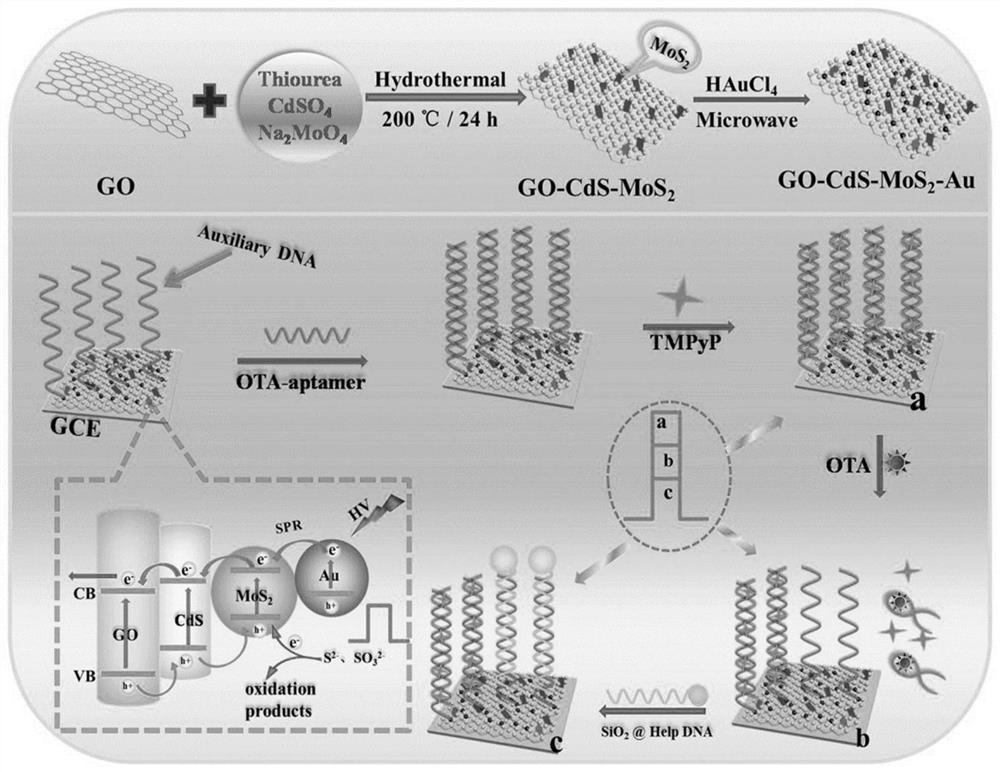
Figure 1 
Figure 2 
Figure 3
Abstract
Description
technical field
[0001] The invention relates to a photoelectrochemical ochratoxin A detection method based on double signal amplification, including the construction of a photoelectrochemical biosensor of graphene oxide / cadmium sulfide / molybdenum disulfide / nano-gold composite, belonging to the field of photoelectrochemical bioanalysis. Background technique
[0002] Ochratoxin is a secondary metabolite produced by certain species of Aspergillus and Penicillium, which has a wide range of pollution and can contaminate almost all kinds of food commodities (such as wheat, corn, barley, rye, beans, potatoes, bread, dried fruit, nuts, wine). Ochratoxins are mainly composed of ochratoxins A, B, and C, among which ochratoxin A (OTA) is the most toxic, widely distributed, and most closely related to human health. Due to the toxic, teratogenic, carcinogenic, mutagenic and immunosuppressive effects of OTA on animals and humans, rapid and sensitive detection of OTA is of great hygienic ...
Examples
Embodiment 1
[0027] (1) 0.006mol Na 2 MoO 4 and an equivalent amount of CdSO 4 Added to 30mL concentration is 0.1mg mL -1In the aqueous dispersion of graphene oxide, subsequently, 0.25mol thiourea was added to the above solution and stirred for 2 hours to form a milky white suspension; the suspension was transferred to a 50mL reactor and reacted for 18 hours at 200 degrees Celsius; the resulting solid product Centrifuge and wash several times, and then redisperse into 10mL aqueous solution.
[0028] (2) Nano-gold modified graphene oxide supported cadmium sulfide molybdenum sulfide nanocomposite (GO-CdS-MoS 2 -Au): 48.6 μL sodium citrate (100 mM), 10 μL Tween 80 (100 mM) and 10 μL HAuCl 4 ·3H 2 O (48.5mM) was quickly added to the GO-CdS-MoS prepared in step (1) 2 In the dispersion liquid, microwave heating to 60° C. for 5 minutes to react, and the obtained product was alternately washed three times with ethanol and water.
[0029] (3) Add 1.8mL n-hexanol, 7.5mL cyclohexane and 1.77mL...