
Dynamic equivalent modeling method of distributed photovoltaic cluster based on deep belief network
A deep belief network and distributed photovoltaic technology, applied in the field of value modeling, can solve the problems of tediousness and complexity in the conversion process, achieve the effect of reducing the amount of calculation and theoretical derivation, universal modeling methods, and avoiding errors
Patent Information
- Authority / Receiving Office
- CN · China
- Patent Type
- Applications(China)
- Current Assignee / Owner
- Publication Date
- 2019-01-11
- Estimated Expiration
- Not applicable · inactive patent
Smart Images
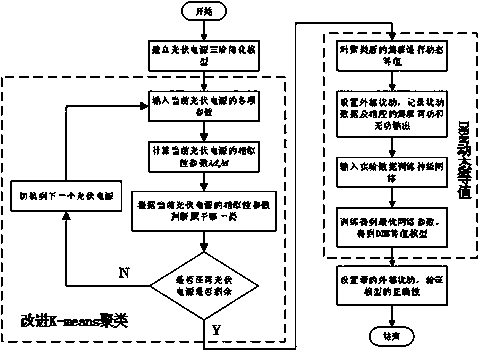
Figure 1 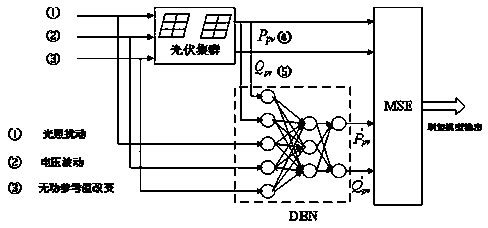
Figure 2 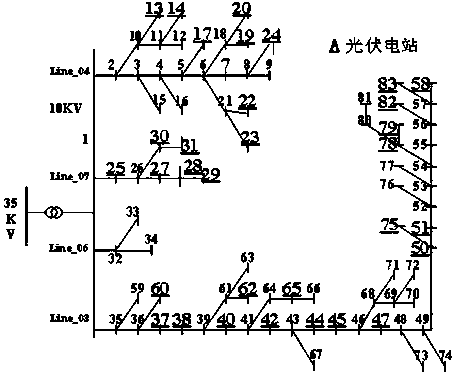
Figure 3
Abstract
Description
[0001] Field
[0002] The invention belongs to the technical field of distributed energy grid-connected modeling and simulation, and specifically relates to a dynamic equivalent modeling method for distributed photovoltaic clusters based on a deep belief network. Background technique
[0003] On July 30, 2018, the National Energy Administration released the energy development situation in the first half of the year. The latest data from China Electricity Union showed that the newly installed photovoltaic capacity was 25.81GW in the first half of 2018. From January to June, the new power generation capacity increased year-on-year. Of the 51,211 KW of newly-added power generation capacity in national infrastructure, solar power generation is 25.81 million KW, accounting for nearly half. It is worth noting that the newly added distributed photovoltaic installed capacity was 12.24 million KW, an increase of 72% year-on-year, and the new scale of distributed photovoltaics exceeded that ...
Examples
Embodiment 1
[0048] Dynamic equivalent modeling method of distributed photovoltaic cluster based on deep belief network, such as figure 1 As shown, including the following steps:
[0049] S1, establishing a third-order simplified model of the photovoltaic power generation unit, the simplified model including a photovoltaic array model, a combined simplified model of photovoltaic cells and chopper circuit, an inverter average control model, and an inverter controller model;
[0050] The photovoltaic array model is:
[0051]
[0052] The combined simplified model of photovoltaic cell and chopper circuit is:
[0053]
[0054] Inverter average control model:
[0055] U AC =[K d sin(ωt+θ)+K q sin(ωt+θ-π / 2)]U dc
[0056] Inverter controller model:
[0057]
[0058] Among them, S is the light intensity (W·m- 2 ), T(K) is the ambient temperature, U pv ,I pv Are the output DC voltage and current of the photovoltaic array, P pvmax Is the maximum power of photovoltaic modules, C dc Is the chopper outlet ca...
Embodiment 2
[0082] An example is listed below to help illustrate the feasibility and technical advantages of the dynamic equivalent modeling method disclosed in the present invention.
[0083] Take an actual distribution network system with distributed photovoltaic power stations in Anhui Province as an example. The system has 83 nodes and 32 photovoltaic power stations. The photovoltaic access points are such as image 3 Shown: The photovoltaic power generation units all adopt the third-order simplified model. After cluster clustering, 6 small-scale photovoltaic clusters are finally obtained. Each photovoltaic power generation unit in the cluster has similar dynamic characteristics. The results of cluster division are shown in Table 1:
[0084] Table 1 Cluster division results
[0085] Photovoltaic cluster
The location of the node where the photovoltaic power source is connected in the cluster
Cluster 1
7,13,17,19,20,22,23,24
Cluster 2
25,27,28,29,30,31
Cluster 3
37,38,40,60,62
Cluste...