

High performance flame-retardant polycarbonate alloy, flame retardant, compatibilizer and application
A technology of flame-retardant polycarbonate and polycarbonate, which is applied in the field of high-molecular polymers and flame retardants, can solve problems such as unsatisfactory compatibilization effect, strong corrosion and irritation, achieve good solubility, reduce growth Plastic side effect, reduce the effect of melt viscosity
Patent Information
- Authority / Receiving Office
- CN · China
- Current Assignee / Owner
- Publication Date
- 2019-10-29
- Estimated Expiration
- Not applicable · inactive patent
Smart Images
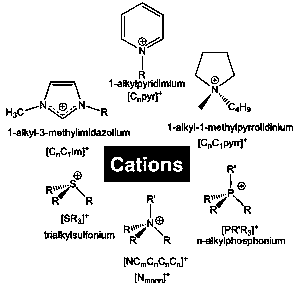
Figure 1 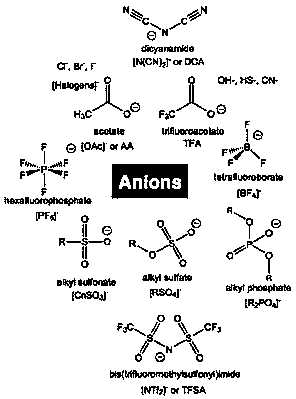
Figure 2 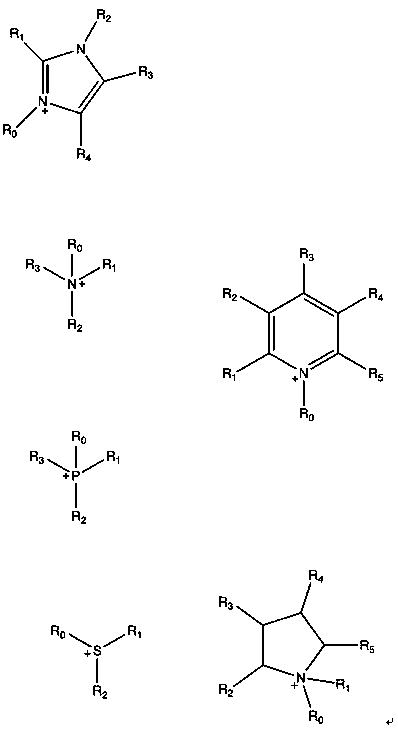
Figure 3
Abstract
Description
technical field
[0001] The invention relates to a high-performance flame-retardant polycarbonate alloy plastic. Specifically, the patent of the present invention discloses the application of ionic liquids as flame retardants and compatibilizers in polycarbonate alloy plastics, which belongs to the technical field of high molecular polymers and flame retardants. Background technique
[0002] Alloys of polycarbonate (PC), such as acrylonitrile / butadiene / styrene (ABS), polystyrene (PS), polybutylene terephthalate (PBT), acrylonitrile-styrene-acrylic Esters (ASA) and PC are widely used in automobiles, electronics, precision instruments, office equipment, packaging materials, building materials and other fields.
[0003] PC alloy plastics are often flammable, and flame retardants must be added to improve their flame retardancy.
[0004] At present, the halogen-free flame retardants commonly used in PC alloy plastics are mainly phosphate ester flame retardants. However, the fla...
Examples
Embodiment example 1
[0026] 1,3-Dimethylimidazolium Dimethyl Phosphate
[0027] Add 50-60 parts of polycarbonate resin particles and 25-35 parts of acrylonitrile-butadiene-styrene copolymer particles into a high-speed mixer and mix for 20 minutes at 50-55°C, mix the mixed materials with 15 parts of 1 , 3-Dimethylimidazolium dimethyl phosphate compound is melt-extruded and granulated through a twin-screw extruder. The extruder is also equipped with a liquid feeder, and the temperature of each section of the extruder is controlled at 220-245 ° C. Then samples were prepared by injection molding to test the flame retardancy.
Embodiment example 2
[0029] 1-Ethyl-3-methylimidazolium dibutyl phosphate
[0030] The processing and testing process of the above implementation case 2 is similar to that of case 1 and will not be repeated here. Wherein, the raw material formula is: 50-60 parts of polycarbonate, 30-40 parts of polybutylene terephthalate, and 10 parts of 1-ethyl-3-methylimidazole dibutyl phosphate.
Embodiment example 3
[0032] 3-(Triphenylphosphonium)propane-1-sulfonate
[0033] The raw material formula is: 50-65 parts of polycarbonate, 20-35 parts of acrylonitrile-styrene-acrylate, and 15 parts of 3-(triphenylphosphine)propane-1-sulfonate.