
Non-metal bcn/g-c 3 n 4 Van der Waals heterojunction photocatalyst and preparation method and application thereof
A photocatalyst, g-c3n4 technology, applied in the direction of physical/chemical process catalysts, non-metallic elements, chemical instruments and methods, etc., can solve the problem of carbon nitride being difficult to be widely used, high carrier recombination efficiency, and low photocatalytic activity and other issues, to achieve the effect of facilitating large-scale production, improving the electron transmission rate, and low cost
Patent Information
- Authority / Receiving Office
- CN · China
- Patent Type
- Patents(China)
- Current Assignee / Owner
- Publication Date
- 2022-07-22
Smart Images
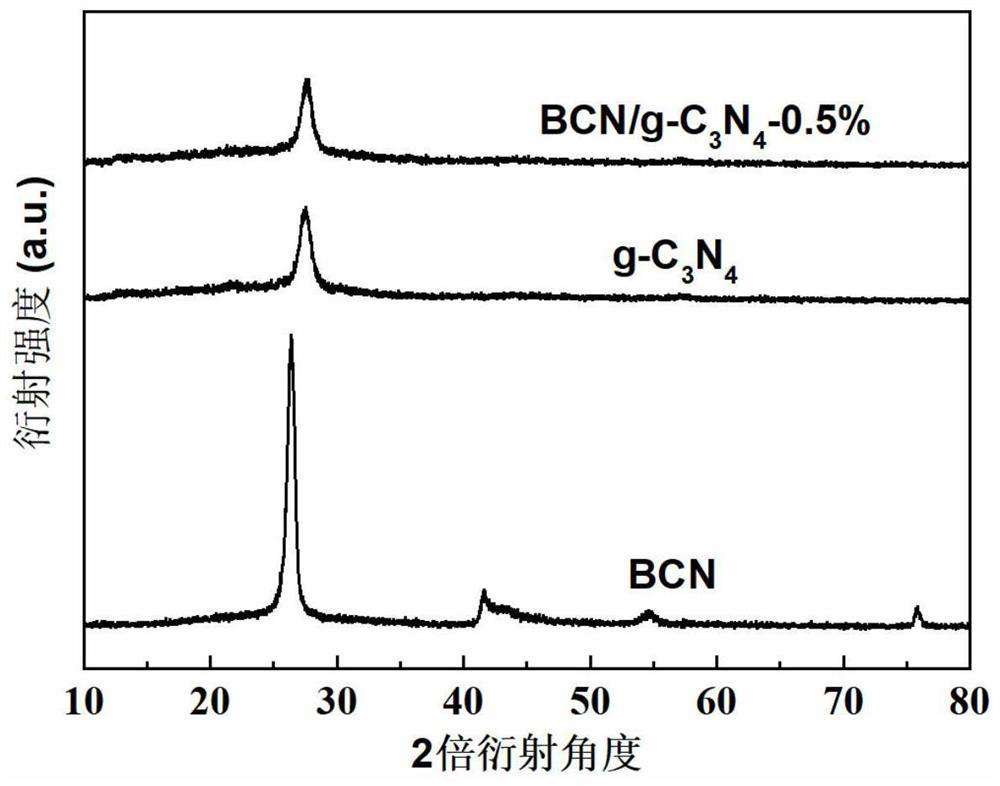
Figure 1 
Figure 2 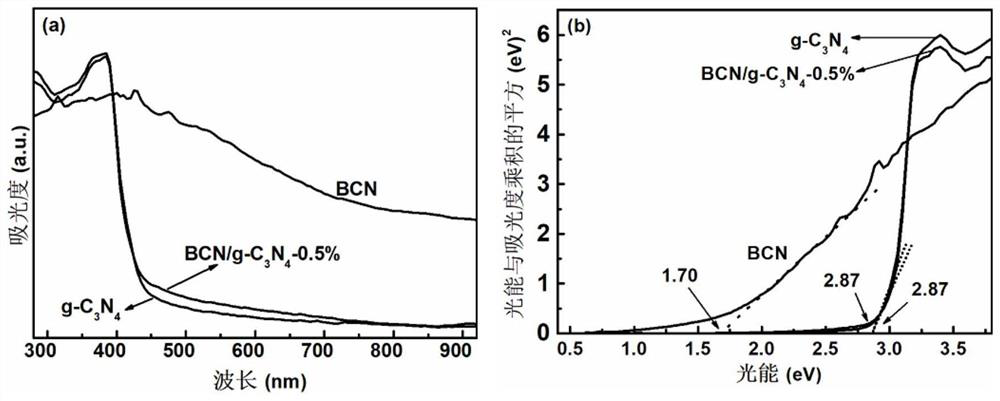
Figure 3
Abstract
Description
technical field
[0001] The invention belongs to the field of nanomaterial synthesis and relates to non-metallic BCN / g-C 3 N 4 Van der Waals heterojunction photocatalyst and preparation method and application thereof. Background technique
[0002] At present, the photo-splitting hydrogen production technology driven by renewable solar energy is widely used in the field of clean energy development due to its cheap energy source, non-toxic, non-polluting, mild reaction conditions, strong stability and reusability. A promising green and sustainable hydrogen production technology.
[0003] Among the various light-responsive materials that can be used as photocatalysts, semiconductor-based photocatalysts are the most explored and developed. There are many kinds of semiconductor materials, such as titanium dioxide, zinc oxide, cadmium sulfide, ferric oxide and other transition metal oxides and sulfides, among which titanium dioxide has strong chemical properties, non-toxic, stro...
Examples
Embodiment 1
[0032] Example 1: Preparation of BCN / g-C 3 N 4 -0.1% van der Waals heterojunction photocatalyst and its photocatalytic hydrogen production
[0033] (1) Preparation of g-C 3 N 4
[0034] Weigh 100 g of urea, put it in a drying oven at 80 °C for 12 hours, take it out, grind it to powder, put it into a crucible, cover it, and put it in a muffle furnace for calcination at 550 °C for 4 hours, with a heating rate of 2.5 °C / min. After natural cooling, the calcined product was taken out and put into 300 mL of 1.5 M nitric acid solution, and stirred for 12 h. Then carry out washing and suction filtration, wash with deionized water until the pH value of the filtrate is the same as that of deionized water, and finally put it into a drying oven for drying at 80°C.
[0035] (2) Preparation of BCN nanosheets
[0036] Weigh 2g of boron oxide, 4g of urea, 0.6g of glucose into a quartz mortar and finely grind, mix well, then put the mixture into a porcelain boat, cover it, put it into a ...
Embodiment 2
[0041] Example 2: BCN / g-C 3 N 4 Preparation of -0.3% van der Waals heterojunction photocatalyst and photocatalytic hydrogen production
[0042] Steps (1)-(2) are the same as in Example 2.
[0043] (3) Preparation of BCN / g-C 3 N 4 -0.3% van der Waals heterojunction photocatalyst
[0044] Weigh 1 g of g-C prepared in step (1) 3 N 4 With 0.003g of BCN nanosheets, finely ground in a quartz mortar, transferred to a porcelain boat, put the porcelain boat into a tube furnace, and heated in N 2 Heated to 500 °C at a heating rate of 5 °C / min under gas protection, and calcined for 4 h to obtain BCN / g-C 3 N 4 -0.3% photocatalyst.
[0045] (4) BCN / g-C 3 N 4 -0.3% van der Waals heterojunction photocatalyst for photocatalytic hydrogen production
[0046] The photocatalytic reaction was carried out in a closed reaction system with a total volume of about 250 mL, and 50 mg BCN / g-C 3 N 4 -0.3% catalyst was uniformly dispersed in 100mL of 20vol% TEOA aqueous solution pH 11.4, then...
Embodiment 3
[0047] Example 3: BCN / g-C 3 N 4 Preparation of -0.5% van der Waals heterojunction photocatalyst and photocatalytic hydrogen production
[0048] Steps (1)-(2) are the same as in Example 2.
[0049] (3) Preparation of BCN / g-C 3 N 4 -0.5% van der Waals heterojunction photocatalyst
[0050] Weigh 1 g of g-C prepared in step (1) 3 N 4 With 0.005g of BCN nanosheets, finely ground in a quartz mortar, transfer to a porcelain boat, put the porcelain boat into a tube furnace, in N 2 Heated to 500 °C at a heating rate of 5 °C / min under gas protection, and calcined for 4 h to obtain BCN / g-C 3 N 4 -0.5% photocatalyst.
[0051] (4) BCN / g-C 3 N 4 -0.5% van der Waals heterojunction photocatalyst for photocatalytic hydrogen production
[0052] The photocatalytic reaction was carried out in a closed reaction system with a total volume of about 250 mL, and 50 mg BCN / g-C 3 N 4 -0.5% catalyst was uniformly dispersed in 100mL of 20vol% TEOA aqueous solution pH 11.4, then 3% H was adde...