
Silencing device for reducing noise
A noise reduction device and noise reduction technology, applied in the direction of pipes/pipe joints/fittings, mechanical equipment, pipe components, etc., can solve the problem of adding resonators, etc., and achieve the effects of widening the noise reduction frequency band, saving space, and simple structure
Patent Information
- Authority / Receiving Office
- CN · China
- Patent Type
- Applications(China)
- Current Assignee / Owner
- Publication Date
- 2020-10-30
Smart Images
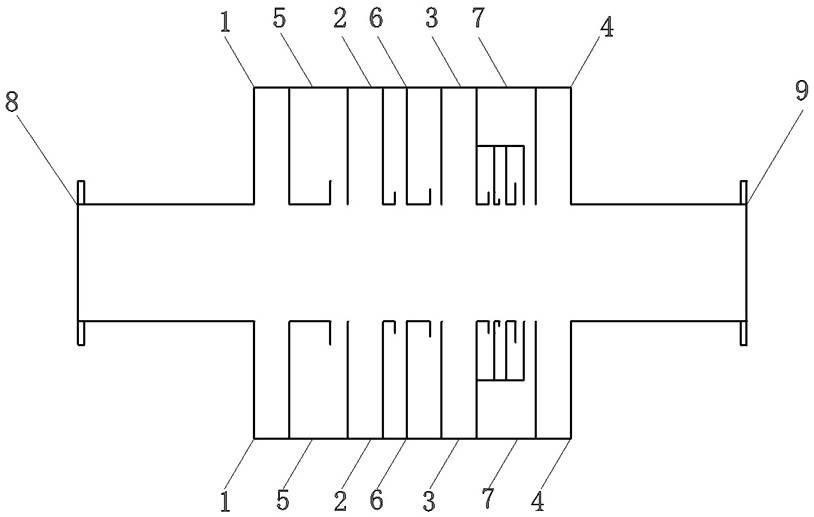
Figure 1 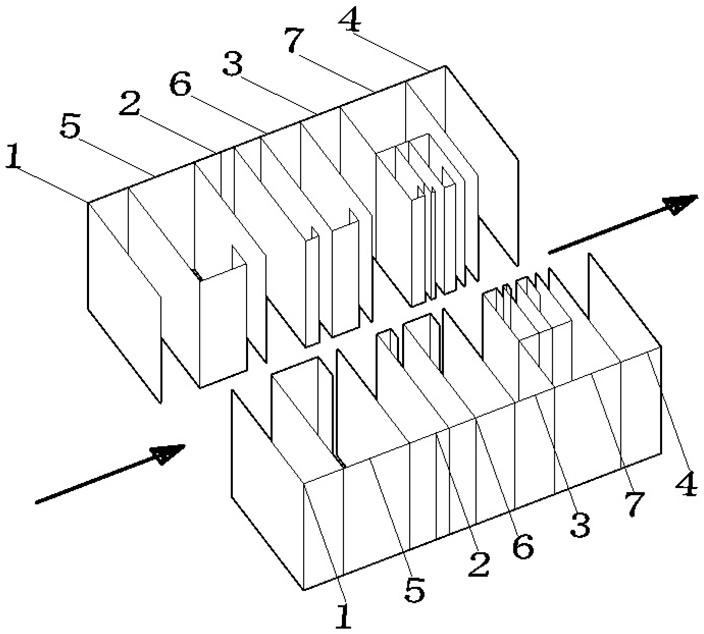
Figure 2 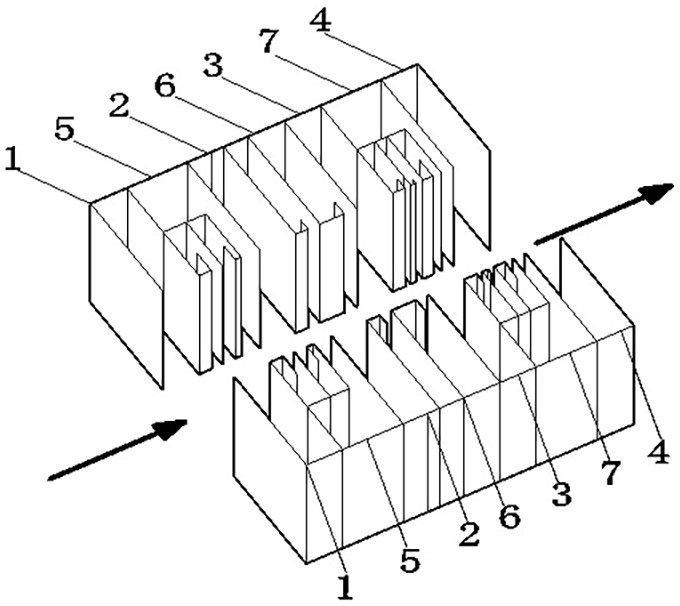
Figure 3
Abstract
Description
technical field
[0001] The invention relates to a noise reduction device, and more specifically relates to a noise reduction device capable of reducing broadband noise formed by closely connecting resonator structures. Background technique
[0002] As one of the pollution that affects the quality of human life, noise has attracted the attention of scientists. Long-term noise interference will not only affect the performance, efficiency and working life of mechanical equipment, but also damage human health in severe cases. With the development of the times, people have higher and higher requirements for noise reduction.
[0003] The usual way to reduce noise is to install a muffler, and using a resonator to eliminate noise is a widely used noise reduction technology. Because the resonator has a simple structure and can effectively reduce the noise of a specific frequency, the resonator plays an important role in noise control. It is an important means, but the resonator can ...
Examples
Embodiment 1
[0028] refer to figure 1 and figure 2 , the noise reduction device of this embodiment includes four side branch resonators 1, 2, 3, 4 and three Helmholtz resonator groups 5, 6, 7. The four side branch resonators 1, 2, 3, 4 The sizes should be exactly the same and arranged at equal intervals; the Helmholtz resonator groups 5, 6 and 7 are composed of one, two and three Helmholtz resonators respectively, and each Helmholtz resonator has a different size. One, three Helmholtz resonator groups 5, 6, 7 are inserted between the four side branch resonators 1, 2, 3, 4 respectively.
[0029] refer to Figure 5 It is the transmission loss curve obtained by the finite element calculation of the noise reduction device of this exemplary embodiment. It can be seen from the figure that the Helmholtz resonance inserted in the side branch resonator and the Helmholtz resonator is set in parallel in the above way The number of side branch resonators does not affect the resonance frequency of ...
Embodiment 2
[0031] refer to figure 1 and image 3 , the noise reduction device of this embodiment includes four side branch resonators 1, 2, 3, 4 and three Helmholtz resonator groups 5, 6, 7. The four side branch resonators 1, 2, 3, 4 The size should be exactly the same and arranged at equal intervals; the Helmholtz resonator groups 5, 6 and 7 are composed of two, two and three Helmholtz resonators respectively, and each Helmholtz resonator has a different size. One, three Helmholtz resonator groups 5, 6, 7 are inserted between the four side branch resonators 1, 2, 3, 4 respectively.
[0032] refer to Image 6 It is the transmission loss curve obtained by the finite element calculation of the noise reduction device of this exemplary embodiment. It can be seen from the figure that the Helmholtz resonance inserted in the side branch resonator and the Helmholtz resonator is set in parallel in the above way The number of side branch resonators does not affect the resonance frequency of sid...
Embodiment 3
[0034] refer to figure 1 and Figure 4 , the noise reduction device of this embodiment includes four side branch resonators 1, 2, 3, 4 and three Helmholtz resonator groups 5, 6, 7. The four side branch resonators 1, 2, 3, 4 The size should be exactly the same and arranged at equal intervals; the Helmholtz resonator groups 5, 6 and 7 are composed of two, two and three Helmholtz resonators respectively, and each Helmholtz resonator has a different size. One, three Helmholtz resonator groups 5, 6, 7 are inserted between the four side branch resonators 1, 2, 3, 4 respectively.
[0035] refer to Figure 7 It is the transmission loss curve obtained by the finite element calculation of the noise reduction device of this exemplary embodiment. It can be seen from the figure that the Helmholtz resonance inserted in the side branch resonator and the Helmholtz resonator is set in parallel in the above way The number of side branch resonators does not affect the resonance frequency of s...