
Phosphorylcholine-containing polysiloxane monomer
A technology of polysiloxane monomer and acylcholine, which is applied in the directions of instruments, optics and optical components to achieve the effects of suitable oxygen permeability, suitable mechanical strength and high hydrophilicity
Patent Information
- Authority / Receiving Office
- CN · China
- Patent Type
- Patents(China)
- Current Assignee / Owner
- Publication Date
- 2022-02-18
Smart Images
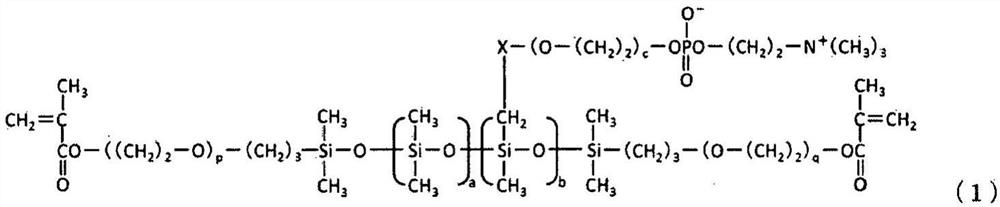
Figure 1 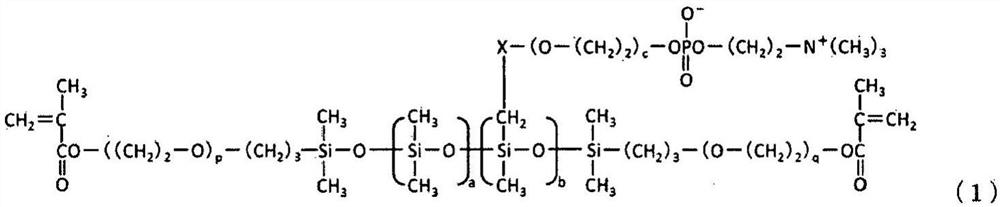
Figure 2 
Figure 3
Abstract
Description
technical field
[0001] The present invention relates to a polymerizable phosphorylcholine group-containing polysiloxane monomer, which can be used in the manufacture of ophthalmic devices, such as contact lenses, intraocular lenses, artificial cornea.
[0002] This application claims the priority of Japanese Application Japanese Patent Application No. 2018-073052 which is incorporated by reference into this application. Background technique
[0003] Silicone hydrogel is a material widely used in ophthalmic lenses such as contact lenses because of its high oxygen permeability, so it is less burdensome to the eyes. On the other hand, silicone hydrogels tend to have insufficient wettability and lubricity because they contain waterproof silicone. Therefore, surface hydrophilization by a surface modification method and surface hydrophilization by mixing a hydrophilic polymer into a lens composition before curing have been studied. Currently, there are various methods of provid...
Examples
Embodiment 1
[0147] The analysis condition of embodiment 1
[0148] The analysis conditions of Example 1 are as follows.
[0149] 1 H NMR assay
[0150] Measuring device: JNM-AL400 manufactured by JEOL Ltd.
[0151] Solvent: CDCl 3 (TMS Benchmark)
Embodiment 2
[0152] Components used in Example 2 and Comparative Example
[0153] Components other than the polysiloxane monomer of the present invention used in Example 2 and Comparative Example are as follows.
[0154] 〇Comparative compound of formula (1)
[0155] PMPC: a macromonomer containing a phosphorylcholine functional group side chain (the compound of Experimental Example 4 of Patent Document 8)
[0156] FM-7721: JNC Corporation, two-terminal methacryloxy polydimethylsiloxane (molecular weight ≒ 5,000)
[0157] 〇Other monomers
[0158] SiGMA: 2-Hydroxy-3-(tris(trimethylsiloxy)silyl)propyl methacrylate
[0159] ES: 4-(2-hydroxyethyl)=1-[3-tris(trimethylsilyloxy)silylpropyl]=2-methine succinate
[0160] TEGDMA: Tetraethylene glycol dimethacrylate
[0161] 〇Hydrophilic monomer
[0162] MPC: 2-(methacryloyloxyethyl)-2-(trimethylaminoethyl)phosphate
[0163] HPMA: Hydroxypropyl methacrylate (a mixture of 2-hydroxypropyl and 2-hydroxy-1-methylethyl ester, manufactured by NIPPONS...
Embodiment 1-1
[0179] In a 100 mL three-necked flask, make 10.00 g of silicone intermediate 1 (hydrosilyl group-containing two-terminal methacryloyl silicone represented by formula (4)) and 0.2140 g of alkene-containing silicone represented by formula (5) The propyl phosphorylcholine compound was dissolved in 10.00 g of 2-propanol, heated to 80° C. using an oil bath, and then 40 μL of a 4% by weight hexachloroplatinic acid hexahydrate 2-propanol solution was added.
[0180] Dissolve 1.93 g of the allyl group-containing phosphorylcholine compound represented by the formula (5) in a solution of 5.78 g of 2-propanol to obtain a solution, add the solution to a 10 mL dropping funnel, and install In the upper part of the three-neck flask.
[0181] The solution in the dropping funnel was dropped over 30 minutes while maintaining 80°C. After the dropwise addition, the reaction was further carried out in a reflux state for 1 hour. After removing low-boiling point components by vacuum distillation, ...