
Primer probe combination, detection kit and application of detection kit
A detection kit, primer probe technology, applied in the field of nucleic acid detection, can solve the problems of low specificity and accuracy of dengue virus and Zika virus, avoid non-specific amplification, improve specificity and accuracy, Highly specific effect
Patent Information
- Authority / Receiving Office
- CN · China
- Patent Type
- Applications(China)
- Current Assignee / Owner
- Publication Date
- 2021-01-26
Smart Images
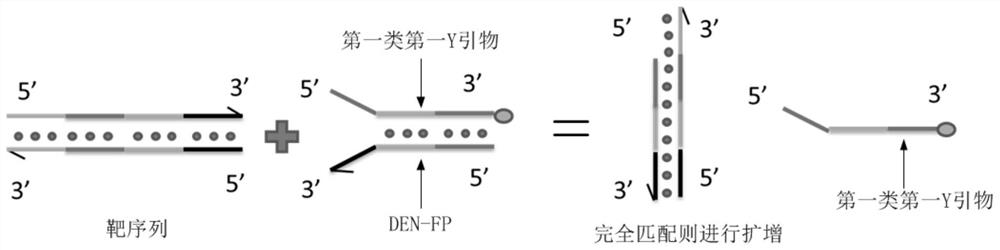
Figure 1 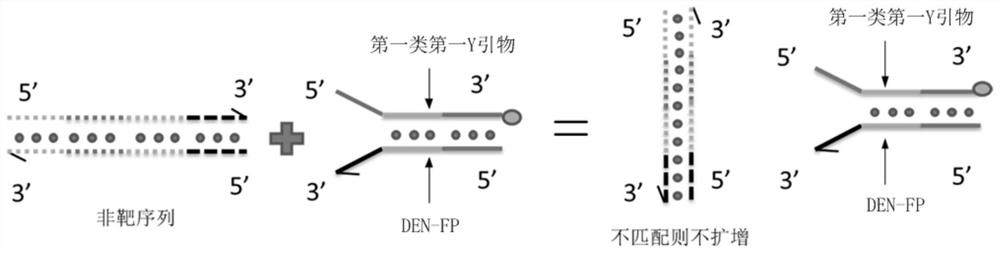
Figure 2 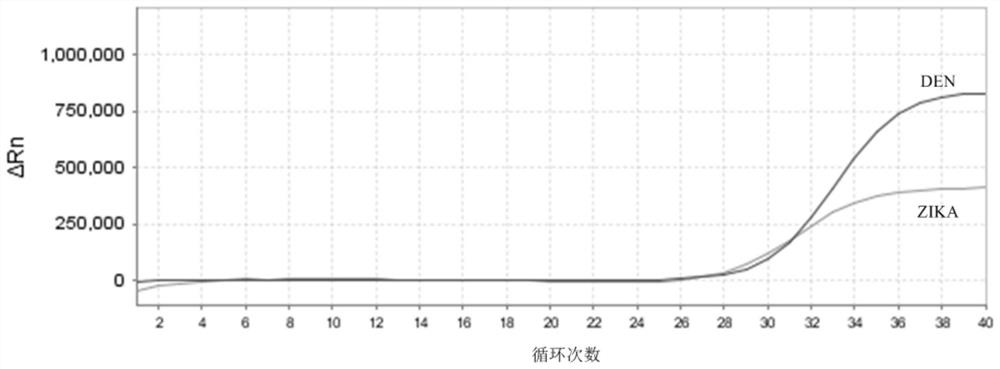
Figure 3
Abstract
Description
Technical field
[0001] The invention belongs to the technical field of nucleic acid detection, and specifically relates to a primer probe combination, a detection kit and application thereof, and a detection method of dengue virus and / or Zika virus.Background technique
[0002] Dengue virus belongs to the Flaviviridae Flaviviridae and is a single positive-stranded RNA virus. Zika virus belongs to the Flaviviridae Flavivirus and has an envelope. The genome is a single-stranded positive-stranded RNA.
[0003] At present, the diagnostic methods for dengue virus and Zika virus at home and abroad mainly include serological tests, virus culture and PCR. Among them, serological tests and virus culture have shortcomings such as low sensitivity, immune cross-reaction, and long cycle; most of the existing in vitro diagnostic kits for dengue virus and Zika virus use single-plex RT-PCR reactions to face insects. During the large-scale sample detection during the arbovirus epidemic season, there are probl...
Examples
Embodiment 1
[0089]This embodiment provides a detection kit, which includes an RT-PCR reaction solution, an RT-PCR enzyme mixture, a positive quality control product and a negative quality control product.
[0090]Among them, the RT-PCR reaction solution contains 2×One-Step RT-qPCR Buffer and Dengue virus specific primers (DENV-FP, DENV-RP), the first type Y primer (DENV-FP2, DENV-RP2) and the Type I fluorescent probe (DENV-FAM), Zika virus specific primers (ZIKA-FP, ZIKA-RP), type II Y primer (ZIKA-FP2, ZIKA-RP2) and type II fluorescent probe (ZIKA -HEX), among which, the method of obtaining primers and fluorescent probes is: download all known dengue virus and Zika virus genome sequences from NCBI, use Clone Manager software for sequence comparison, and search for each type sequence Then use Primer Express 3.0 software to design dengue virus specific primers (DENV-FP, DENV-RP), first type Y primer Y primer (DENV-FP2, DENV-RP2) and first type fluorescence Probe (DENV-FAM), Zika virus specific prim...
Embodiment 2
[0097]This example uses the detection kit obtained in Example 1 to detect positive quality control products, including the following steps:
[0098](11) Verification of positive quality control products: take the positive quality control products in the kit for verification; use ABI 7500 automatic fluorescent quantitative PCR detector for program setting, the fluorescent reporter group is: FAM, VIC channel, Passive Reference: NONE , The reaction procedure is shown in Table 2;
[0099](12) After the amplification, the fluorescence curve obtained is as followsimage 3 Shown.
[0100]byimage 3 It can be seen that the two fluorescence curves are both S-shaped, the Ct value is ≤38, and the first type of fluorescent probe and the second type of fluorescent probe both emit light, indicating that the detection kit obtained in Example 1 can simultaneously detect dengue Virus (DEN) and Zika virus (ZIKA).
[0101]Table 2 RT-qPCR reaction program
[0102]
[0103]
Embodiment 3
[0105]This embodiment uses the detection kit obtained in Example 1 to detect the negative control substance, including the following steps:
[0106](21) Negative control product verification: take DEPC water for negative control product verification; use ABI 7500 automatic fluorescent quantitative PCR detector for program setting, fluorescent reporter group: FAM, VIC channel, Passive Reference: NONE, The reaction procedure is shown in Table 2;
[0107](22) After the amplification, the fluorescence curve obtained is asFigure 4 Shown.
[0108]byFigure 4 It can be seen that when the detection kit obtained in Example 1 detects the negative control substance, the fluorescence curve obtained is not S-type and has no Ct value, indicating that there is no dengue virus and Zika virus, and the detection results are accurate and will not appear false Positive.