
Polyamide-imide binder for lithium ion battery and electrode plate
A polyamide-imide and polyamide-imide copolymer technology, which is applied in battery electrodes, secondary batteries, circuits, etc., can solve the problems of low interface infiltration, poor segment flexibility, and difficulty in realizing industrialization. To achieve the effect of simple preparation process and preparation conditions, strong bonding strength and flexibility, and improved safety in use
Patent Information
- Authority / Receiving Office
- CN · China
- Patent Type
- Applications(China)
- Current Assignee / Owner
- Publication Date
- 2021-10-29
Smart Images
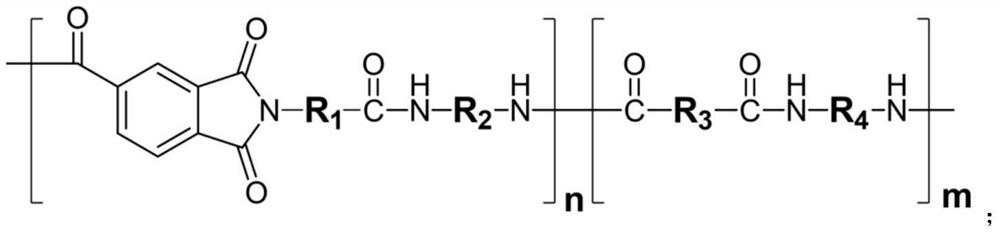
Figure 1 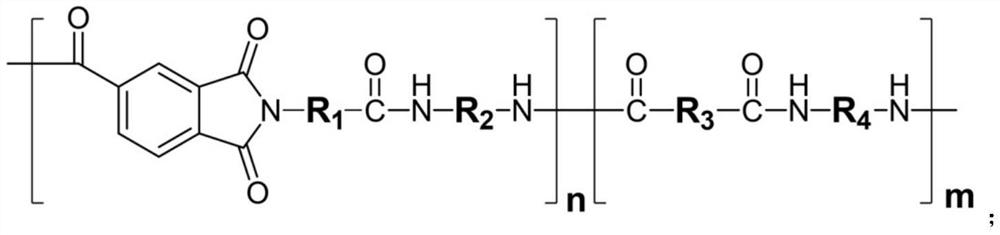
Figure 2 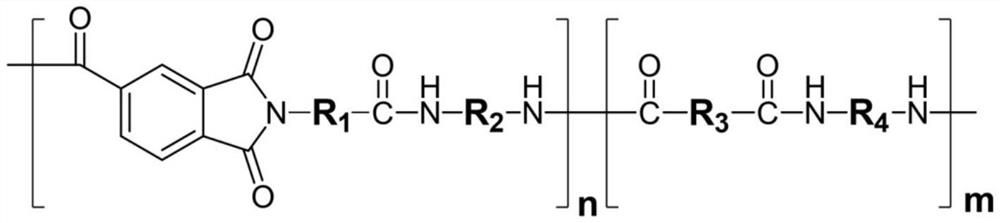
Figure 3
Abstract
Description
technical field
[0001] The invention relates to the field of lithium-ion battery materials, in particular to a polyamide-imide binder and battery pole pieces for lithium-ion batteries. Background technique
[0002] As a clean energy source, lithium-ion batteries are widely used in various electronic devices and electric vehicles. As a member of the lithium battery components, although the amount of electrode binder is small, it ensures the good mechanical properties and processability of the electrode sheet, maintains the integrity of the conductive network of the electrode during charging and discharging, and has a positive effect on the electrical properties of the lithium ion battery electrode. Chemical properties have a significant impact.
[0003] Currently, the most widely used binders in Li-ion batteries are polyvinylidene fluoride (PVDF) and acrylic polymer (PAA). However, it has a series of obvious deficiencies. For example, the bonding force of PVDF is mainly de...
Examples
Embodiment 1
[0038] In the present embodiment, the electrode binder used contains the polyamide-imide copolymer of following structural formula:
[0039]
[0040] Wherein, n:m=75:25 in the synthesized polyamide-imide copolymer.
[0041] Its preparation method is:
[0042] Put 384.3g of trimellitic anhydride, 402.6g of aminoundecanoic acid and 2.50L of glacial acetic acid into a 5L reactor, heat up to 120°C and react for 2 hours, then cool and stand still, filter out the white precipitate, and wash it fully with ethanol to obtain Diacid monomer TMA-11.
[0043] Put 212.3g of 4,4-diaminobenzophenone, 281.6g of TMA-11 and 57.6g of 1,12-dodecanedioic acid into the autoclave, add 165g of deionized water, through repeated vacuuming and Fill the reactor with nitrogen to replace the gas. Seal the reaction kettle and raise the temperature to 230°C while stirring. At this time, discharge water vapor through the exhaust valve to keep the pressure in the kettle constant. The reaction was carried...
Embodiment 2
[0045] In the present embodiment, the electrode binder used contains the polyamide-imide copolymer of following structural formula:
[0046]
[0047] Wherein, n:m=75:25 in the synthesized polyamide-imide copolymer.
[0048] In the preparation, except that 4,4-diaminobenzophenone was replaced by p-phenylenediamine in Example 1, the same method as in Example 1 was used to obtain the polyamideimide described in this example copolymer.
Embodiment 3
[0050] In the present embodiment, the electrode binder used contains the polyamide-imide copolymer of following structural formula:
[0051]
[0052] Wherein, n:m=75:25 in the synthesized polyamide-imide copolymer.
[0053] In the preparation, except that aminoundecanoic acid in Example 1 was replaced with 2-aminodecanoic acid, the same method as in Example 1 was used to obtain the polyamideimide copolymer described in this example.