
Low-power-consumption docking station and power consumption monitoring method thereof
A technology of docking station and low power consumption, which is applied in the field of low-power docking station and its power consumption monitoring. It can solve the problems of wasting power consumption of the docking station, and achieve the effect of reducing power consumption and prolonging the service life
Patent Information
- Authority / Receiving Office
- CN · China
- Patent Type
- Applications(China)
- Current Assignee / Owner
- Publication Date
- 2022-05-06
- Estimated Expiration
- Not applicable · inactive patent
Smart Images
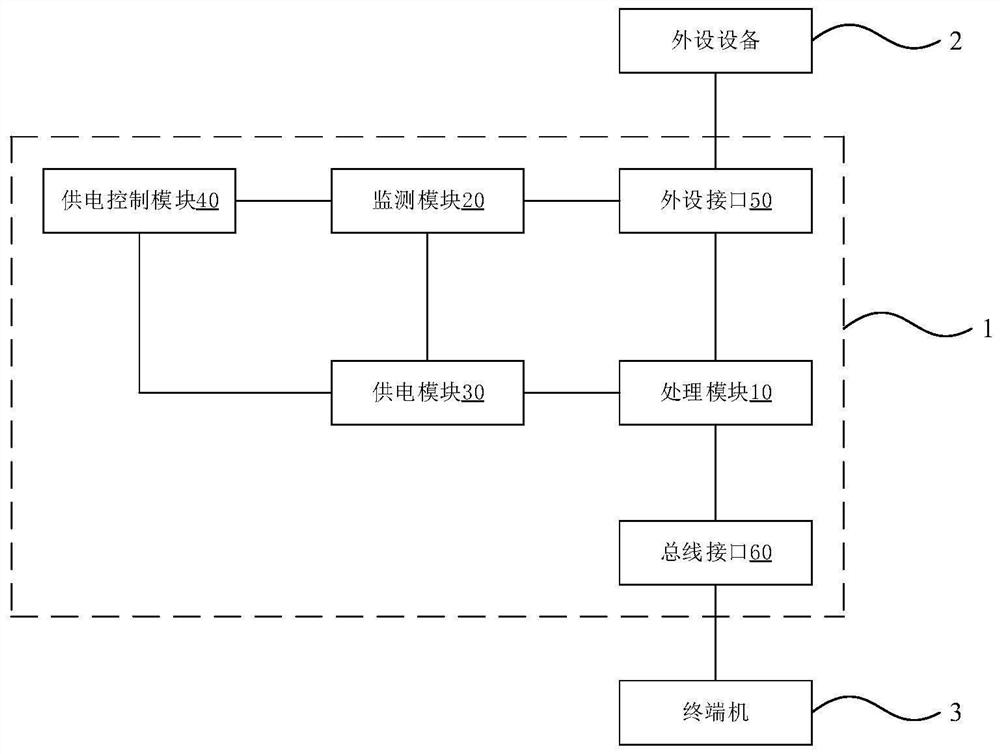
Figure 1 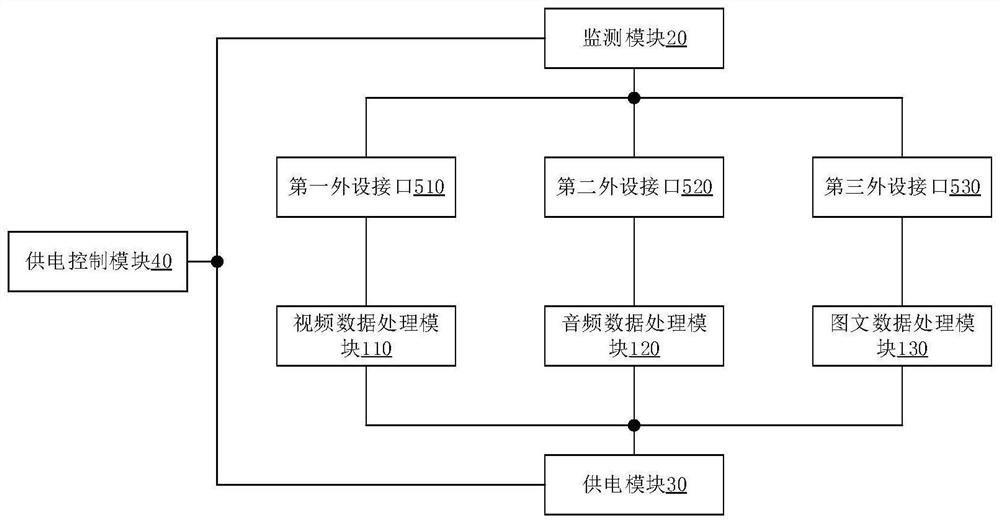
Figure 2 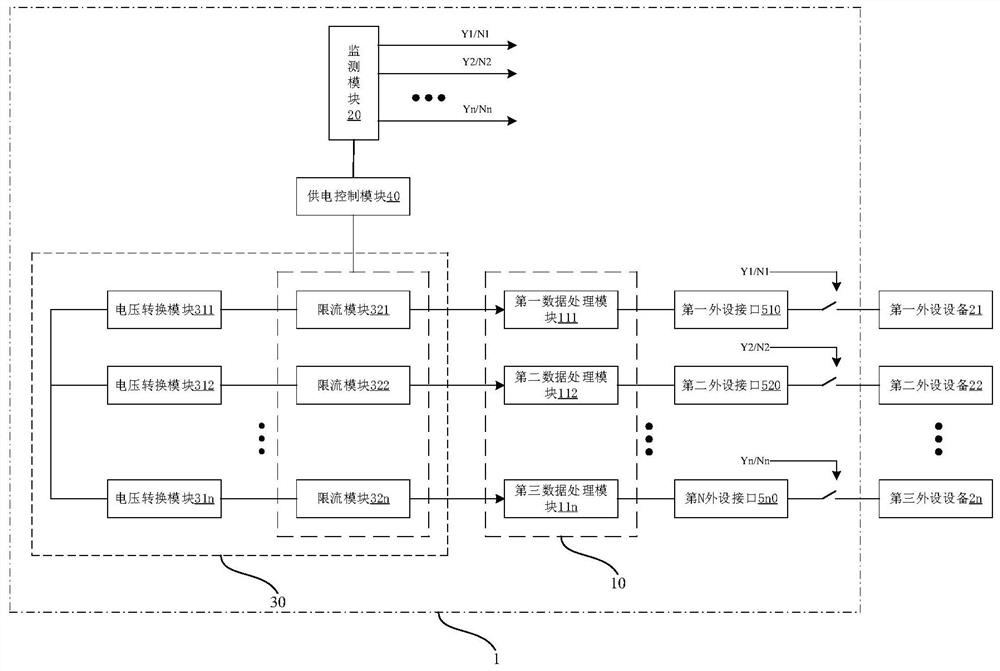
Figure 3
Abstract
Description
technical field
[0001] The present disclosure generally relates to a low-power docking station and a power consumption monitoring method thereof. Background technique
[0002] A docking station, also known as a port replicator, is an external device applied to computer systems and portable computer systems. By duplicating or even expanding the ports of a notebook computer, it is possible to make a convenient one-stop connection between a notebook computer and multiple accessories or external devices (such as power adapters, network cables, mice, external keyboards, printers, and external monitors).
[0003] Among the existing docking stations, most of the USB / WUSB docking stations are designed to be plug-and-play, that is, after plugging in a USB cable, a data cable or connecting to the host computer wirelessly, all the drivers in the docking station will start to work , the internal modules related to each external interface are powered on and start working. Usually, the ...
Examples
Embodiment Construction
[0026] Hereinafter, preferred embodiments of the present disclosure will be described in detail with reference to the drawings. In the following description, the same reference numerals are given to the same components, and repeated descriptions are omitted. In addition, the drawings are only schematic diagrams, and the ratio of dimensions between components, the shape of components, and the like may be different from the actual ones.
[0027] figure 1 is a schematic block diagram showing an example of a low-power docking system according to an embodiment of the present disclosure.
[0028] refer to figure 1The low-power docking station 1 involved in this embodiment (hereinafter referred to as the docking station 1) may include a processing module 10, a monitoring module 20, a power supply module 30, a power supply control module 40, a peripheral interface 50, and a bus interface 60. The docking station 1 can be connected to the terminal machine 3 through the bus interface ...