
Method for preparing hydrophobic silicon oxide aerogel based on inorganic salt aqueous solution
A technology of inorganic salt solution and water silicon oxide, which is applied in the direction of inorganic chemistry, chemical instruments and methods, silicon compounds, etc., can solve the problems of high material cost, achieve the effects of low preparation cost, shorten the preparation cycle, and improve efficiency
Patent Information
- Authority / Receiving Office
- CN · China
- Patent Type
- Applications(China)
- Current Assignee / Owner
- Publication Date
- 2022-07-29
Smart Images
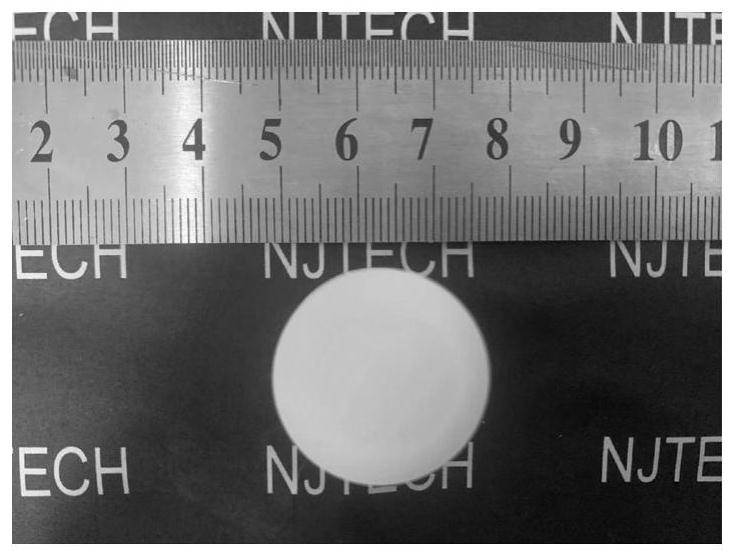
Figure 1
Abstract
Description
technical field
[0001] The invention belongs to the field of preparation of new materials, in particular to a method for preparing hydrophobic silica aerogel based on an inorganic salt aqueous solution. Background technique
[0002] As a lightweight porous nanomaterial with excellent thermal insulation properties, silica aerogel has good application prospects in aerospace, new energy, chemical and other fields. Silicon oxide aerogel materials generally use silicon alkoxides as precursors, and the preparation cost is high. The cost problem greatly limits the large-scale production and application of aerogels. Therefore, it is necessary to find high-quality and cheap silicon sources to reduce production costs. Moreover, the performance of pure silica aerogel without hydrophobic modification will decrease due to moisture absorption, and the skeleton structure is very fragile and cannot withstand external forces. Patents CN102020285A and CN105377758A use water glass as silicon ...
Examples
example 1
[0026] 30 parts of sodium methylsilicate and 200 parts of water were mixed and stirred for 3 hours to obtain a mixed solution. Mix and stir 5 parts of water glass with a modulus of 3.3 and 30 parts of water for 0.5 h to obtain a silica sol, mix and stir the mixed solution and the silica sol at a ratio of 1:1 for 0.5 h to obtain a mixed sol, first add oxalic acid to adjust the pH of the mixed solution 6 was mixed and stirred for 0.1 h, and the mixed solution was gelatinized at 50° C. to obtain a wet gel. The obtained wet gel was immersed in an ammonia solution with a pH of 10 and aged at 90 °C for 6 h, and then an ethanol solution was added for solvent replacement 6 times for 3 h each time. The wet gel after the replacement is subjected to carbon dioxide supercritical drying, and the silica aerogel obtained by drying is heat-treated in an air atmosphere of 350° C. for 3 hours to obtain a hydrophobic silica aerogel. The obtained hydrophobic silica aerogel sample picture is as f...
example 2
[0028] 10 parts of potassium methyl silicate and 50 parts of water were mixed and stirred for 1 h to obtain a mixed solution. Mix and stir 10 parts of water glass with a modulus of 1.5 and 80 parts of water for 1.5 hours to obtain a silica sol. The mixed solution and the silica sol are mixed and stirred at a ratio of 2:1 for 2.5 hours to obtain a mixed sol. First, add hydrochloric acid to adjust the pH of the solution to 5. After mixing and stirring for 0.3 h, the mixed solution was gelatinized at 70° C. to obtain a wet gel. The obtained wet gel was immersed in a pH 7 ammonia solution and aged at 50°C for 12h. Then add methanol solution for solvent replacement 3 times, 1h each time. The wet gel after the replacement is vacuum-dried, and the silica aerogel obtained by drying is heat-treated in an air atmosphere of 150° C. for 1 h to obtain a hydrophobic silica aerogel. The density of the hydrophobic silica aerogel material is 0.2g / cm3, the specific surface area is 600m2 / g, an...
example 3
[0030] 15 parts of sodium methylsilicate and 100 parts of water were mixed and stirred for 1.5 h to obtain a mixed solution. Mix and stir 8 parts of water glass with modulus 2 and 60 parts of water for 0.8 h to obtain silica sol, mix and stir the mixed solution and silica sol at a ratio of 3:1 for 1.5 h to obtain a mixed sol, first add acetic acid to adjust the pH of the solution to 7 After mixing and stirring for 0.2 h, the mixed solution was gelatinized at 20° C. to obtain a wet gel. The obtained wet gel was immersed in a pH 8 ammonia solution and aged at 60°C for 10h. Then water was added to perform solvent replacement 6 times, 3h each time. The wet gel after the replacement is freeze-dried, and the silica aerogel obtained by drying is heat-treated in an air atmosphere of 180° C. for 1.5 h to obtain a hydrophobic silica aerogel. The density of the hydrophobic silica aerogel material is 0.12g / cm3, the specific surface area is 635m2 / g, and the hydrophobic angle is 131°.