
Multi-stream merge network for data width conversion and multiplexing
a multi-stream merge and data width technology, applied in the field of multi-stream merge network for data width conversion and multiplexing, can solve the problems of large and expensive circuits that are not capable of running at high speeds, control complexity becomes substantial, logic and routing complexity increases, etc., and achieves the effect of less complexity of implementation logi
Patent Information
- Authority / Receiving Office
- US · United States
- Patent Type
- Applications(United States)
- Current Assignee / Owner
- Publication Date
- 2003-01-02
- Estimated Expiration
- Not applicable · inactive patent
Smart Images
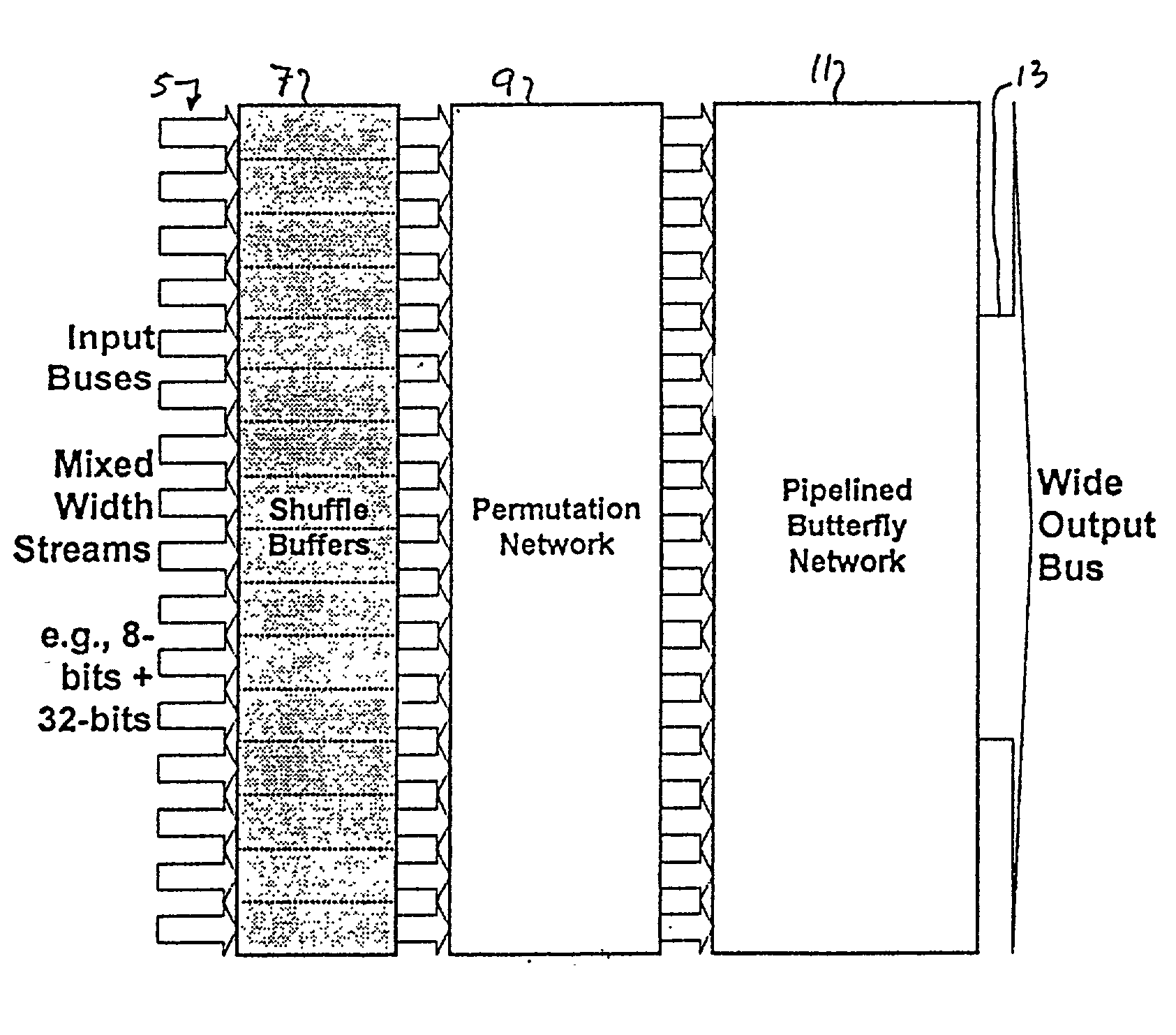
Figure 1 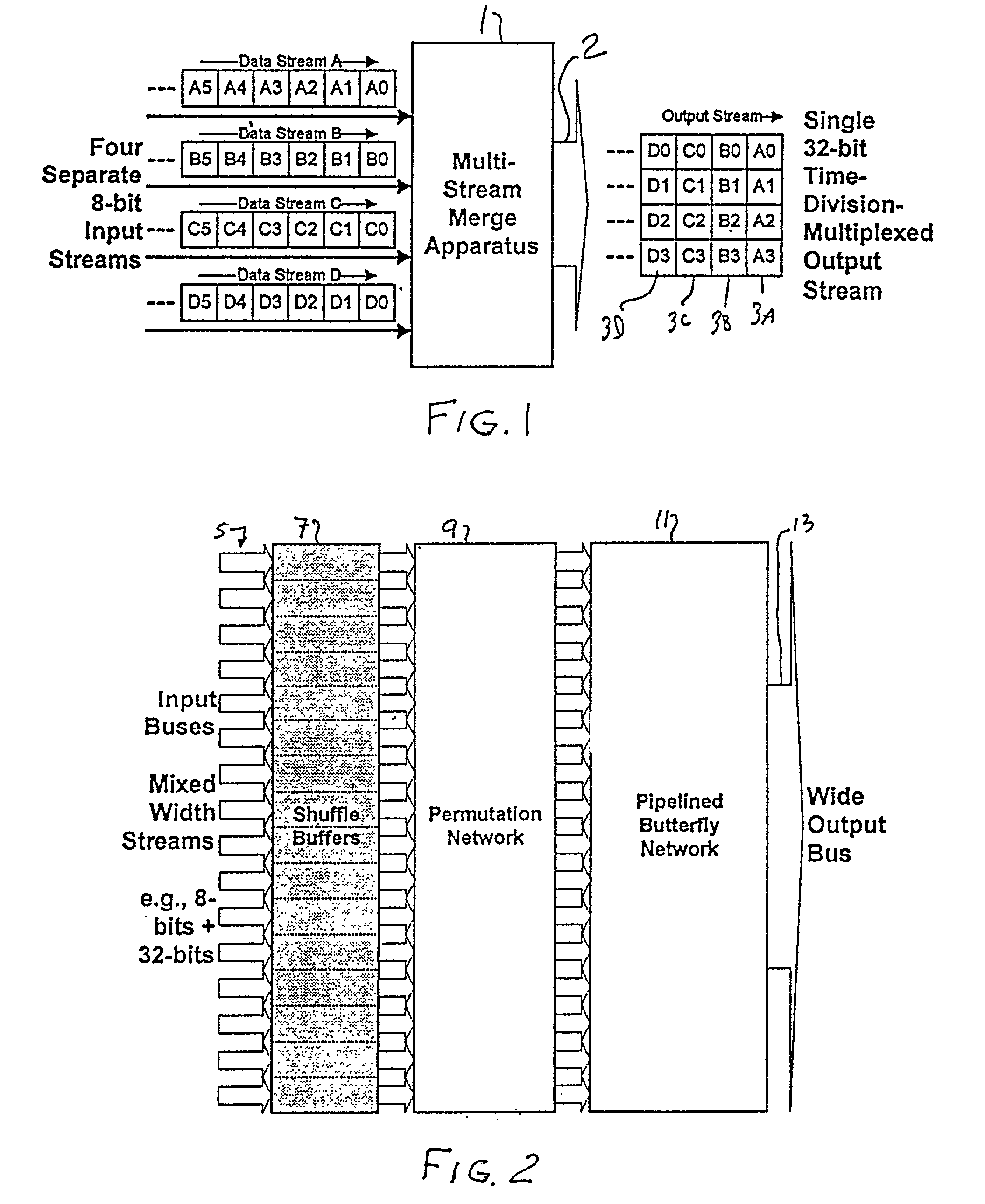
Figure 2 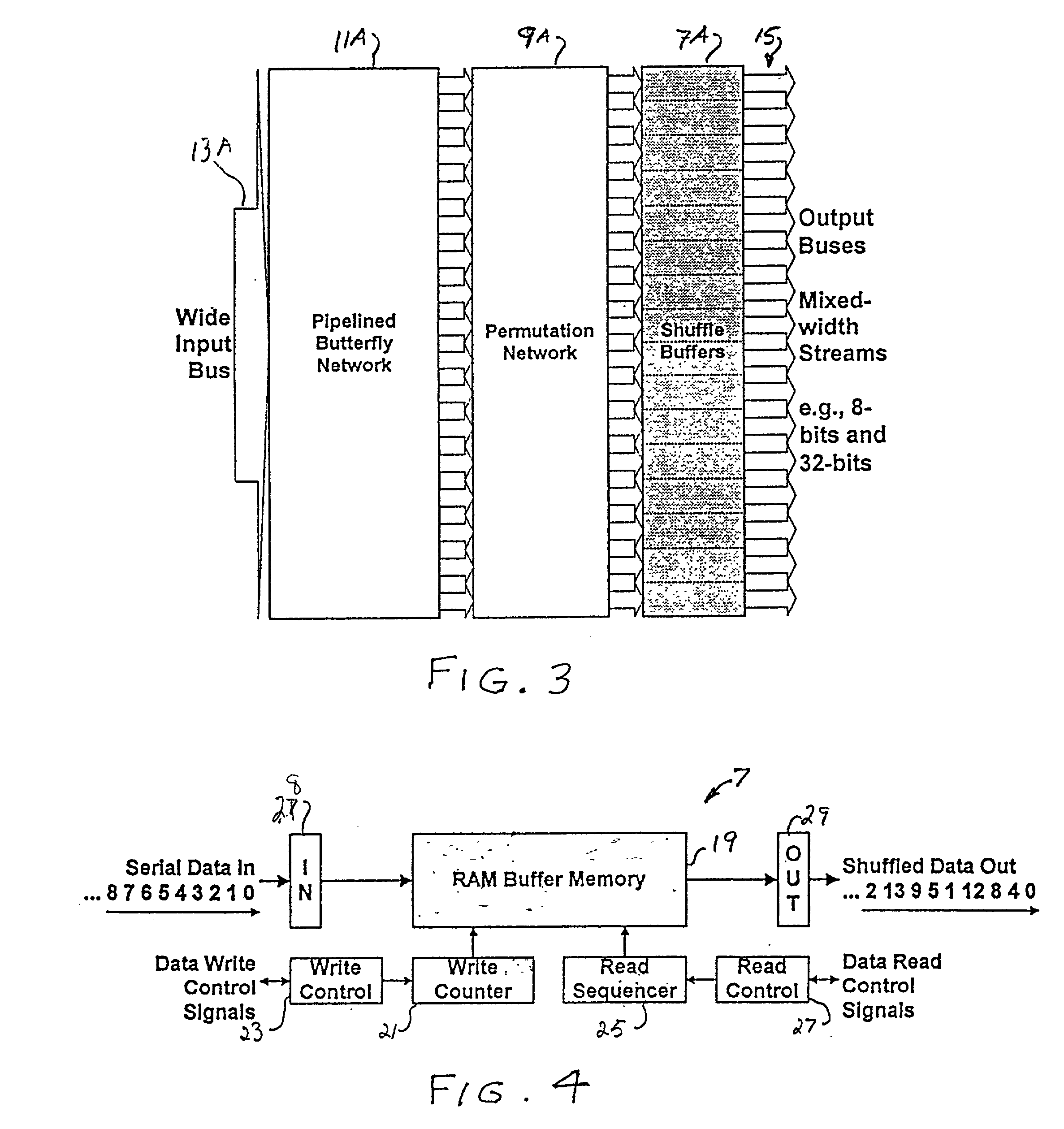
Figure 3
Abstract
Description
[0001] This invention relates to the field of data transmission, and in particular to a system and method for converting data between various widths or formats.BACKGROUND TO THE INVENTION
[0002] It is frequently necessary to convert data between various widths or formats. For example, interconnecting buses of different widths (e.g. an 8-bit bus to be interfaced with a 32-bit bus) requires that data be transformed from or to an 8-bit format to or from a 32-bit format. As an example of a more specific requirement, a physical layer device for a telecommunications network interface may need to convert data widths between an optical fiber link on one side of the interface and a local system bus on the other. The data received from the optical fiber may consist of 8-bit bytes, but must be placed on a 32-bit system bus as contiguous 32-bit words.
[0003] It is also sometimes necessary to merge different data streams received from separate physical entities into a single stream, or to split on...
Examples
Embodiment Construction
[0034] Turning to FIG. 2, a plurality of input buses 5 carry mixed width data streams, having the power of 2 relationship described above, i.e. the various widths of the input data streams are restricted to power of 2 multiples of each other.
[0035] The mixed width data streams are input to a shuffle buffer network 7 formed of a plurality of shuffle buffers. The shuffle buffer network accepts, buffers and reorders incoming data from the multiple different-data-width input buses, if required, as will be described later.
[0036] The output of the shuffle buffer system 7 is applied to a permutation network 9. The permutation network 9 rearranges the different data streams to create interleaved groups based on the input data width, again if necessary as will be described later.
[0037] The output of the permutation network 9 is applied to a pipelined butterfly network 11, which outputs its data to a wide output bus 13. The pipelined butterfly network performs the actual merging and data widt...