
Optical Layer including mu-oxo-bridged boron-subphthalocyanine dimer
a technology of boron-subphthalocyanine dimer and optical layer, which is applied in the field of optical layer, can solve the problems of difficult preparation of homogeneous thin layer, insufficient light resistance and resolvability of subphthalocyanine monomer, etc., and achieves the effects of improving light resistance, high yield, and solvent resolvability and light resistance of -oxo-bridged boron-subphthalocyanine dimer
Patent Information
- Authority / Receiving Office
- US · United States
- Current Assignee / Owner
- Publication Date
- 2008-09-04
- Estimated Expiration
- Not applicable · inactive patent
Smart Images
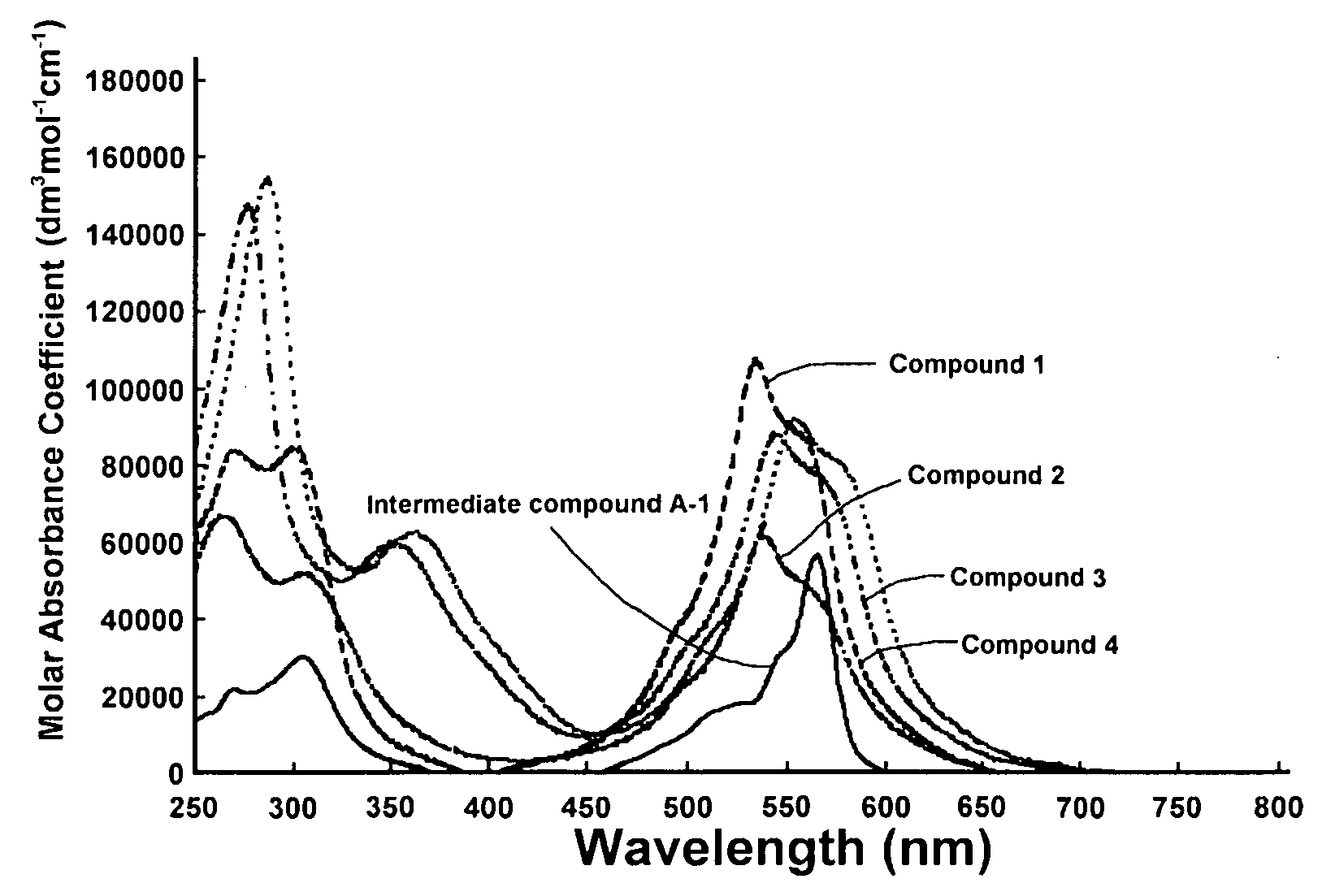
Figure 1 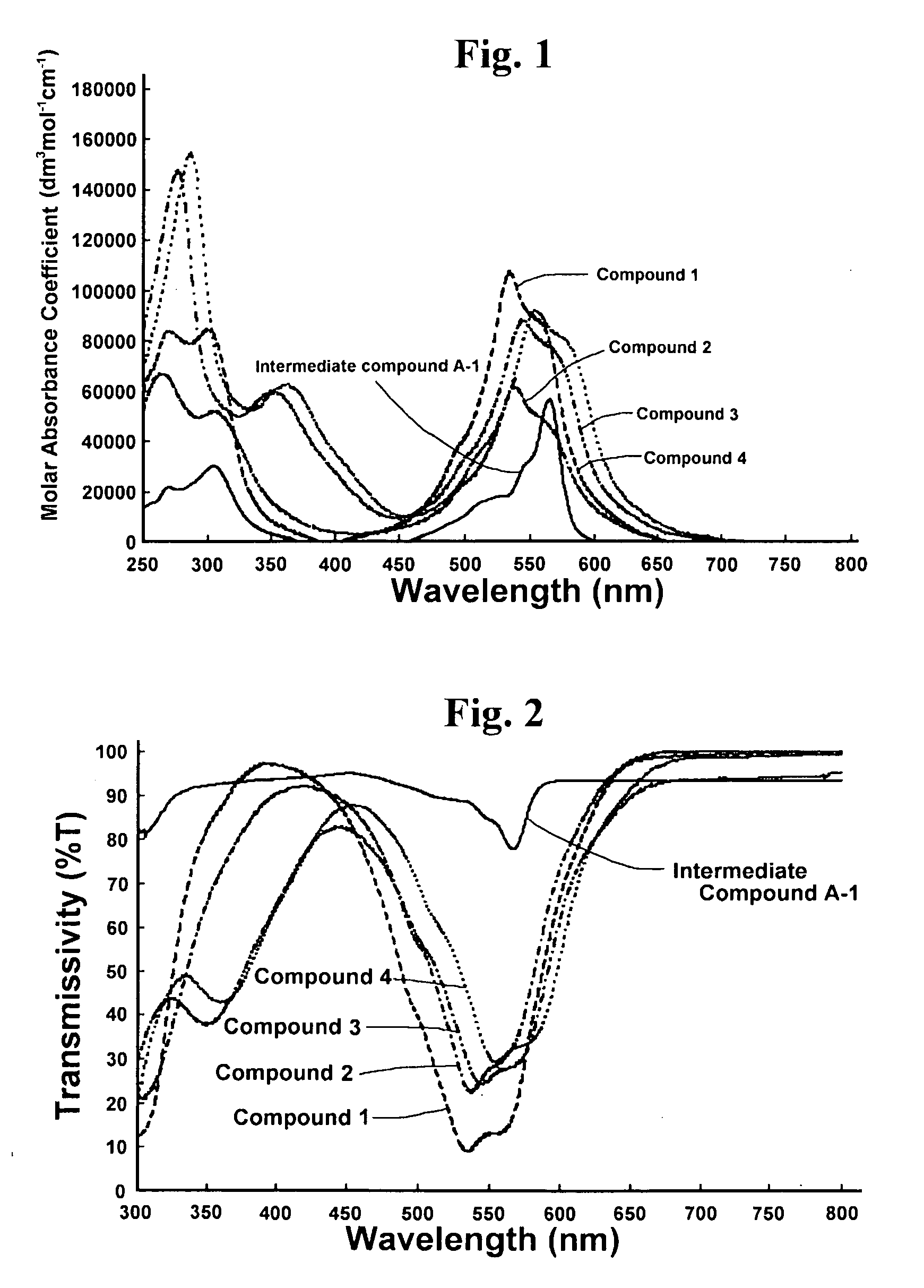
Figure 2 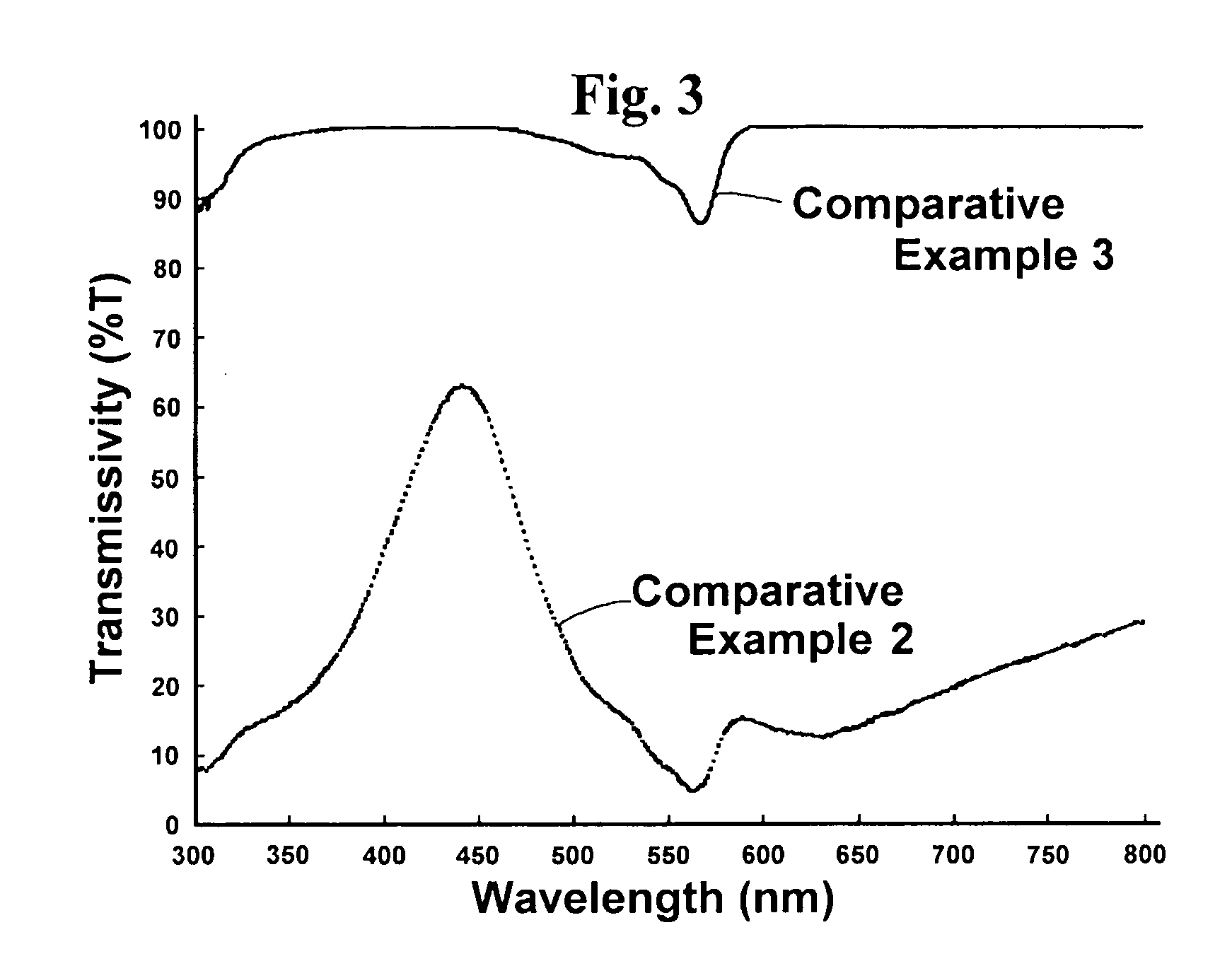
Figure 3
Abstract
Description
TECHNICAL FIELD
[0001] The present invention relates to an optical layer that includes μ-oxo-bridged boron-subphthalocyanine dimer and is used for a functional optical thin layer.BACKGROUND OF THE INVENTION
[0002] An optical layer of a functional optical thin layer such as a light-transmissive layer of an antireflective layer, a color filter and an optical filter and so on is a material that is necessary and important for an apparatus for displaying an image such as a liquid-crystal display and a plasma display.
[0003] Among the optical layers, the antireflective layer is used for coating the surface of the display of a cellular phone or a computer, the windshield of a car and so on. The antireflective layer is used widely as a material that prevents reflection, which is caused by the sunlight or a fluorescent light, from reflecting on the surface of a display. The antireflective layer is also necessary for displaying a clear image on the display. Most of such antireflective layers can ...
Examples
manufacturing example 1
[0099]76.8 g of phthalonitrile, 260 g of p-xylene, and 270 g of 1.0M boron trichloride of p-xylene solution were stirred for 1 hour at reflux temperature under nitrogen gas stream, and 29.3 g of SubPcBCl (Intermediate Compound A-1) was obtained.
[0100]20.0 g of the obtained (Intermediate Compound A-1) was poured into 600 mL of concentrated sulfuric acid of 5 degrees centigrade or less by cooling in order to maintain the temperature thereof at 5 degrees centigrade or less. Then it was stirred for 5 hours at 5 degrees centigrade or less. The solution was poured into 3 liters of iced water in order to slurry and then filtered. It was dispersed in 3 liters of water, stirred for 1 hour under reflux condition and filtered. Then, 12.6 g of SubPcBOH (Intermediate Compound B-1) was obtained.
[0101]13.4 g of the obtained (Intermediate Compound B-1) was poured into 500 ml of ortho-dichlorobenzene, and the solution was stirred for 22 hours under reflux condition. After the reaction, by the proced...
manufacturing example 2
[0108]25.0 g of 4-t-butylphthalonitrile, 58.9 g of p-xylene and 61.3 g of 1.0M boron trichloride of p-xylene solution were stirred for 2 hours at reflux temperature under nitrogen gas stream, and 7.6 g of t-Bu3SubPcBCl (Intermediate Compound A-2) was obtained.
[0109]3.0 g of the obtained (Intermediate Compound A-2) was poured into 50 ml of dimethylformamide and 50 ml of 1N sodium hydrate aqueous solution of 5 degrees centigrade or less. The solution was stirred for 1 hour at 5 degrees centigrade and then for 18 hours at room temperature. By filtering slurry and washing the slurry with 100 ml of 25% of methanol aqueous solution and then with 100 ml of water, 2.6 g of t-Bu3SubPcBOH (Intermediate Compound B-2) was obtained.
[0110]2.0 g of (Intermediate Compound A-2), 2.0 g of (Intermediate Compound B-2) and 1.0 g of sodium hydride were added to 60 ml of xylene, and the solution was stirred for 1 hour at reflux temperature. By the procedures of filtering the reaction solution, concentrati...
manufacturing example 3
[0117]10.0 g of 4-octyloxyphthalonitrile, 16.9 g of p-xylene and 17.6 g of 1.0M boron trichloride of p-xylene solution were stirred for 2 hours at reflux temperature under nitrogen gas stream, and 4.0 g of (C8H17O)3SubPcBCl (Intermediate Compound A-3) was obtained.
[0118]4.0 g of the obtained (Intermediate Compound A-3) was poured into 20 ml of dimethylformamide and 20 ml of 1N sodium hydrate aqueous solution of 5 degrees centigrade or less. The solution was stirred for 1 hour at 5 degrees centigrade and then for 2 hours at room temperature. By filtering slurry and washing the slurry with 200 ml of 50% of methanol aqueous solution, 3.2 g of (C8H17O)3SubPcBOH (Intermediate Compound B-3) was obtained.
[0119]By using the same method as Manufacturing Example 2, 1.07 g (36.5% of yield from the Intermediate Compound B-3) of {(C8H17O)3SubPcB}2O (Compound 3) was obtained from 3.0 g of (Intermediate Compound A-3) and 3.0 g of (Intermediate Compound B-3).
[0120]The evaluation of elementary analy...