

Liquid crystal composition and liquid crystal display device
a liquid crystal display and composition technology, applied in the field of liquid crystal composition, can solve the problems of large contrast ratio of the device, small electric power consumption, and device service li
Patent Information
- Authority / Receiving Office
- US · United States
- Current Assignee / Owner
- Publication Date
- 2009-11-12
- Estimated Expiration
- Not applicable · inactive patent
Smart Images
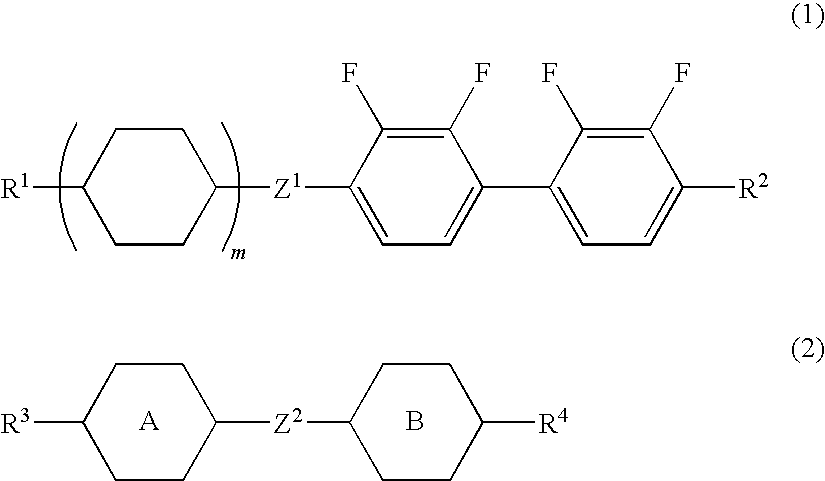
Figure 1 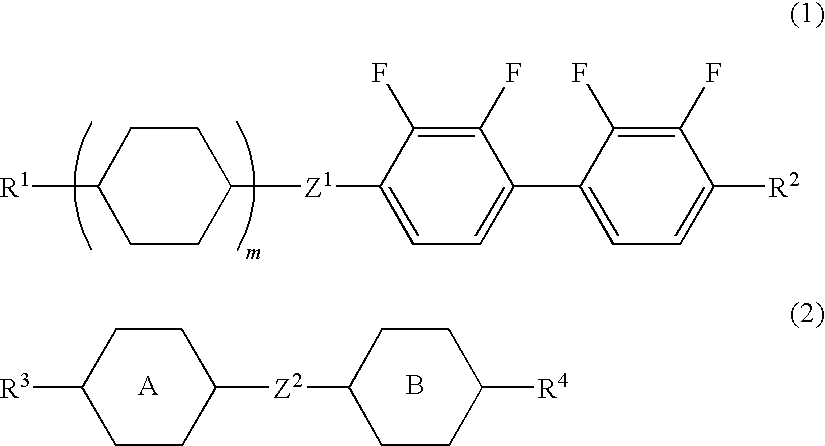
Figure 2 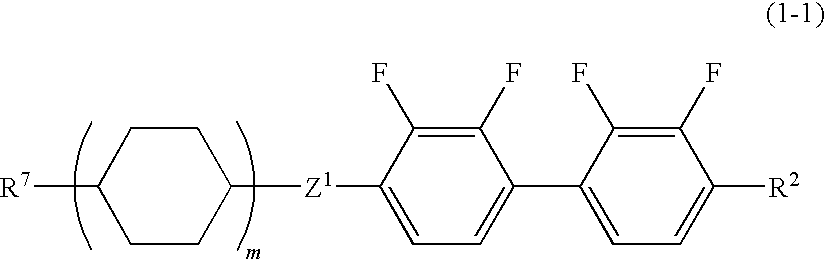
Figure 3
Abstract
Description
CROSS REFERENCE TO RELATED APPLICATIONS
[0001] This application claims priority under 35 U.S.C. §119 to Japanese Patent Application No. JP 2008-122422, filed May 8, 2008, which application is expressly incorporated herein by reference in its entirety.BACKGROUND OF THE INVENTION
[0002] 1. Field of the Invention
[0003] The invention relates to a liquid crystal composition suitable for use in an active matrix (AM) device, and an AM device containing the composition. More specifically, the invention relates to a liquid crystal composition having a negative dielectric anisotropy, and also relates to a device of an in plane switching (IPS) mode, a vertical alignment (VA) mode or a polymer sustained alignment (PSA) mode containing the composition.
[0004] 2. Related Art
[0005] In a liquid crystal display device, classification based on an operating mode of liquid crystals includes phase change (PC), twisted nematic (TN), super twisted nematic (STN), electrically controlled birefringence (ECB), optica...
Examples
example 1
Synthesis of 4′-ethoxy-2,3,2′,3′-tetrafluoro-4-(4′-vinylbicyclohexyl-4-ylmethoxy)-biphenyl (a7)
[0123]
First Step
[0124]In a reactor under nitrogen atmosphere, 50 ml of tetrahydrofuran (THF) was added to 6.15g of magnesium (Mg), followed by stirring at 44° C. 60.0 g of 1-bromo-4-etoxy-2,3-difluorobenzene (a1) dissolved in 130 ml of THF was added dropwise thereto in the temperature range of 38° C. to 49° C. for 1 hour. The resulting solution was added dropwise to a solution of 200 ml of THF and 39.5 g of trimethyl boratein the temperature range of −50° C. to −30° C. The reaction solution was injected into a mixture of 500 ml of 1N hydrochloric acid and 600 ml of ethyl acetate. The mixture was separated into organic layer and aqueous layer, and the organic layer was extracted. The resulting organic layer was washed with saturated chloride aqueous solution and dried over anhydrous magnesium sulfate, and the solvent was concentrated under reduced pressure to provide the residue. The result...
example 2
Synthesis of 4′-ethoxy-2,3,2′,3′-tetrafluoro-4-(trans-4-vinylcyclohexylmethoxy)-biphenylmethoxy)-biphenyl (a10)
[0131]
First Step
[0132]In a reactor under nitrogen atmosphere, 200 ml of toluene was added to 12.0 g of compounds (a8), 7.6 g of imidazole and 29.2 g of triphenylphosphine (Ph3 P), followed by stirring at 5° C. 27.2 g of iodine divided by 10 parts were added thereto in the temperature range of 5° C. to 10° C., followed by stirring for three hours to verify the completion of reaction by GC analysis. The resulting reaction mixture was filtered to remove deposited solid matters, and the solvent was distilled off from the resulting filtered solution under reduced pressure. The resulting residue was purified by column chromatography (heptane, silica gel), dried to provide 15.2 g of 1-iodidemethyl-trans-4-vinylcyclohexane (a9). The compounds (a8) can be produced according to the synthesis methods described in International publication No.2006 / 064853.
Second step
[0133]In a reactor u...
example 3
[0138]The compositions of Example 3 have a smaller viscosity and a shorter response time than those of Comparative Example 1.
3-HH1OB(2F,3F)B(2F,3F)-O4(1)4%5-HH1OB(2F,3F)B(2F,3F)-O4(1)3%3-HHEB(2F,3F)B(2F,3F)-O4(1)3%5-HHEB(2F,3F)B(2F,3F)-O2(1)3%3-HEB(2F,3F)B(2F,3F)-O2(1)6%5-HEB(2F,3F)B(2F,3F)-O2(1)4%V-H1OB(2F,3F)B(2F,3F)-O4(1-1-3)3%V-HH-3(2-1-1)42%1V-HH-3(2-1-1)6%7-HB-1(2-2-1)4%V2-BB-1(2-3-1)6%3-HB(2F,3F)-O2(4-1-1)8%5-HB(2F,3F)-O2(4-1-1)8%NI = 74.4° C.;Tc ≦−20° C.;Δn = 0.086;η = 17.6 mPa · s;Δε = −3.3;Vth = 2.16 V;τ = 7.2 ms;VHR-1 = 99.1%;VHR-2 = 98.2%;VHR-3 = 98.2%.