
Modulators of Itch Ubiquitinase Activity
Patent Information
- Authority / Receiving Office
- US · United States
- Current Assignee / Owner
- Publication Date
- 2009-12-10
Smart Images
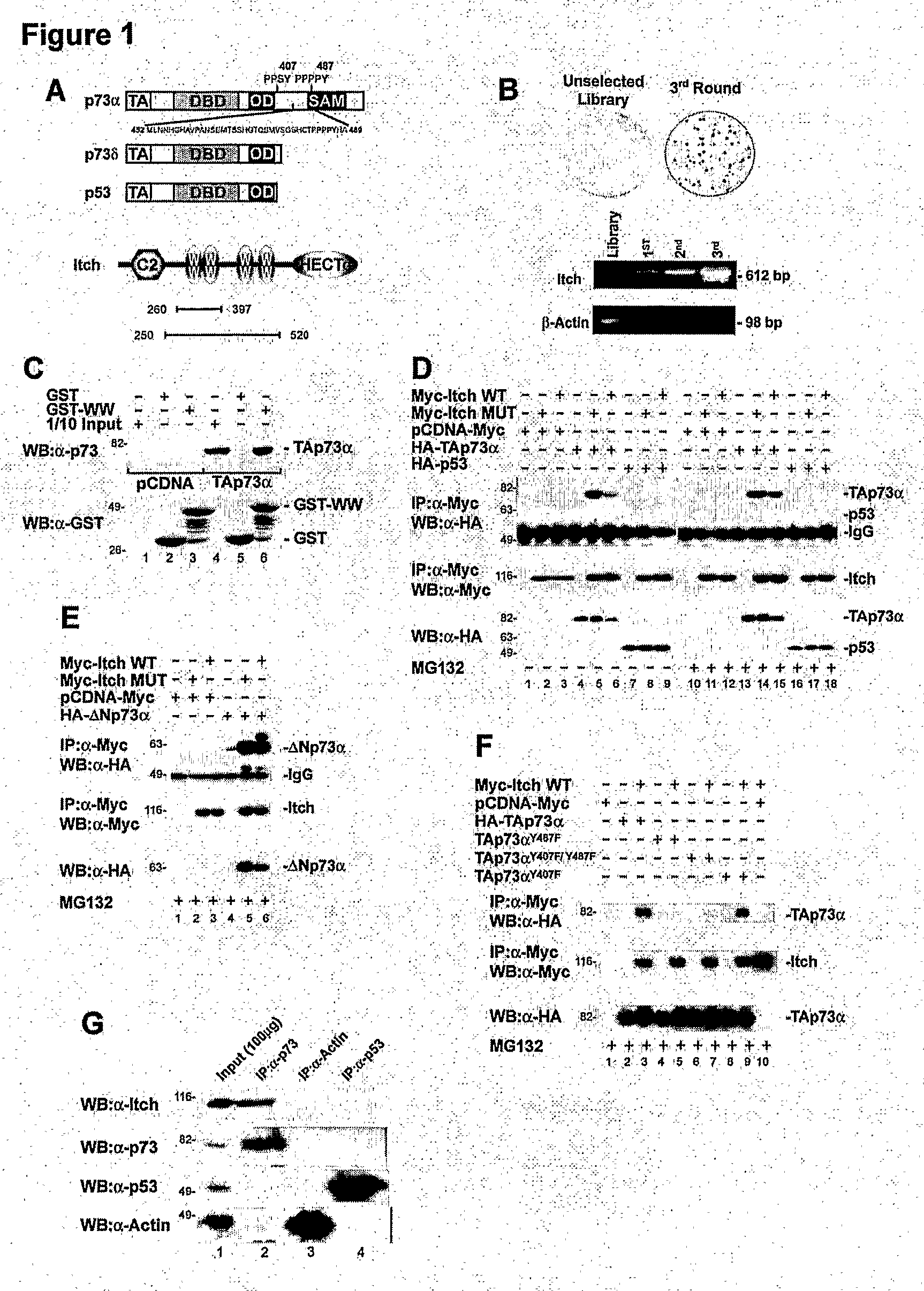
Figure 1 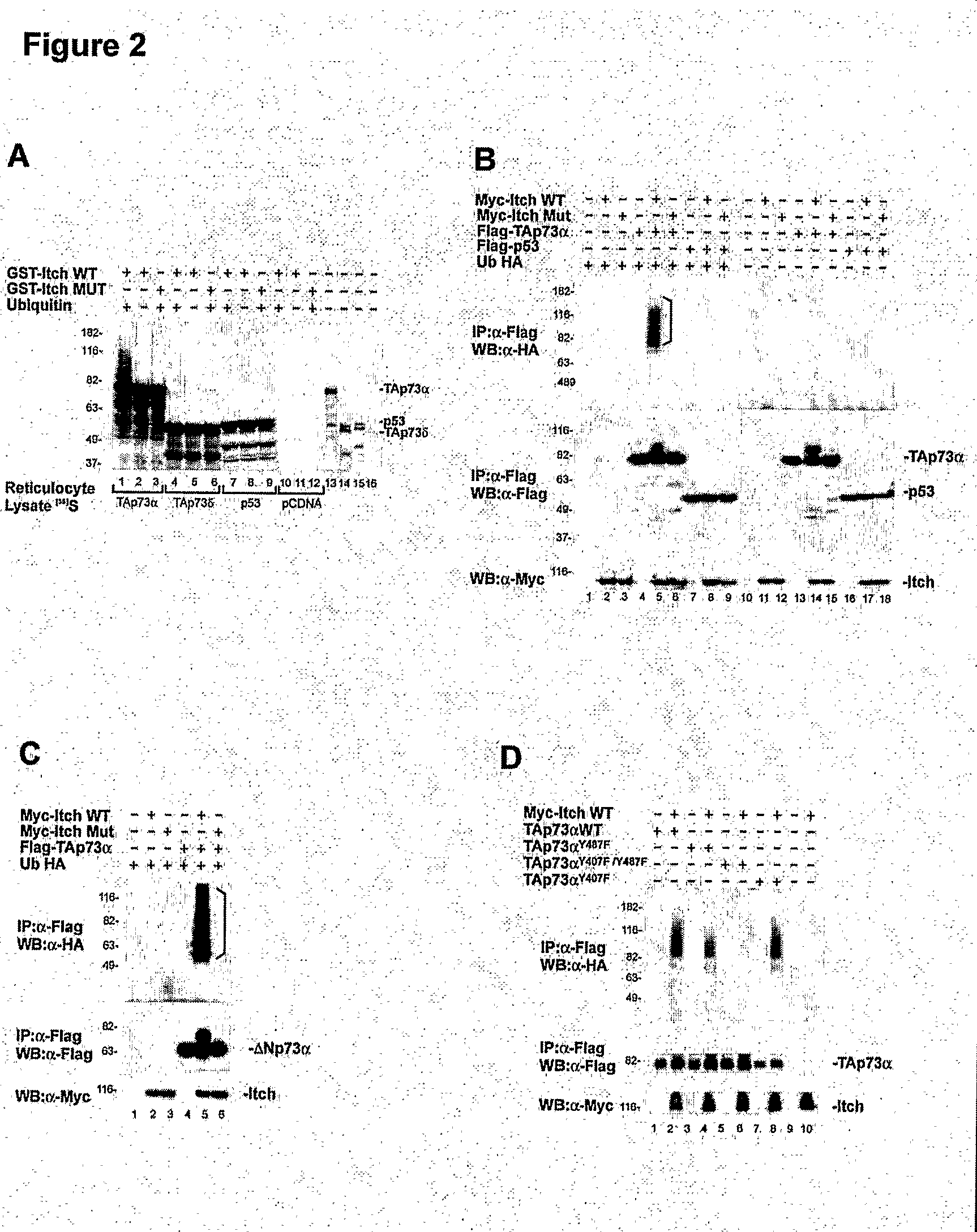
Figure 2 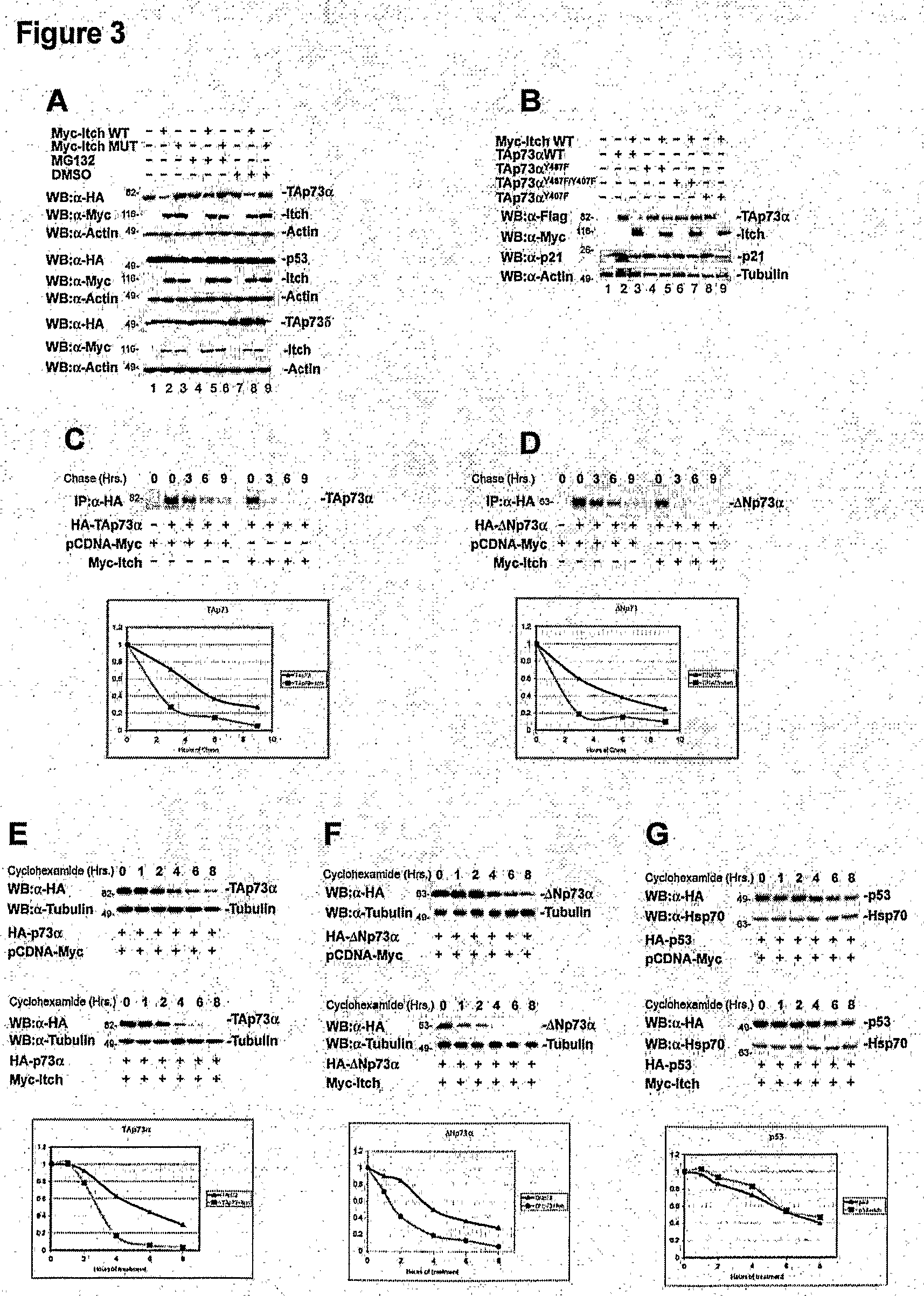
Figure 3
Abstract
Description
[0001] This application is a U.S. National Phase Application pursuant to 35 U.S.C. 371 of International Application No. PCT / GB2006 / 000181, which was filed Jan. 19, 2006, claiming benefit of priority of Great Britain Patent Application No. 0501202.6, which was filed Jan. 20, 2005, which is based on U.S. Provisional Patent Application No. 60 / 646,425, which was filed Jan. 24, 2005. The entire disclosure of each of the foregoing applications is incorporated herein by reference.SUMMARY OF THE INVENTION
[0002] The present invention relates to the identification of new drug targets for therapy of disorders including cancer. In particular, the present invention relates to inhibition of the E3 ubiquitin ligase, Itch, as a means for treating disorders. Furthermore, the present invention relates to the regulation of p63 and p73 stability in cells. In particular, the invention relates to the modulation of the regulation of p63 and p73 stability in cells through modulation of the expression or acti...
Examples
example 1
The Ubiquitin-Protein Ligase Itch Regulates p73 Stability
Materials and Methods
Plasmids
[0258]Myc-Itch and Myc-Itch MUT plasmids (C830A) were provided by Dr. T. Pawson (Winberg, 2000). Itch GST fusion proteins, were generated by subcloning PCR fragments into the BamHI and SalI sites of pGEX-6P1 (Amersham Pharmacia Biotech). The following fragments were cloned: GST-Itch, from Thr 277 to Glu 903 (lacking the N-terminal C2 domain) and GST-WW, from Pro 317 to Pro 520 (spanning only the four WW domains). HA-p73α and HA-p73δ were described previously (De Laurenzi, 1998). GST-p73 fusion protein encompassing only the PY motif (GST-PY, from Met 452 to Ala 489) was obtained by subcloning into BainHI and NotI sites of the pGEX-6P1. The poly-HA-ubiquitin construct (HA-Ub) was kindly provided by Dr. D. Bohmann (Treier, 1994). pET23a-Ubch7 (E2) bacterial expression vectors directing the synthesis of the E2 enzyme (Ubch7) and the E1 ubiquitin-activating enzyme Uba1 were a gift of Dr. P. M. Howley (K...
example 2
An Interaction Between p63 and ITCH
Methods
Plasmids
[0289]Myc-Itch and Myc-Itch MUT plasmids (C830A) were provided by Dr. T. Pawson. Flag-TAp63α and Flag-ΔNp63α were obtained by subcloning the cDNA TAp63α and ΔNp63α into NheI and NotI sites of the pCDNA3.1. The HA-ubiquitin construct (HA-Ub) was kindly provided by Dr. D. Bohmann.
Cell Culture and Transfection
[0290]Human embryonal kidney cells (Hek293), HeLa cells and MEFs were grown in Dulbecco's modified Eagle medium (DMEM) (GibcoBRL); the human lung carcinoma cells H1299 and the human osteosarcoma cells Saos-2 were cultured in RPMI (GibcoBRL). Itch− / − MEF cells were prepared from Itch− / − mice (Y-C-Liu) or they were generous gift from Neil Copeland, Lynda Matesic, Nancy Jenkins. All media were supplemented with 10% (v / v) fetal bovine serum (FBS) (GibcoBRL). All cell lines were grown at 37° C. in a humidified atmosphere of 5% (v / v) CO2 in air. Transient transfection was performed with lipofectamine 2000 reagent according to the manufac...
example 3
Effects of Down-Regulation of Itch in Cancer Cell Lines
Materials and Methods
Cell Culture and Transfections
[0303]H1299 and Saos-2 were grown in RPMI medium (GibcoBRL 31870), and HeLa, MCF7, HEK293, HEK293T, A549, A431, Cos-1, cells were grown in Dulbecco's modified Eagle's medium (GibcoBRL 61965), U2OS and HCT116 were grown in McCoy's 5A media (GibcoBRL), SH-SY5Y were grown in 50% F12 / 50% DMEM (Gibco 31330). All media were supplemented with 10% (vol / vol) fetal bovine serum (GibcoBRL), and cells were cultured at 37° C. in a humidified atmosphere of 5% (vol / vol) CO2 in air. Transient transfections were performed with Lipofectamine 2000 or Calcium Phosphate reagents according to the protocol of the manufacturer (Invitrogen).
Plasmids
[0304]The pSUPER-ITCH2, pSUPER-ITCH18 and pSUPER-scrambled vectors were generated by insertion in pSUPER vector (OligoEngine) of oligos targeting the following sequences:
ITCH 2,AAACATTAAAGTCAAACAATATG,ITCH 18AAGGAGCAACATCTGGATTAATA,
(These sequences are 100% i...