
Method of generating compound type combined public key
Patent Information
- Authority / Receiving Office
- US · United States
- Current Assignee / Owner
- Publication Date
- 2011-07-14
- Estimated Expiration
- Not applicable · inactive patent
Smart Images
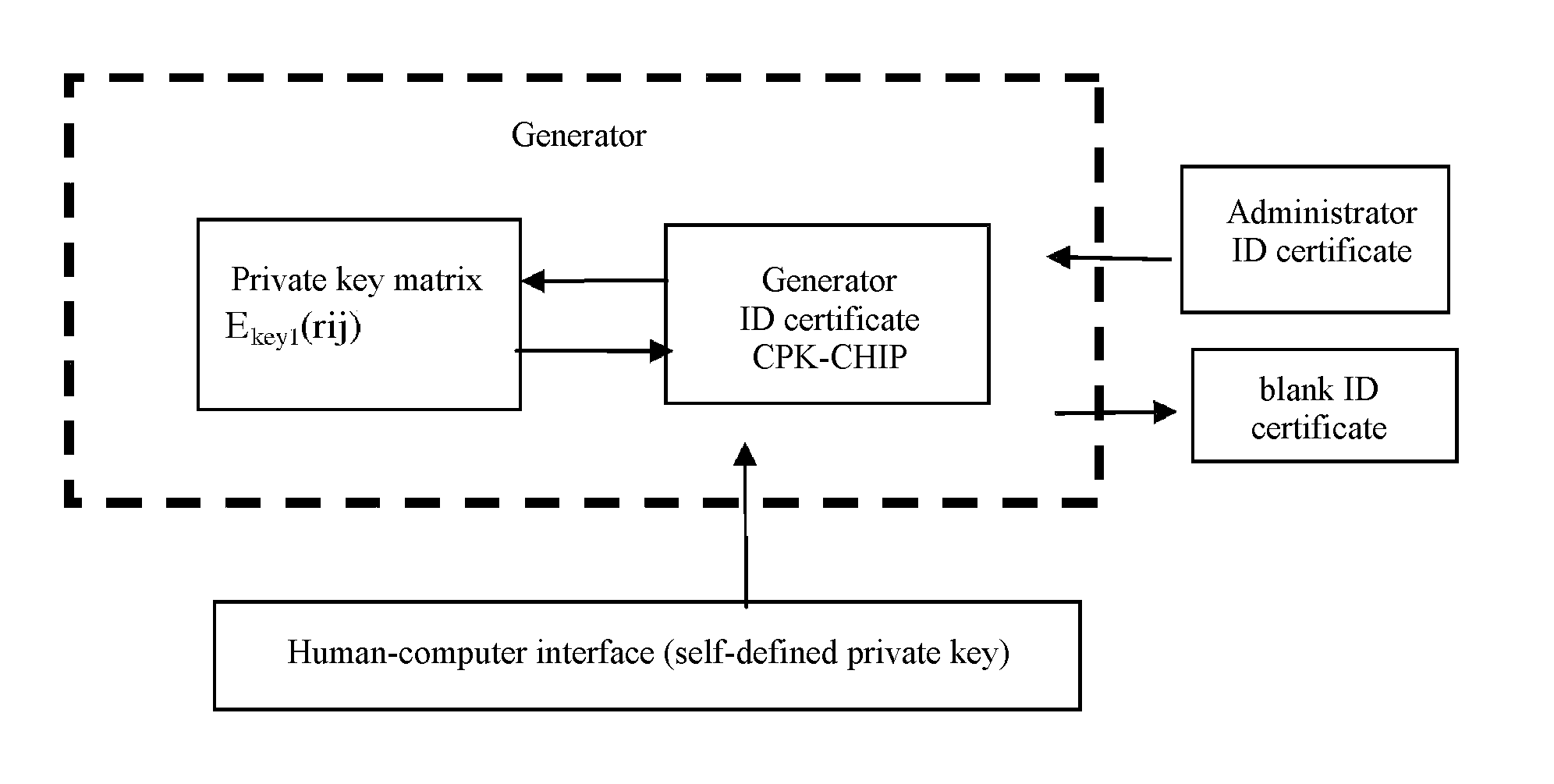
Figure 1 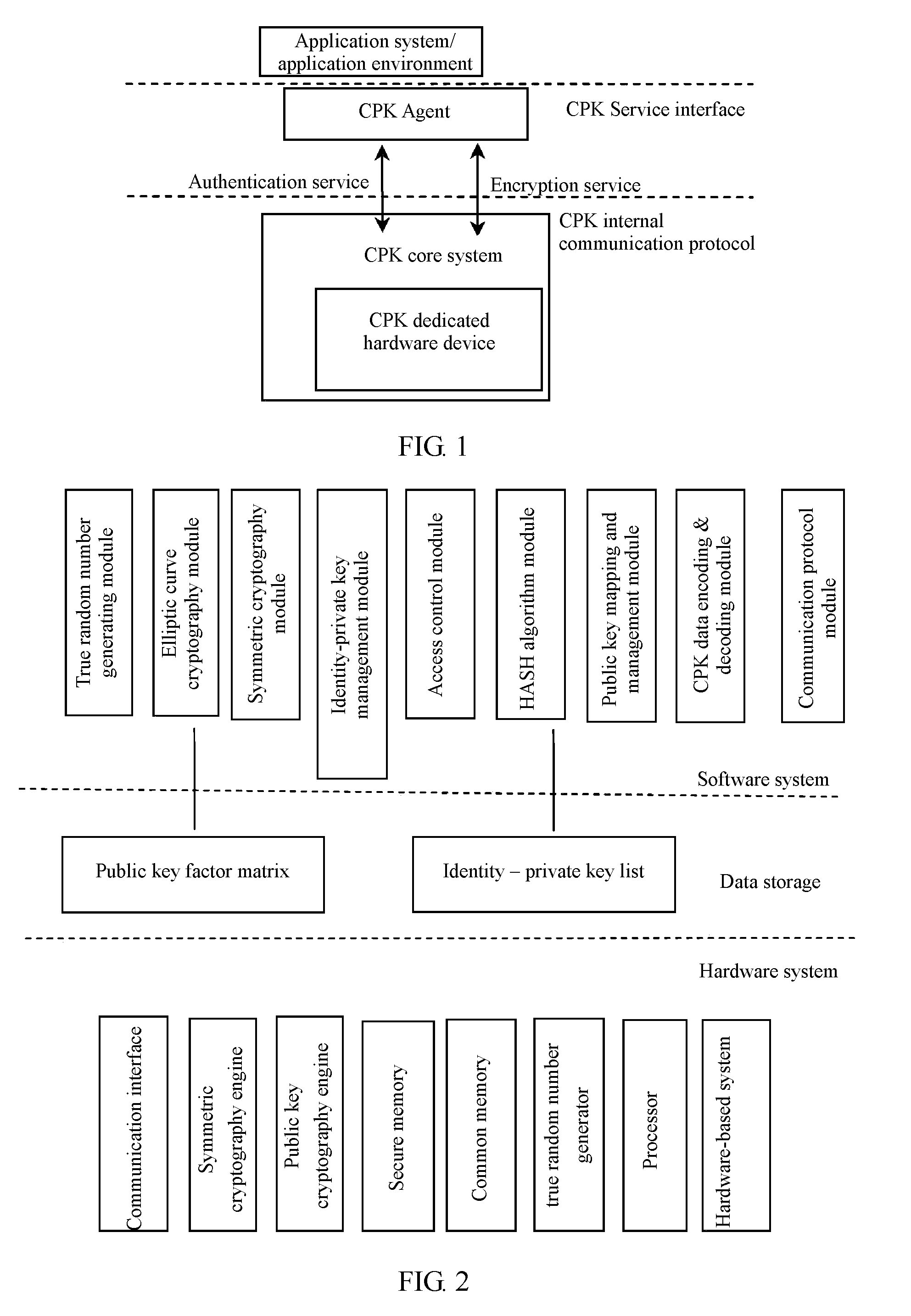
Figure 2 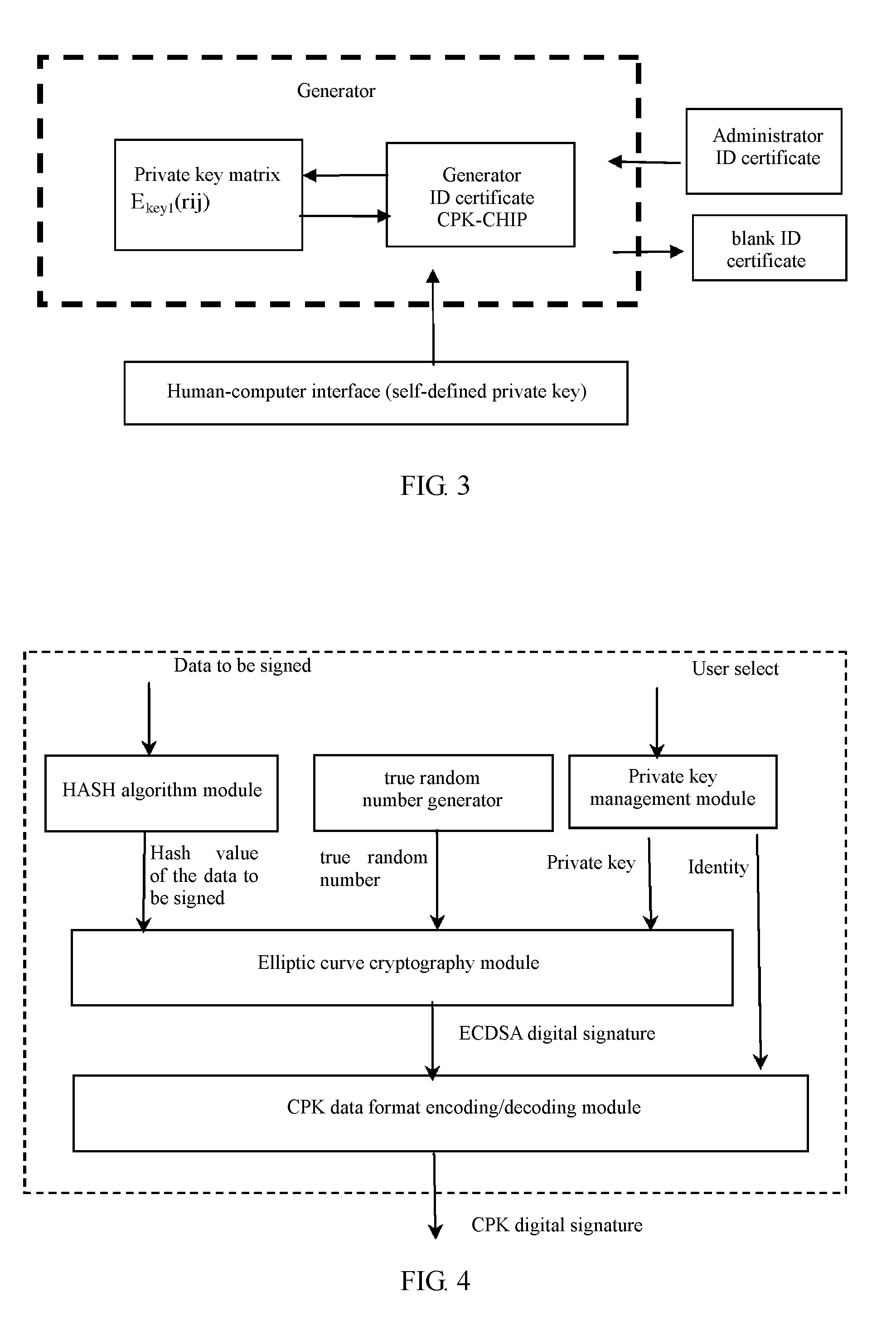
Figure 3
Abstract
Description
FIELD OF INVENTION
[0001] This invention relates to crypto-system and identity authentication field. In particular, it relates to a CPK-based compound type combined public key generating method.BACKGROUND OF THE INVENTION
[0002] Information security mainly relates to authentication technology and data security. Authentication technology mainly relies on authentication protocol and digital signature algorithm. Data security relies on key exchange protocol.
[0003] One kind of digital signature requires that the signature key is defined by individual to ensure privacy and exclusiveness, so that no one else can have the same signature key, including the key management center. Key exchange requires to be uniformly defined by the key management center, to realize no-handshaking key exchange as much as possible, so as to fit for network grouping communication of storage and forwarding, and the nation can interfere if necessary.
[0004] Thus, internationally the common practice is that key exchange ...
Examples
example 1
Entity Identity Authentication
[0282]In a transaction, business relationship between the entities came first, which involves authentication of the entity identity and authentication of data. If data contains seal, such as the seal of a corporate, an account number, a bank, and special seal for financial affairs, etc., then authentication the seal identity will further be involved.
[0283]The initiator of the transaction is the prover, who shall provide proof of authenticity for the entity identity and for the data. Proof of authenticity for the entity is the signature of the entity's identity to the identity itself. Proof of authenticity for the data is the signature of the entity's identity to the data (entity level / user level). Proof of authenticity for the seal is the signature by the seal's identity to the seal itself (identity level). If privacy is desired, support by key exchange may be used, for example:
[0284]identity signature: SIGentity idnetity (TAG);
[0285]data signature: SIG...
example 2
E-Note Authentication
[0291]See the Applicant's prior application no. 200610081134.6 entitled “CPK-based e-note trusted authentication system and method”, which is incorporated herein by reference in its entirety.
[0292]In e-note, the relationship between proof and verification is as follows:
[0293]Three signatures are needed, for such as account number, name, and unit, e.g.:
sign1=SIGaccount number (mac);
sign2=SIGname (mac);
sign3=SIGunit (mac);
[0294]The note file and the signature field are prepared into one file, such as the note file as shown in FIG. 5.
[0295]The verification system in the bank server verifies each digital signature upon receiving the e-note.
[0296]The e-note along with the digital signature can be stored in the database in the form of electronic document, or can be printed out as hardcopy. Both have same effects as the true note.
example 3
Software Tag Authentication
[0297]See the Applicant's prior application no. 200610081133.1 entitled “CPK-based trusted authentication system”, which is incorporated herein by reference in its entirety.
[0298]Transaction between users is carried out through the computer, and hence there is a demand for trusted computing. The trusted computing needs to solve three problems: 1. whether the program shall be loaded; 2. whether the program is loaded correctly; 3. whether the program is running as expected. As the first checkpoint for trusted computing, i.e., whether the program shall be loaded is very important. It can be solved using the identification technology of process identity. If the identity is illegitimate, loading is denied. Thus, the malicious software such as virus cannot take effect even if successfully invaded. The software tag authentication needs the coding signing technology to solve the problem.
[0299]For a banking system, if no software other than those approved by the ba...