
Methods to identify macromolecule binding and aggregation prone regions in proteins and uses therefor
Patent Information
- Authority / Receiving Office
- US · United States
- Current Assignee / Owner
- Publication Date
- 2011-10-20
- Estimated Expiration
- Not applicable · inactive patent
Smart Images

Figure 1 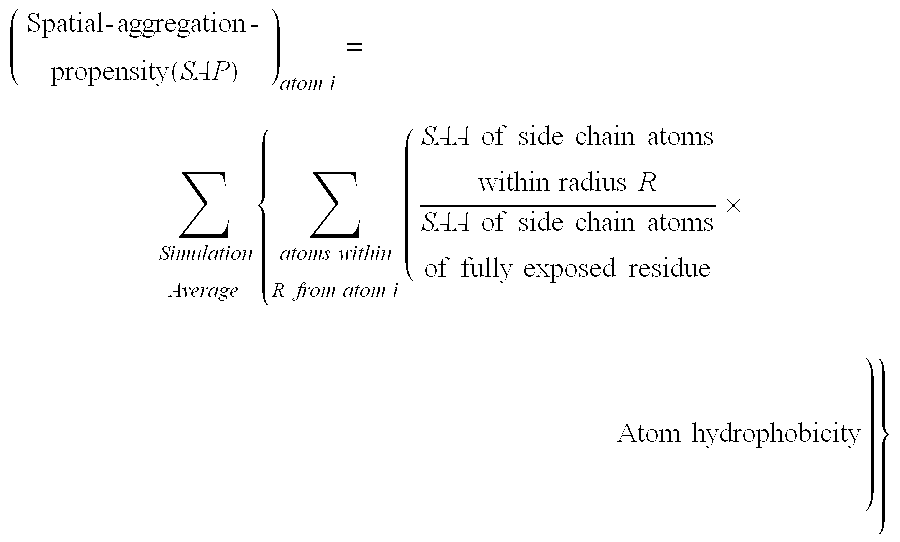
Figure 2 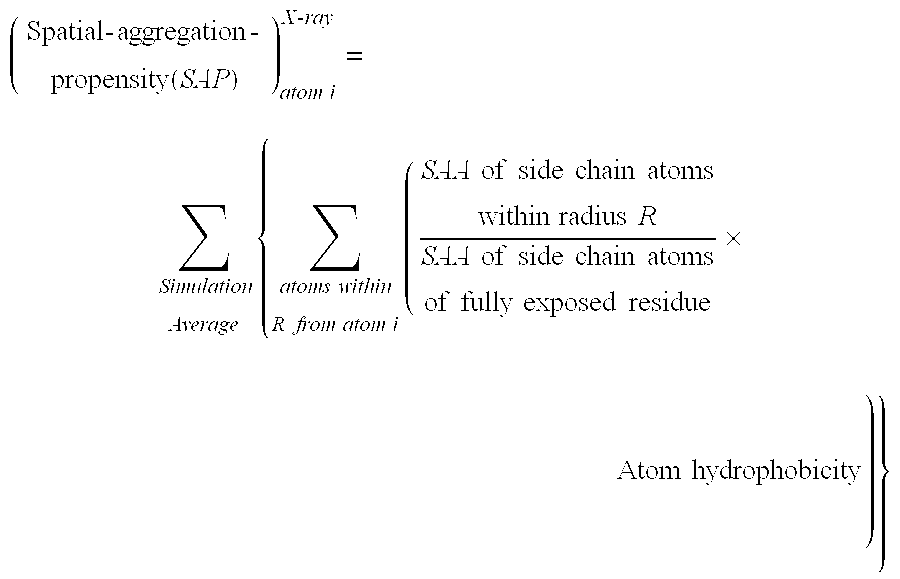
Figure 3
Abstract
Description
BACKGROUND OF THE INVENTION
[0001] Understanding and controlling protein stability has been a coveted endeavor to Biologists, Chemists, and Engineers. The first link between amino acid substitution and disease (Ingram. Nature. 1957, 180(4581):326-8.) offered a new and essential perspective on protein stability in health and disease. The recent tremendous increase of protein-based pharmaceuticals has created a new challenge. Therapeutic proteins are stored in liquid for several months at very high concentrations. The percent of non-monomeric species increases with time. As aggregates form, not only the efficacy of the product decreases, but side effects such as immunological response upon administration may occur. Assuring stability of protein pharmaceuticals for the shelf-life of the product is imperative.
[0002] Because of their potential in the cure of various diseases, antibodies currently constitute the most rapidly growing class of human therapeutics (Carter. Nature Reviews Immunol...
Examples
example 1
Molecular Dynamics Simulation Methodology
[0147]Molecular dynamics simulations were performed for a full antibody using an all atom model. The initial structure for simulation for the full antibody was obtained from the X-ray structures of individual Fab and Fc fragments. The X-ray structure of a proof-of-concept (POC) Fab fragment was selected for modeling onto the X-ray structure of Fc obtained from the IgG1 antibody 1HZH (Saphire et al., Science. 2001, 293, 1155). 1HZH was chosen since the X-ray structure is known for the full antibody and since the Fc structure is the same for all of the IgG1 class of antibodies. The structure of a full POC antibody was then obtained by aligning the Fab and Fc fragments using the 1HZH structure as a model template. In order to align the fragments at the correct distance and orientation, the RMSD (Root Mean Square Deviation) was minimized between the common CYS residues of the fragments and the full antibody template (1HZH). The CYS residues were ...
example 2
Calculation of the Spatial Aggregation Propensity (SAP)
[0150]In order to overcome the shortcomings of SAA, a new parameter was defined called ‘Spatial-Aggregation-Propensity’ as described above.
[0151]In this example the ‘Spatial-Aggregation-Propensity’ was calculated for spherical regions with radius R centered on every atom in the antibody described in Example 1. The value of Spatial-Aggregation-Propensity was thus evaluated with a 3Ons simulation average for the Fc-fragment of the antibody for two different radii of patches (R=5 Å, 10 Å) (One of skill in the art will appreciate various time steps for simulation may be chosen according to the computational resources available and the desired resolution of the result). In both cases it was noticed that the majority of values were negative, indicating that most exposed regions are hydrophilic. This was as expected since most of the exposed protein surface is usually hydrophilic. It was also observed that there are a few regions with ...
example 3
Selection of Antibody Sites for Stability Engineering
[0157]The sites to be engineered for enhanced antibody stability were selected on the basis of the SAP parameter. This spatial parameter accounts for (1) Solvent accessible area (SAA) of each residue, (2) the residue's hydrophobicity, and (3) the spatial contributions of all residues within a certain radius. In this example, the hydrophobic residues that correspond to the positive peaks in CH2 were changed to non-hydrophobic residues. It was expected that this would improve the overall protein stability. The two selected sites (A1 and A2) correspond to two very hydrophobic residues. An analysis was undertaken of substitutions of these residues with lysine, a very hydrophilic amino acid with a positively charged side chain. Variant A1 and Variant A2 differ from wild-type by single amino substitution.