
Automated multi-point probe manipulation
Patent Information
- Authority / Receiving Office
- US · United States
- Current Assignee / Owner
- Publication Date
- 2012-05-17
Smart Images
Figure 1 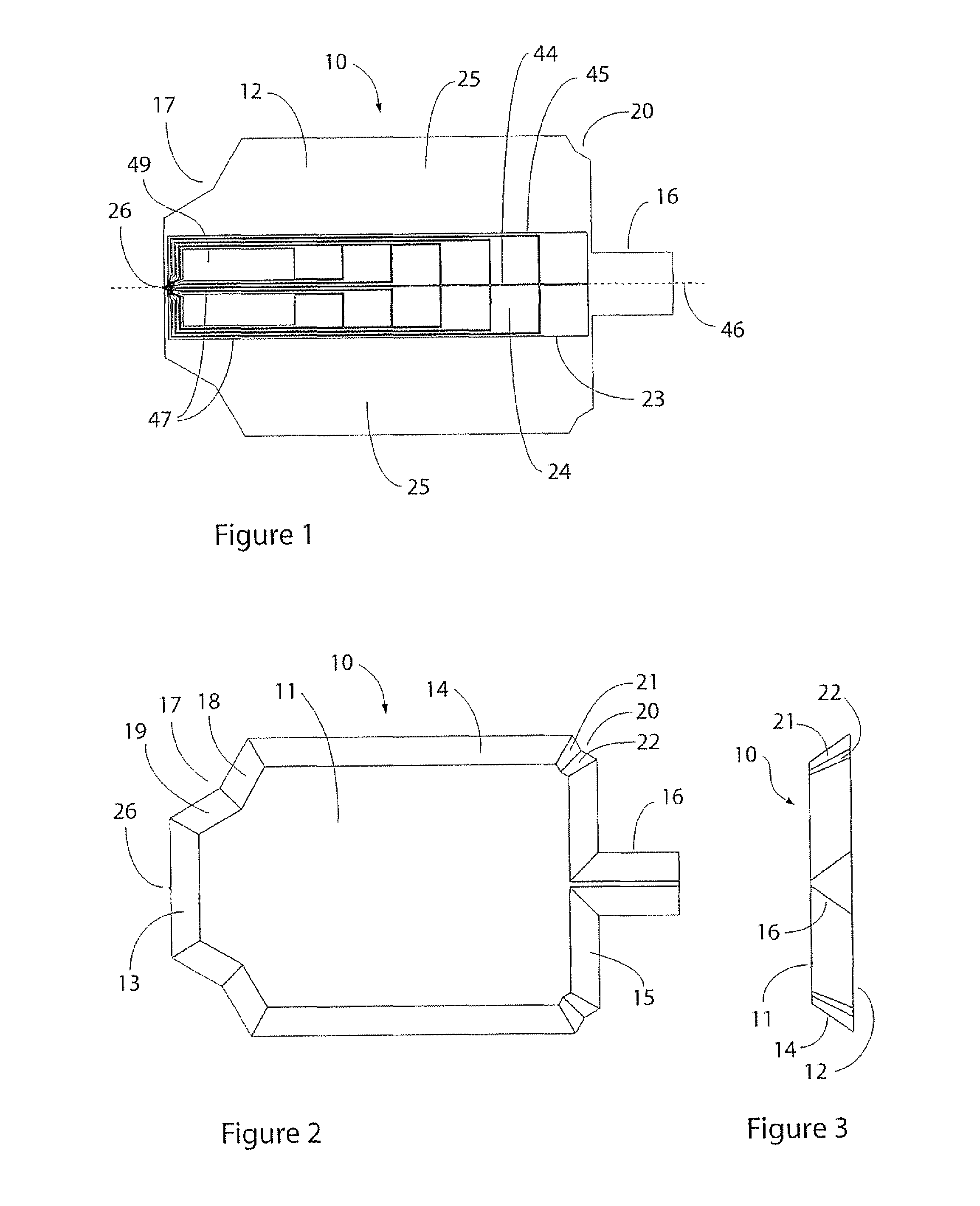
Figure 2 
Figure 3
Abstract
Description
CROSS-REFERENCE TO RELATED APPLICATION
[0001] This application is a national phase filing, under 35 U.S.C. §371(c), of International Application No. PCT / EP2010 / 054180, filed Mar. 30, 2010, the disclosure of which is incorporated herein by reference in its entirety.FEDERALLY SPONSORED RESEARCH OR DEVELOPMENT
[0002] Not ApplicableFIELD OF THE INVENTION
[0003] The present invention generally relates to the handling of and measuring by multi-point probes, and in particular to the improving of the security and accuracy in automated handling. More specifically, the present invention relates to a multi-point probe, a probe holder, a probe cassette, a probe manipulator head, and a probe loader, which contribute to improve the security and accuracy.DESCRIPTION OF RELATED ART
[0004] The handling of multi-point probes involves a significant amount of manual intervention, e.g. when loading them into measuring systems or manipulators. This presents a significant risk, as the tips or arms of the multi-po...
Examples
example
[0183]A prototype implementation of the presently preferred embodiment described above was built, where the probe 10 was manufactured of Silicon, Silicon-di-oxide and Poly-silicon and the bevelled front 13, side 14 and end faces 15 were achieved through KOH etching. The engraved cuts 23 were provided via a combination of isotropic and anisotropic etching with BHF (buffered Hydrofluric acid) and ASE (Advanced Silicon Etching). The metal layer was of Titanium and Nickel and provided via e-beam evaporation, while the oxide layer was Silicon-di-oxide and provided through a thermal growth process.
[0184]For the probe holder, the support column 50 and brackets 51 were made by injection moulded ABS, which gave a sufficiently flexible bracket neck 54, but at the same time a sufficiently rigid support column 50. The cover 110 of the probe cassette 100 had a cassette housing 114 of milled industrial aluminium and a handle 129 of cast and milled industrial aluminium. For the cassette rack 140 t...