
Use of iminocyclitols as inhibitors of bacterial adherence to epithelial cells
a technology of iminocyclitols and inhibitors, which is applied in the direction of antibacterial agents, biocide, heterocyclic compound active ingredients, etc., can solve the problems of intestinal discomfort, diarrhoea, and the necessary active mannose concentration to produce inhibition, so as to prevent and/or treat bacterial infections, inhibit bacterial adherence, and prevent and/or coadjuvant treatment
Patent Information
- Authority / Receiving Office
- US · United States
- Patent Type
- Applications(United States)
- Current Assignee / Owner
- Publication Date
- 2013-01-10
- Estimated Expiration
- Not applicable · inactive patent
Smart Images
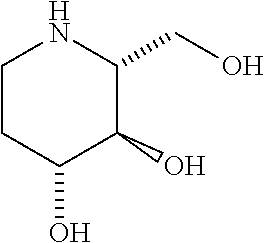
Figure 1 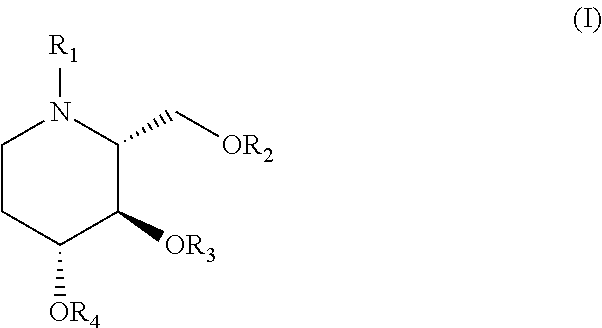
Figure 2 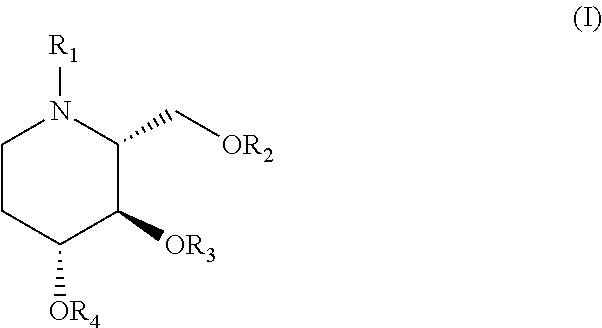
Figure 3
Abstract
Description
[0001] The present invention relates to the use of iminocyclitols in the prevention and / or coadjuvant treatment of bacterial infections or microflora imbalances, as well as to pharmaceutical, veterinary, or food compositions containing them.BACKGROUND ART
[0002] Bacterial adherence to mucosal surfaces is considered to be an important prerequisite for colonization and infection. A variety of molecules and macromolecular structures, collectively known as adhesins, binding entity coming from the bacterium, recognized and interact with receptors on the surface on the host cells.
[0003] Three principal types of adhesin-receptor interactions have been described. The first type of adhesive interaction is due to the binding of lectins with carbohydrate structures. The second type, of which a significant number of cases are known, involves recognition between a protein on the bacterium and a complementary protein on the mucosal surface. The third type, comprises the binding interactions that occu...
Examples
example 1
Bacterial Agglutination Assay
[0063]Bacteria used in the assay were Escherichia coli, Salmonella tphimurium and Streptococcus mutans, from over night cultures. The bacteria were inoculated in the 100 ml flask with Luria medium. The bacteria were grown for 24 h at 37° C. After incubation, Agar Luria medium plates were inoculated. After 24 h suspensions of each strain were prepared in PBS medium (108 CFU / ml). Serial dilutions of the products to be tested, D-fagomine and D-fagomine tartrate (20 ppm, 200 ppm, 2000 ppm) were made. The dilutions were mixed with bacterial suspensions in a 1:1 ratio. After 90 min. at room temperature the suspensions were observed under optical microscope. They were compared with the control culture without any product added. It was found that the two products assay at 20 ppm, 200 ppm and 2000 ppm, agglutinated the cells of the three strains.
[0064]When the bacteria are agglutinated they lost their ability to adhere to other cells or substrate.
example 2
Bacterial Agglutination Assay
[0065]Bacteria used in the assay were Escherichia coli, Salmonella tphimurium, Streptococcus mutans, Lactobacillus casei and Bifidobacterium sp., from over night cultures. The bacteria were inoculated in the 100 ml flask with Luria medium. The bacteria were grown for 24 h at 37° C. After incubation, Agar Luria medium plates were inoculated. After 24 h suspensions of each strain were prepared in PBS medium (108 CFU / ml). Serial dilutions of the product to be tested, D-fagomine tartrate (10 ppm, 20 ppm, 2000 ppm) were made. The dilutions were mixed with bacterial suspensions in a 1:1 ratio. After 90 min. at room temperature the suspensions were observed under optical microscope. They were compared with the control culture without any product added. The Escherichia coli and Salmonella tphimurium were compared with a positive control culture (mannose 0.05 M).
[0066]It was found that the product assay, at 20 ppm and 200 ppm, agglutinated the cells of the three ...
example 3
Anti-Adherence Activity of D-Fagomine against Streptococcus mutans
[0067]Glass surface adherence assay was performed. The bacterium used in the assay was Streptococcus mutans from over night cultures (1 1010 UCF / ml). The bacterium was grown for 18 h at 37° C. in PBS medium. The bacteria from the overnight culture (0.25 ml) were grown for 18 h at 4° C. in a glass dish with the specific medium (0.5 ml). After the 18 h, 0.25 ml of D-fagomine (10 ppm, 20 ppm and 40 ppm) was added. In the control plate was added only PBS. After 90 min. the cells were transfered (0.5 ml) to a falcon tube, then were washed two times with PBS (0.5 ml each time). The wash of each bacteria was collected in a falcon tube and was kept at 4° C. The cells (100 μl) were seeded in the plates in TSA medium. The cells adhered were scrapped. In each well, it was added 0.5 ml of sterile PBS. The plaques with 100 μl were inoculated. The plaques were counted.
[0068]Results:
TABLE 1Results of the recounted from glass and su...