
Enzymatic pre-treatment of market pulp to improve fiber drainage and physical properties
a technology of enzymatic pretreatment and market pulp, which is applied in the field of enzymatic pretreatment of market pulp, can solve the problems of affecting the quality of refining pulp, affecting the quality of pulp products, so as to enhance paper strength or pulp drainage, and improve pulp drainage and strength properties.
Patent Information
- Authority / Receiving Office
- US · United States
- Patent Type
- Applications(United States)
- Current Assignee / Owner
- Publication Date
- 2013-06-13
Smart Images
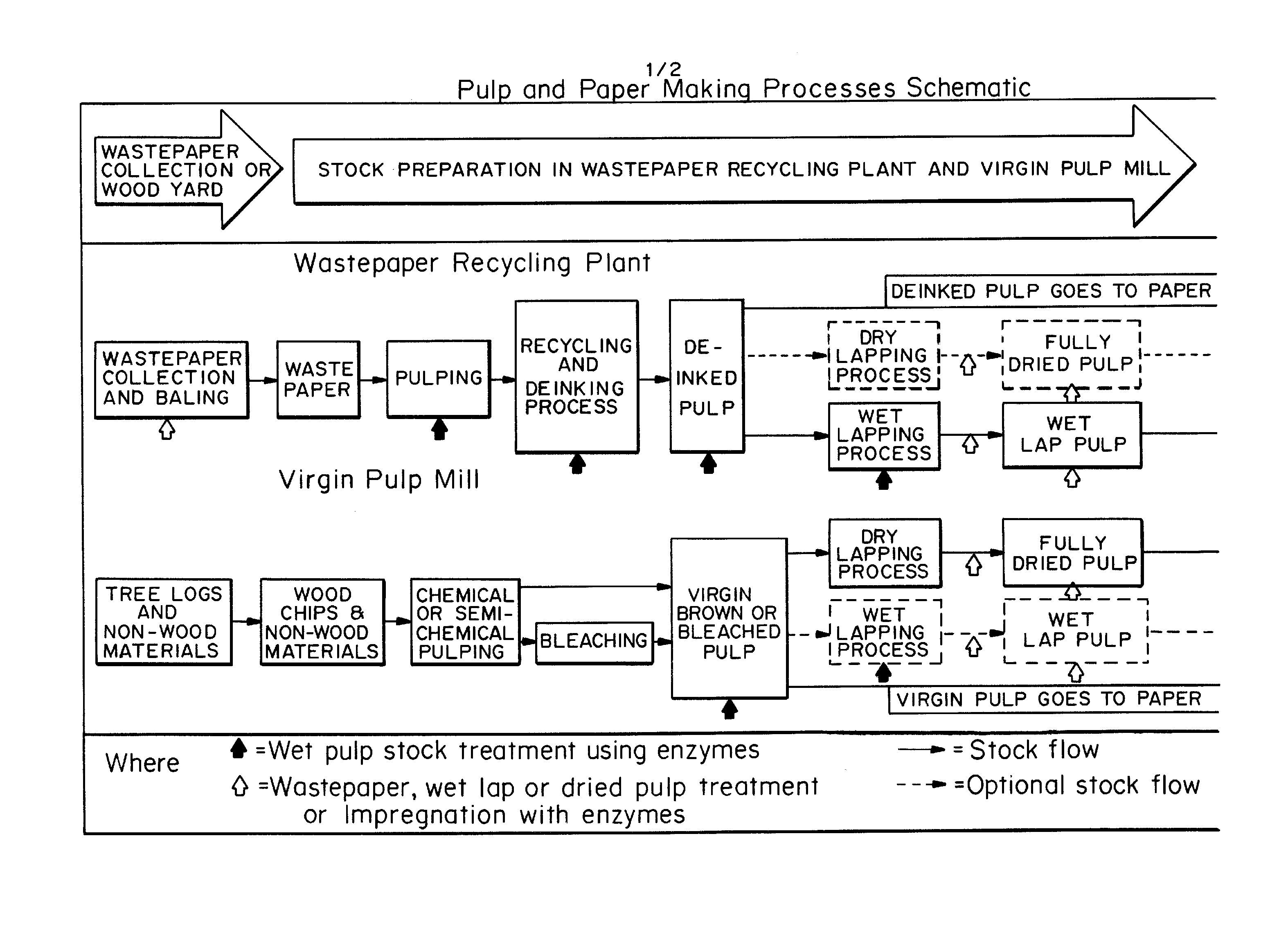
Figure 1 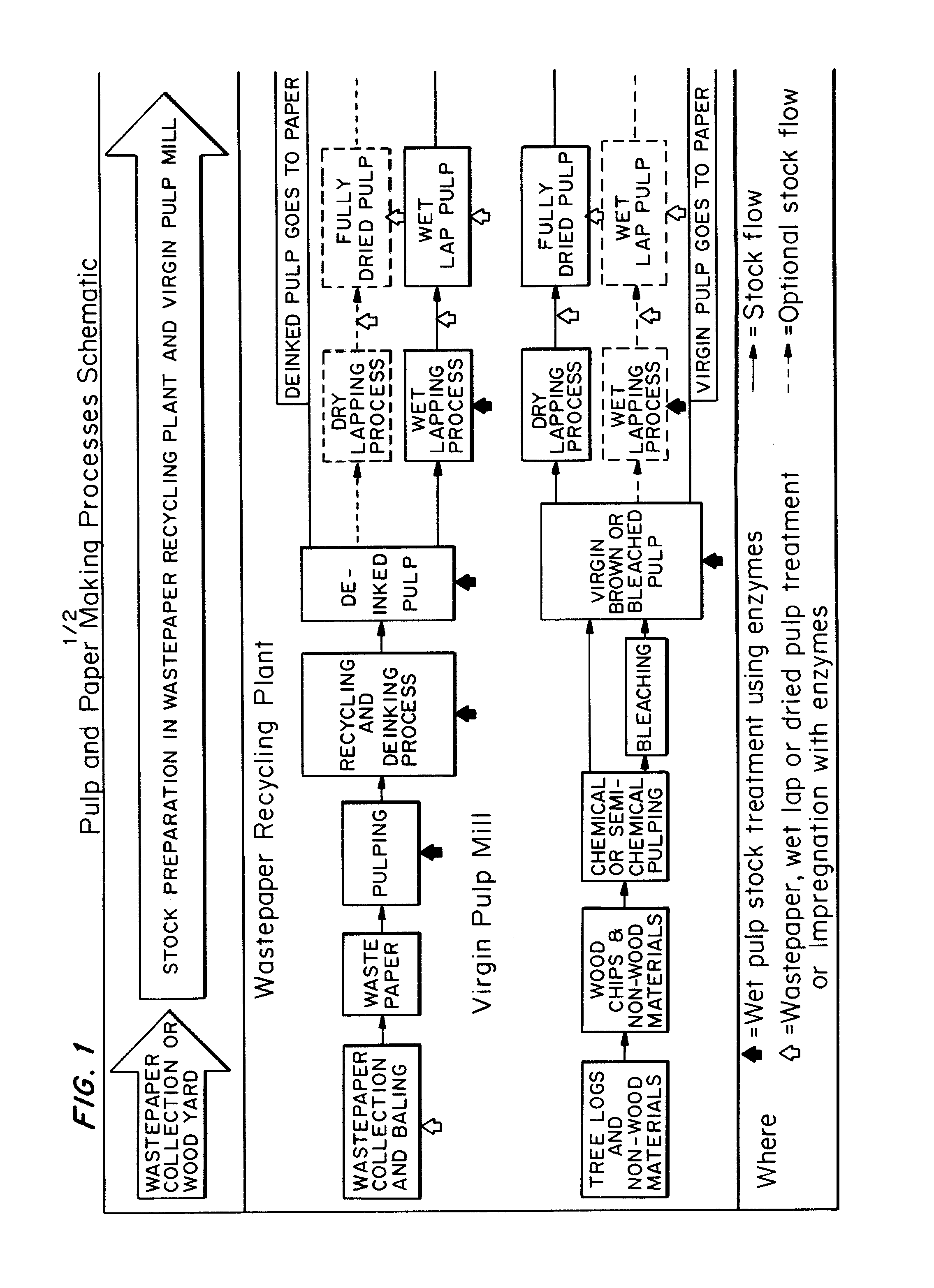
Figure 2 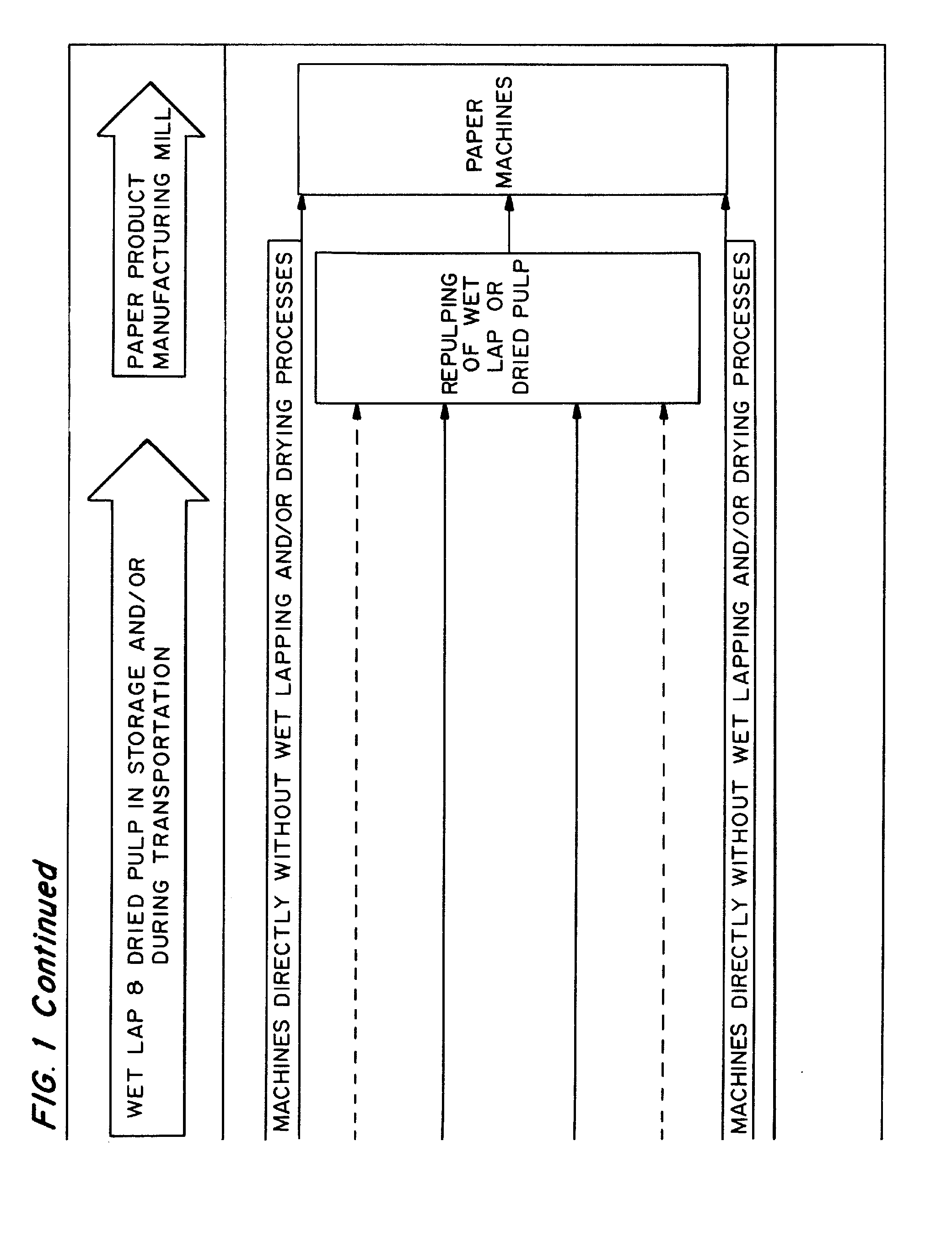
Figure 3
Abstract
Description
FIELD OF THE INVENTION
[0001] The present invention is generally in the field of treating pulp, including wet lap or fully dried pulp, at virgin pulp and / or waste paper recycling mills and / or treatment or impregnation of dry furnish loads or bales with enzymes prior to wetting in a wastepaper processing plant for the purpose of combating the hornification / deterioration of pulp quality through the wet-lapping, drying and recycling processes and producing a greater value virgin or recycled pulp for the eventual user of the pulp product.BACKGROUND OF THE INVENTION
[0002] Current methods of producing virgin pulp utilize large manufacturing facilities (pulp mills) that produce pulp for multiple end users. Pulp mills process pulp from softwood, hardwood logs or chips or non-wood sources into fibers which are used in the manufacture of paper. Methods of processing virgin pulp to remove lignin to varying degrees range from purely mechanical methods such as grinding logs and wood chips into indi...
Examples
example 1
Impact of Enzymatic Treatment and Wet Lapping and Drying on Fully Bleached Kraft Hardwood Pulp
[0083]Materials and Methods
[0084]Experiments were conducted to determine the effect of enzyme, the effect of starch, and the wetlapping, drying and repulping on the treated pulp. The sheets were produced from the treated and control pulps with the similar conditions as follows: treatment temperature at 45° C., stock at about pH 6.4 with continuing mixing at 3.5% consistency for 45 minutes. The wet stock from the pulp mill was treated with enzyme alone and starch alone and the individually treated stocks are compared to non-treated stock. The non-treated stock, enzyme treated stock and starch treated stock were then split into two portions. The first portion was used for analysis as non-dewatered and dried stock. In this case the treated stock was measured for drainage and then sheets were made to measure sheet physical properties. The second portion was used for analysis of the post dewater...
example 2
Impact of Enzymatic and Starch Treatment on Deinked Pulp Stock
[0089]Materials and Methods
[0090]A similar set of experiments as described in Example 1 was conducted on deinked pulp stock taken from the end of the deink plant where mixed office waste paper was a major furnish component. The deinked pulp was very clean with very low residual dirt. Its brightness was about 75% ISO. The deinked pulp was treated similarly as the virgin hardwood pulp used in Example 1.
[0091]Results
[0092]The results are shown in Table 2.
TABLE 2Effect of enzymes and starch on drainageand strength of deinked pulp stockPhysicalTreatmentRefinase ®,Starch,propertiesconditionsControl0.05%1.0%Freeness, mlNever-dried466531415Dewatered,438524485dried and repulpedBurst, kPa · m2 / gNever-dried2.83.23.1Dewatered,2.32.72.2dried and repulpedTensile, N · m / gNever-dried43.751.647.6Dewatered,33.338.332.9dried and repulped
[0093]The dewatering, drying and repulping once again showed significant deterioration in pulp properties...
example 3
Impact of Enzymatic Treatment of Fully Bleached Kraft Loblolly Pulp
[0094]Materials and Methods
[0095]A wet pulp stock at about 3.6% consistency was collected from a southern Kraft pulp mill which makes bleached dry lap commercial products. The wet pulp stock was treated in a similar manner as described in Example 1 for hardwood pulp using Refinase® B at 0.05% based on OD fiber.
[0096]Results
[0097]The results are shown in Table 3.
TABLE 3Effect of enzyme on bleached Loblolly Kraft pulpPhysicalTreatmentRefinase ®,Starch,propertiesconditionsControl0.05%1.0%Freeness, mlNever-dried682729589Dewatered,665728683dried and repulpedBurst, kPa · m2 / gNever-dried2.73.13.0Dewatered,1.92.42.1dried and repulpedTensile, N · m / gNever-dried32.237.736.1Dewatered,24.228.422.1dried and repulped
[0098]As in examples 1 and 2, the enzymatic treatment of never-dried pulps provided material gains to drainage and strength which carried through the dewatering and drying process as compared to the non-treated control...