
Use of precipitated carbonate in the manufacture of a fibre product
a technology of precipitated carbonate and fibre, which is applied in the field ofiller, can solve the problems of difficult drawing an exact line between fillers and coating pigments, unstable vaterite, and high price of special pigments, and achieves the effect of improving strength
Patent Information
- Authority / Receiving Office
- US · United States
- Patent Type
- Applications(United States)
- Current Assignee / Owner
- Publication Date
- 2014-03-13
- Estimated Expiration
- Not applicable · inactive patent
Smart Images
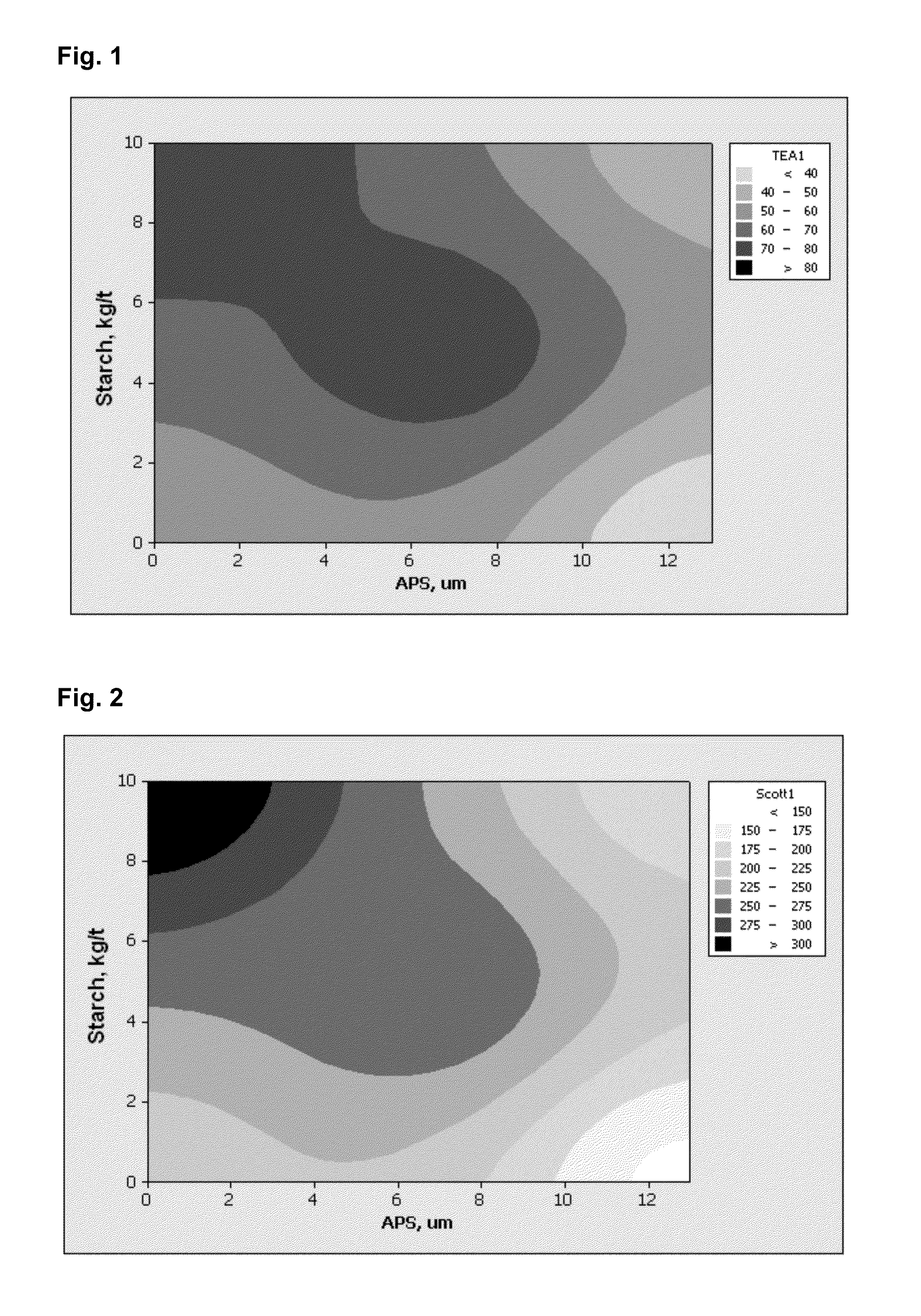
Figure 1 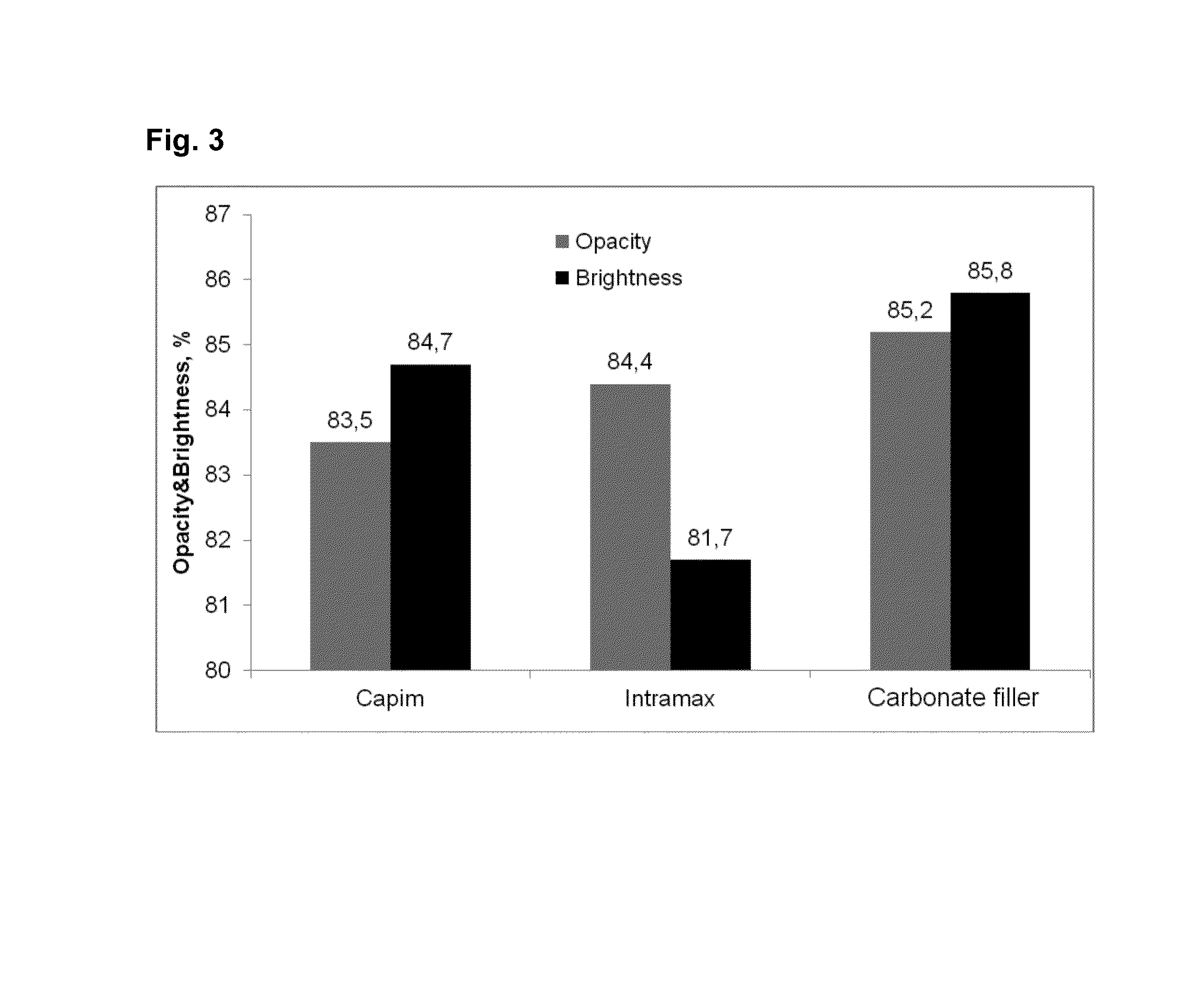
Figure 2 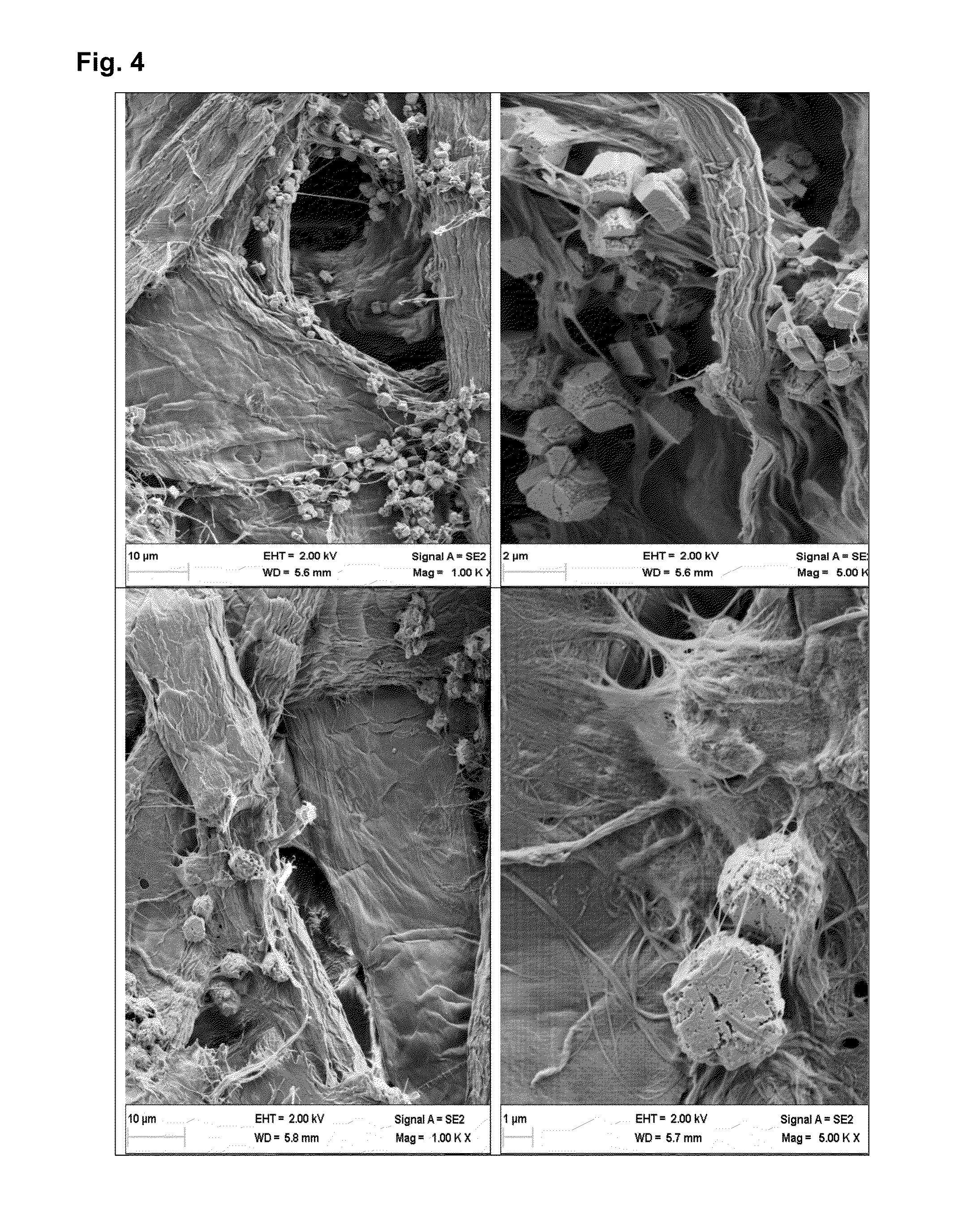
Figure 3
Abstract
Description
CROSS REFERENCE TO RELATED APPLICATIONS
[0001] This application is entitled to the benefit of and incorporates by reference essential subject matter disclosed in International Patent Application No. PCT / FI2012 / 051286 filed on Dec. 21, 2012 and Finnish Patent Application No. 20116326 filed Dec. 28, 2011.FIELD OF THE INVENTION
[0002] The present invention relates to a filler or a filler mixture, which contains carbonate, and to a process for the manufacture thereof by precipitating the filler directly into the pulp or as a separate process without the presence of fibres, particularly from the white water of the paper or board manufacture. The invention also relates to a fibre product which contains said filler, such as a paper or board product, or a plastic, rubber, concrete or paint product.DESCRIPTION OF THE PRIOR ART
[0003] During the past decades, the demand for precipitated calcium carbonate has been growing strongly particularly in the paper and board manufacture, the processing of ru...
Examples
example 1
Manufacture of the Acidic Bicarbonate Solution
[0078]The acidic bicarbonate ion solution was manufactured by mixing 100 or 200 g of burnt lime (CaO) with 500 g or 1000 g, respectively, of water at 45° C. The Ca(OH)2 slurry thus generated was added to 30 litres of tap water. Subsequently, the water and the calcium hydroxide were allowed to react with carbon dioxide conveyed to the mixture, so that the pH of the mixture at the end of the reaction was 6.3. After 12 hours of sedimentation, the precipitate that sedimented on the bottom was separated from the dissolved and colloidal material (Ca ions, carbonic acid, bicarbonate and colloidal calcium carbonate). The precipitate that sedimented on the bottom was not used in the tests. The bicarbonate ion solution thus manufactured was used as raw material in the precipitation tests described below.
[0079]A portion of the acidic bicarbonate ion solutions thus manufactured was further utilised, so that their entire solid matter (also the sedime...
example 2
Precipitation of Bicarbonate as a Separate Process
[0081]In this example, the bicarbonate ion solutions (30 litres) manufactured according to the previous example were used, 100 g of calcium oxide having been added to one of them and 200 g of calcium oxide to the other. The precipitate that sedimented on the bottom was not used in the tests. The bicarbonate solutions were heated to 55° C., after which an underpressure of 0.92 bar (i.e. an absolute pressure of 0.08 bar) was allowed to influence the bicarbonate ion solution in a 50-litre steel container. The underpressure was created by means of a pump.
[0082]Tables 2 and 3 show the delay times, after which the samples were taken out of the underpressure container, and the measured properties of the samples.
TABLE 2100 g of calcium oxide (CaO) per 30 litres of water.Time,APS10,APS50,APS90,Conductivity,secμmμmμm(μS / cmpH01.18.331.014306.63303.35.710.59707.291204.38.822.38307.312404.29.423.06767.406003.77.616.45507.40
TABLE 3200 g of calcium...
example 3
Precipitation of Bicarbonate with Fibres Present
[0084]In laboratory tests, pine pulp and birch pulp ground to an SR number of 30 were used. Of the pulp, 70% was pine pulp and 30% was birch pulp. The consistency of the pulp was 3.8%. From this pulp, sheets of 80 g / m2 were made by a sheet mould at a consistency of about 0.2%. Control samples were diluted to a consistency of 0.2% with tap water. A dilution to a consistency of 0.2% was made with said bicarbonate ion solution (Table 3) at the test points, in some of which a carbonate filler of 6.5 μm or 13 μm was formed. In the following results, the filler contents are normalized to a level of 6%, if not separately otherwise stated. The control test points were:[0085]Capim SBF, Imerys (and 10 kg / t of starch, added to the 3.8% pulp), hereinafter Capim Intramax, Imerys (and 10 kg / t of starch, added to the 3.8% pulp), hereinafter Intramax Control 1, i.e. sheets made from chemical pulp fibre without starch Control 2, i.e. 5 kg / t of starch, ...