
Process for producing a fibrous product
Patent Information
- Authority / Receiving Office
- US · United States
- Current Assignee / Owner
- Publication Date
- 2007-06-14
- Estimated Expiration
- Not applicable · inactive patent
Smart Images
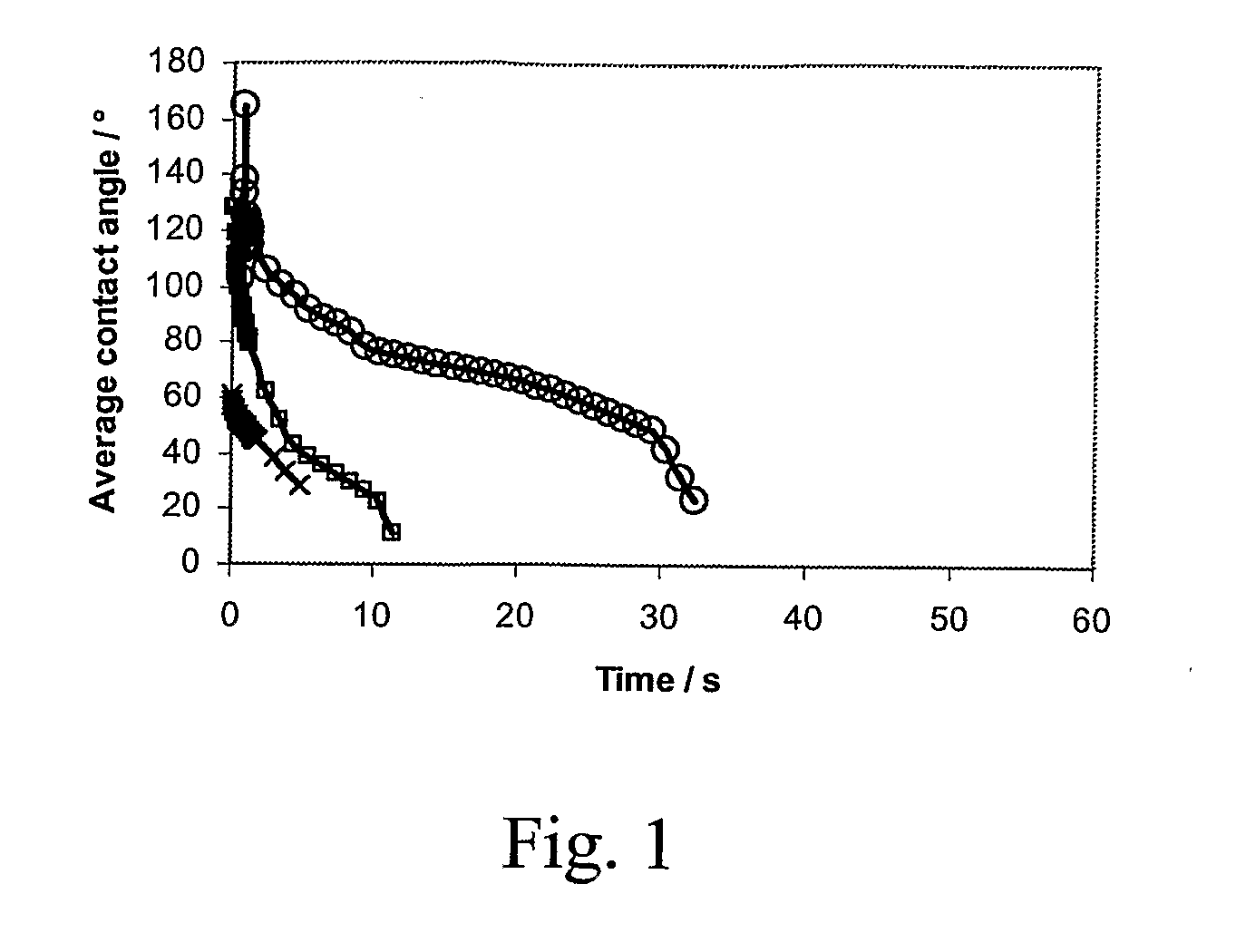
Figure 1
Abstract
Description
BACKGROUND OF THE INVENTION
[0001] 1. Field of the Invention
[0002] The present invention relates to fibrous products. In particular, the present invention concerns a process for modifying a lignocellulosic fibre material so as to impart new properties to the fibrous matrix of the material.
[0003] 2. Description of Related Art
[0004] Lignocellulosic fibres are chemically only moderately reactive, which makes it difficult to attach new compounds to the fibres to tailor the fibrous matrices for new uses or to impart desired new properties to them without imparing material properties. In addition, due to their hydrophilic nature, lignocellulosic fibre matrices are not readily compatible with hydrophobic substances, such as synthetic polymers.
[0005] Various ways of modifying lignocellulosic fibre materials by enzymatic treatments are known in the art. Thus, U.S. Pat. No. 6,187,136 describes a process for altering the surface charge of lignocellulosic fibres by reacting the material wit...
Examples
example 1a
[0094] Bonding of a Positively Charged Compound
[0095] 5 g portion of spruce TMP was suspended in water. The pH of the suspension was adjusted to pH 4.5 by addition of acid. The suspension was stirred and the temperature was maintained at 20° C. Laccase dosage was 1000 nkat / g of pulp dry matter and the final pulp consistency was 7.5%. After 30 minutes laccase reaction, 0.33 mmol 3-hydroxytyramine hydrochloride / g of pulp dry matter was added to the pulp suspension. After 1 h total reaction time the pulp suspension was filtered and the pulp was washed thoroughly with water. For comparison purposes, reference treatments were carried out using the same procedure as described above but without addition of laccase, tyramine or both laccase and tyramine. The N-content of the pulp was analysed by a ESCA and by a modified Kjeldahl method from handsheets made of the treated pulps (Table 1).
TABLE 1The effect of bonding of a positively charged, nitrogen containingcompound to TMP on the nitrog...
example 1b
[0097] Chemical Bonding of Positively Charged Compound
[0098] 15 ml of 8.33% 3-hydroxytyramine hydrochloride water solution (1.25 g tyramine chloride) was added to 20 g of disintegrated TMP as an aerosol during 15 minutes in a high-consistency mixer. After addition of tyramine 3 g APS (ammonium persulfate) oxidant dissolved in 15 g of water was added as an aerosol during 15 minutes mixing period. After this the mixer was stopped and the pulp was let to stand for 30 minutes, whereafter the pulp was diluted to 2000 ml water, filtrated twice, and washed with 1000 ml of water. Reference treatments were carried out correspondingly but without addition of APS (water was added in the reference instead of APS). The N-content of the pulp was analysed by a modified Kjeldahl method. Total nitrogen content was higher in the bonded sample than in reference sample. The nitrogen analysis confirmed that a positively charged group was bound to the fibres.
example 2
[0099] Bonding of a Whitening Compound to TMP
[0100] Betulinol dissolved in aceton and 0.1% thesit was bonded as described in example 1 to TMP. The obtained results showed that bonding of betulinol affected the colour of the fibres significantly.
[0101] The above results (examples 1 and 2) demostrate that it is possible to bond new compounds to pulp fibres by enzymatic means and thus to make tailor made fibres via this enzymatic functionalisation.