
Concrete mix composition, mortar mix composition and method of making and curing concrete or mortar and concrete or mortar objects and structures
a technology of mortar mix and concrete, which is applied in the field of cement-based materials, can solve the problems of not getting broad acceptance, slow setting and strength of concrete made with volcanic ash as pozzolanic agent, and still a very expensive and polluting industrial process, and achieves less concrete shrinkage, curling and/or cracking, and longer service life.
Patent Information
- Authority / Receiving Office
- US · United States
- Patent Type
- Patents(United States)
- Current Assignee / Owner
- Publication Date
- 2013-10-01
Smart Images
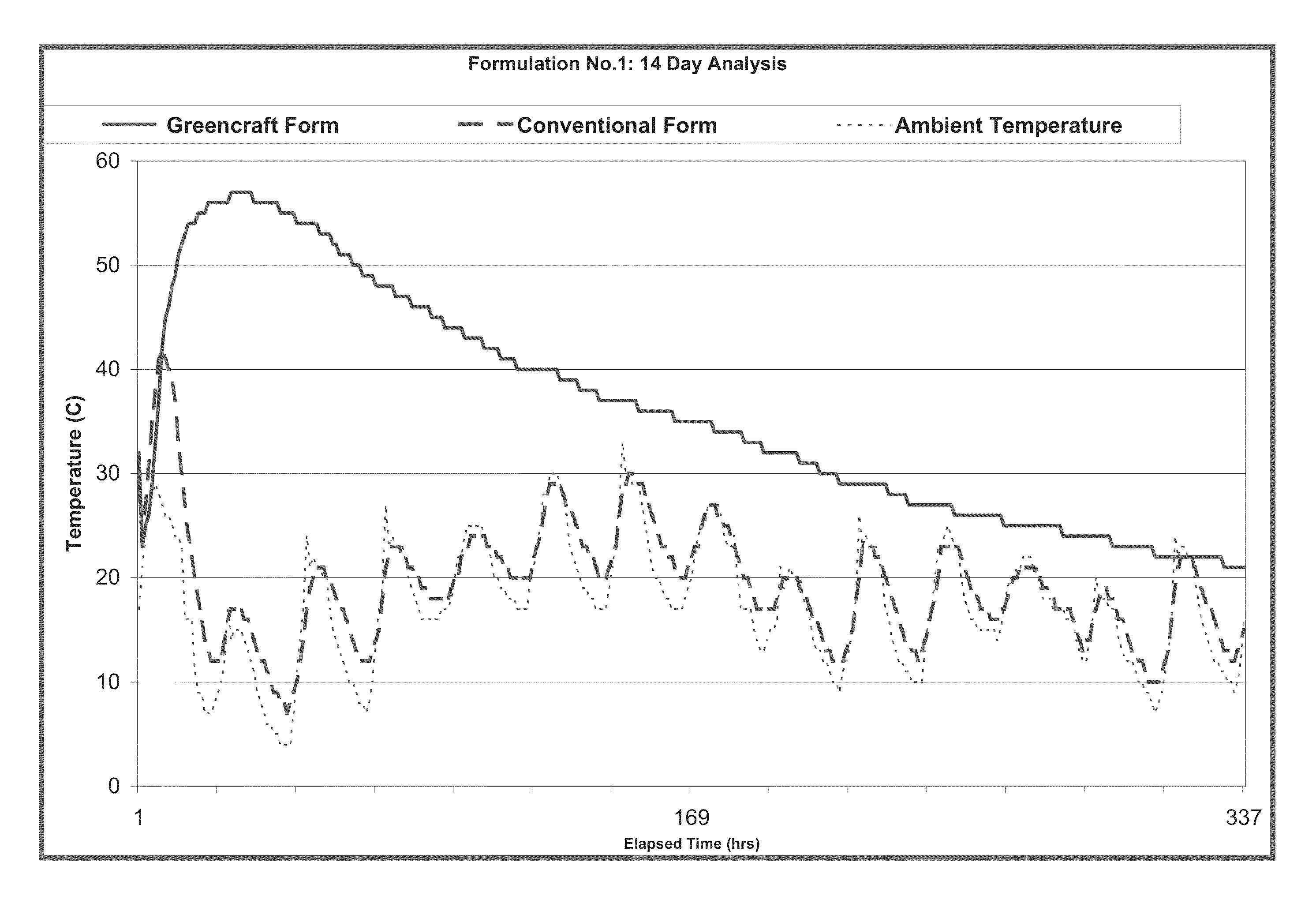
Figure 1 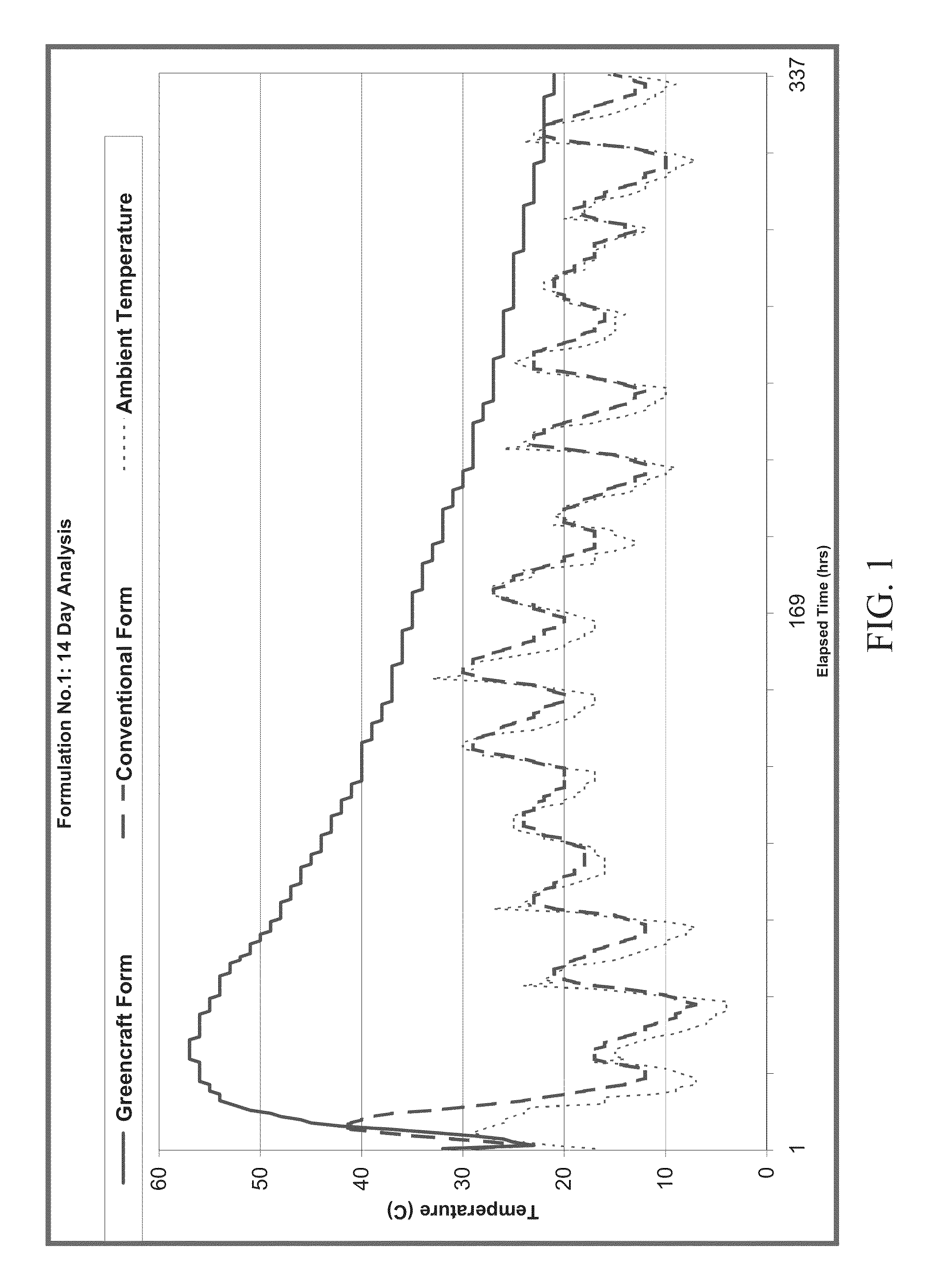
Figure 2 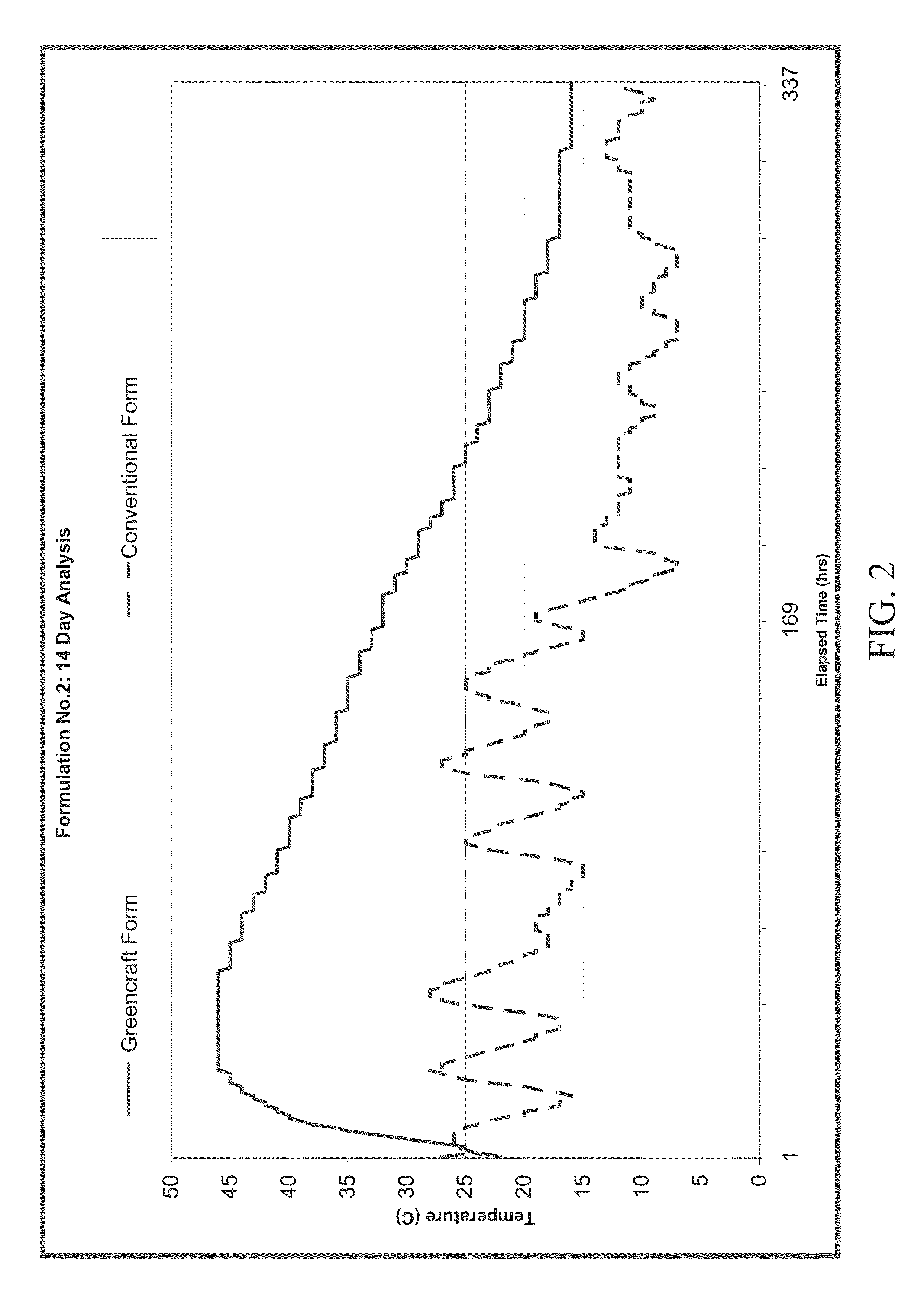
Figure 3
Abstract
Description
CROSS-REFERENCE TO RELATED APPLICATIONS
[0001] The present application claims the benefit of the filing date of U.S. provisional patent application Ser. No. 61 / 558,467 filed Nov. 11, 2011.FIELD OF THE INVENTION
[0002] The present invention generally relates to cement-based materials. The present invention also relates to curing concrete to accelerated concrete maturity or equivalent age of concrete to achieve improved physical properties. More particularly, this invention relates to a method of casting and curing a concrete or mortar composition that includes a relatively low percentage of portland cement by mass, by accelerating maturity or equivalent age of concrete, which produces a concrete of similar or greater strength than conventional concrete. The present invention also relates to a method of casting and curing a concrete or mortar composition that includes a relatively high percentage of recycled material by mass, by accelerating maturity or equivalent age of concrete, which p...
Examples
example 1
[0125]Six concrete forms were set up side-by-side to form vertical wall sections. The forms were erected outside during the spring and were subjected to ambient weather and temperature conditions. Three forms were conventional 4 feet×8 feet aluminum forms. These forms were set for an eight-inch thick wall section. The other three forms were insulated concrete forms. Each insulated concrete forms was made from two 4 feet×8 feet panels of expanded polystyrene foam spaced eight inches from each other. The bottom and the side of the forms were also insulated but the top of the form was left open to the environment. The concrete mixes were batched at a local ready mix concrete batch plant and delivered to the site by way of a conventional concrete truck. An independent testing lab technician from an accredited testing lab was present to sample the concrete. Three different concrete mixes were prepared. The concrete mixes employed three different cement formulations but were otherwise sim...
example 2
[0139]As stated above, maturity of concrete is measured as “equivalent age” and is given in temperature degrees×hours (either ° C.-Hrs or ° F.-Hrs). The concrete maturity was measured by the Intellirock II™ maturity / temperature loggers used in each of the six vertical wall sections identified above in Example 1. A summary of this test data is shown in Table 2 below.
[0140]
TABLE 2ASTM C-42 Vertical Forms Coring Conventional vs. Greencraft Forms Testing:Concrete Maturity (° C.-Hrs)Formulation No. 1Formulation No. 2Formulation No. 3ConventionalInsulatedConventionalInsulatedConventionalInsulatedActual AgeFormGreencraftFormGreencraftFormGreencraftAgeAgeMaturityMaturityMaturityMaturityMaturityMaturity(days)(hours)° C.-Hrs° C.-Hrs° C.-Hrs° C.-Hrs° C.-Hrs° C.-Hrs0.3382732522062212201890.7518574763414620513506124656109653088360271524895424411060198591116063721340368316003071129925357168352475893511670533915441143366512121165323104156331108482867213987196201074916077139621850056134429610355712...
example 3
[0144]In accordance with ASTM 42, cored samples of the concrete from each different form described above in Example 2 were cored and tested by an independent testing laboratory for determining compressive strength. The cored samples of the concrete were tested at 9 days, 28 days, 58 days, 90 days and 14 months. A summary of this test data is shown below in Table 3 below.
[0145]
TABLE 3Compressive Strength (psi)Formulation928589014No.Form TypeDaysDaysDaysDaysMonths1Insulated6,1806,6106,8606,8907,980Conventional3,2404,6605,6406,1906,8102Insulated1,7902,1701,7804,5703,460Conventional6601,1902,1202,0902,1803Insulated5,0805,8806,2306,6407,520Conventional1,4703,9304,8505,6355,830
[0146]The test data shown in Table 5 above surprisingly and unexpectedly shows that the formulations cured in insulated concrete forms achieved greater strength, and particularly higher early concrete strength, than the same concrete cured in conventional forms. Specifically, at day 9 Formulation No. 1 had 191% high...