

Piperidinylpyrazolopyridine derivative
a technology of pyrazolopyridine and piperidinylpyrazolopyridine, which is applied in the direction of drug composition, dispersed delivery, metabolic disorder, etc., can solve the problems that the use of these medicaments has not produced a great improvement in the death rate attributed to cardiac disease, cerebrovascular disease, renal disease, etc., and achieves excellent lcat-activating
Patent Information
- Authority / Receiving Office
- US · United States
- Patent Type
- Applications(United States)
- Current Assignee / Owner
- Publication Date
- 2015-06-04
Smart Images
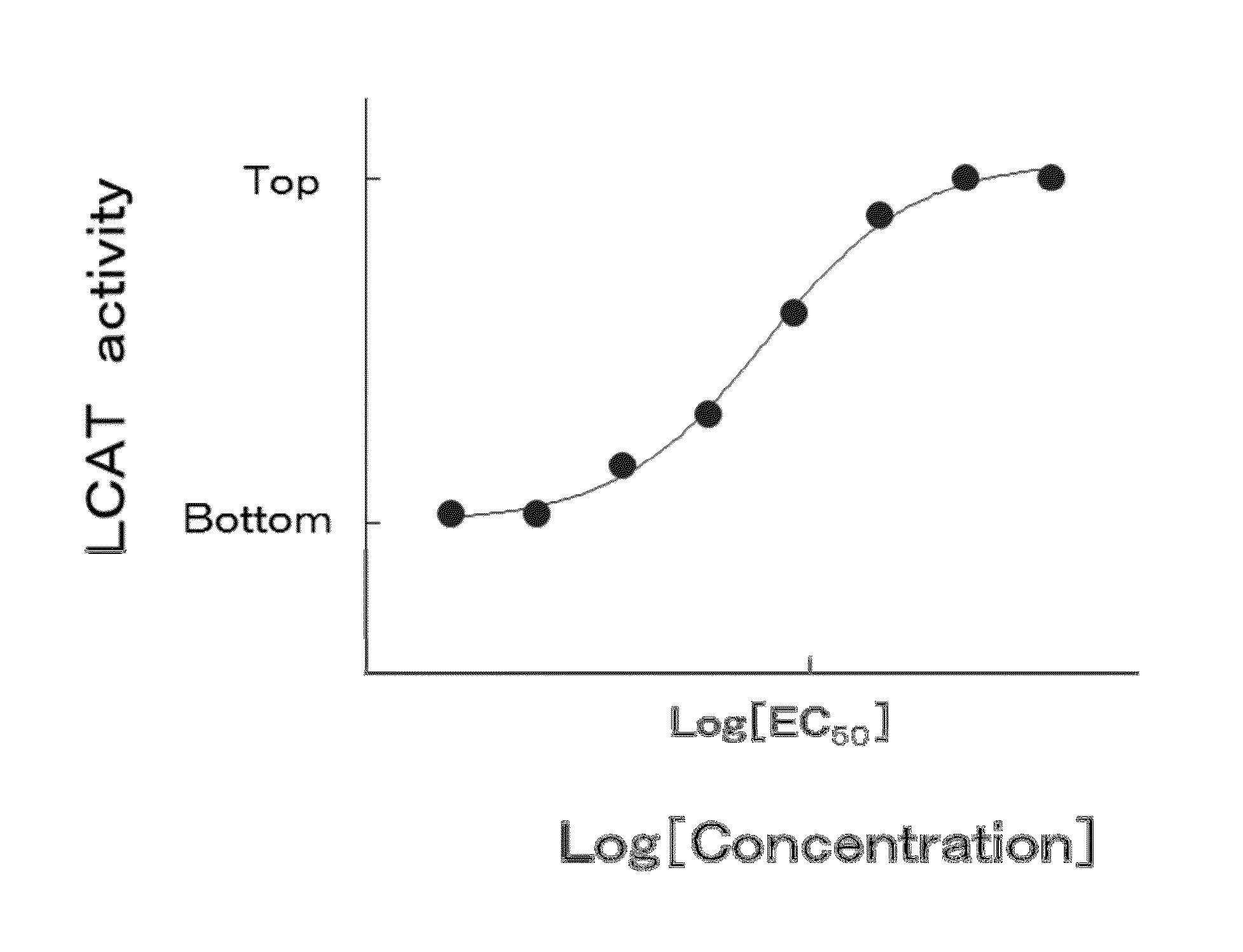
Figure 1 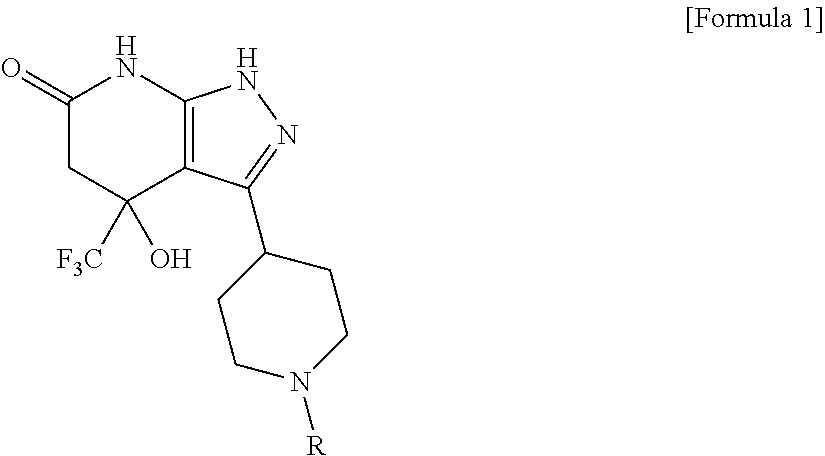
Figure 2 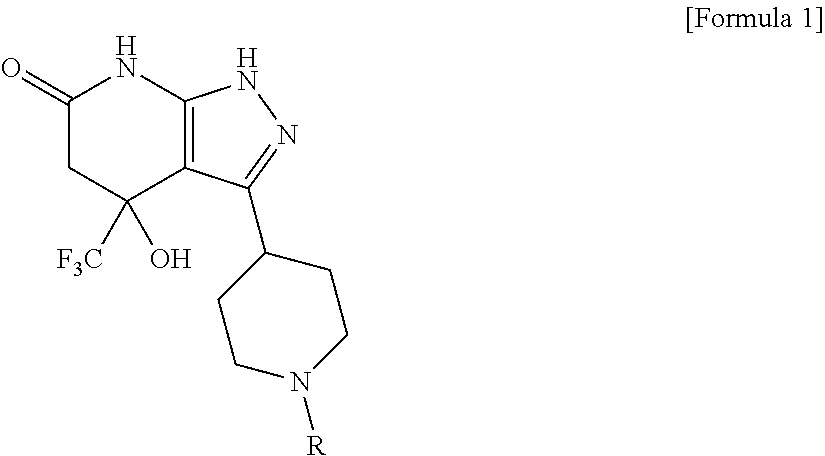
Figure 3
Abstract
Description
TECHNICAL FIELD
[0001] The present invention relates to a piperidinylpyrazolopyridine derivative or a pharmacologically acceptable salt thereof which has an excellent LCAT-activating effect (preferably, reversible LCAT-activating effect).BACKGROUND ART
[0002] Cardiovascular diseases (e.g., cardiac disease, cerebrovascular disease, and renal disease) caused by hypertension, dyslipidemia, diabetes mellitus, or the like are significant problems for developed countries. Antihypertensive, antidyslipidemic, and antidiabetic drugs are used in the treatment of the diseases hypertension, dyslipidemia, and hyperglycemia, respectively. In the clinical setting, α and β blockers, diuretics, calcium antagonists, ACE inhibitors, and A-II antagonists, etc. are used as antidyslipidemic drugs; HMG-CoA reductase inhibitors, anion exchange resins, nicotinic acid derivatives, probucol, and fibrates, etc. are used as antidyslipidemic drugs; and insulins, sulfonylureas, metformin, glitazones, and DPP4 inhibit...
Examples
reference example 1
3-Oxo-3-[1-(pyridin-2-yl)piperidin-4-yl]propanenitrile
[0199]
[0200]Five drops of DMF were added to a solution of 1-(pyridin-2-yl)piperidine-4-carboxylic acid (1.10 g, 5.33 mmol) in dichloromethane (20 mL), then oxalyl chloride (0.60 mL, 6.88 mmol) was added thereto at 0° C., and the mixture was stirred for 25 minutes. Then, the solvent in the reaction solution was distilled off under reduced pressure to obtain an acid chloride compound.
[0201]n-Butyllithium (2.69 M solution in hexane, 7.50 mL, 20.18 mmol) was added dropwise at −78° C. to a solution of cyanoacetic acid (800 mg, 9.41 mmol) and 2,2′-bipyridyl (5 mg, 0.03 mmol) in anhydrous THF (50 mL), and then, the mixture was stirred at the same temperature as above for 30 minutes. To the resulting reaction solution, a solution of the above-obtained acid chloride compound in anhydrous THF (10 mL) was added dropwise at −78° C., and the mixture was stirred at the same temperature as above for 1 hour. A saturated ammonium chloride aqueous...
reference example 2
3-[1-(Pyridin-2-yl)piperidin-4-yl]-1H-pyrazol-5-amine
[0203]
[0204]Hydrazine monohydrate (0.20 mL, 4.12 mmol) was added to a solution of 3-oxo-3-[1-(pyridin-2-yl)piperidin-4-yl]propanenitrile (138 mg, 0.60 mmol) produced in Reference Example 1 in ethanol (20 mL), and the mixture was stirred for 5 hours under heating to reflux. The reaction solution was left until reaching room temperature, and then, the solvent was distilled off under reduced pressure. The obtained residue was purified by silica gel column chromatography [elute: ethyl acetate / methanol=100 / 0-94 / 6 (gradient)] to obtain the title compound (130 mg, yield: 89%).
[0205]1H-NMR (500 MHz, DMSO-d6) δ: 11.18 (1H, brs), 8.09 (1H, d, J=4 Hz), 7.50 (1H, t, J=8 Hz), 6.83 (1H, d, J=9 Hz), 6.59 (1H, t, J=6 Hz), 5.18 (1H, s), 4.45 (2H, brs), 4.31 (2H, d, J=13 Hz), 2.85 (2H, t, J=13 Hz), 2.70 (1H, t, J=12 Hz), 1.87 (2H, d, J=13 Hz), 1.55-1.44 (2H, m).
reference example 3
3-(1-Phenylpiperidin-4-yl)-1H-pyrazol-5-amine
[0206]
[0207](1) 3-Oxo-3-(1-phenylpiperidin-4-yl)propanenitrile was obtained through the same reaction as in Reference Example 1 using 1-phenylpiperidine-4-carboxylic acid (1.01 g, 4.92 mmol) instead of 1-(pyridin-2-yl)piperidine-4-carboxylic acid.
[0208](2) The title compound (648 mg, yield: 54%) was obtained through the same reaction as in Reference Example 2 using the compound obtained in (1) instead of 3-oxo-3-[1-(pyridin-2-yl)piperidin-4-yl]propanenitrile.
[0209]1H-NMR (500 MHz, DMSO-d6) δ: 11.19 (1H, brs), 7.23 (2H, t, J=8 Hz), 6.98 (2H, d, J=8 Hz), 6.78 (1H, t, J=7 Hz), 5.25 (1H, brs), 4.40 (1H, brs), 4.15 (1H, brs), 3.73 (2H, d, J=13 Hz), 2.75 (2H, td, J=12 Hz, 2 Hz), 2.68-2.58 (1H, m), 1.98-1.91 (2H, m), 1.67 (2H, dq, J=12 Hz, 4 Hz).